


Add Some Digital to your Greek and Roman Archaeology Class!
With the word “syllabus” trending among my friends, I thought I might advertise an offering from my press. Last winter, we published a slim volume called Visions of Substance: 3D Imaging in Mediterranean Archaeology edited by myself and Brandon Olson.
The volume is a nice little critical reader on the recent state of 3D imaging in Mediterranean archaeology. Thinking back to my Greek and Roman archaeology courses, I am now struck by how little we discussed technology or even technique in those courses. We mostly considered the architecture present important sites, basic typologies and chronologies, and some big picture themes in the history of the discipline. Today, of course, Greek and Roman archaeology classes are very different. Not only do we expect our students to know something about a range of methods (from open area excavations to intensive pedestrian survey) and methodologies (New Archaeology, Behavioral Archaeology, post-processual archaeology, and increasingly the debate over agency in archaeological practice), but also some familiarity with the use of technology (ranging from carbon-14 dating to GIS, databases, and photogrammetry) and incorporating some basic discussion of post-ancient archaeology. Needless to say, John Bintliff’s recently published survey of Greek archaeology (blogged about here and here) is a very different book than, say, William Biers’ crusty olde (er, venerable) The Archaeology of Greeceor John Pedley’s Greek Art and Archaeology.
The upside of this is that our average field school student at the Western Argolid Regional Project knows a good bit more about archaeology as a discipline than I did as a junior or senior Latin major (or even as an M.A. student with a growing interest in the material culture!). At the same time, Greek and Roman archaeology courses have become more and more difficult to teach as no one textbook or survey introduces students to full scope of Mediterranean archaeology. So supplemental readings are a must.
Visions of Substance is a perfect supplemental reading for a Greek or Roman archaeology class. It is an up-to-date treatment of 3D imaging practices in “old world” archaeology with both practical examples of how the introduction of low cost 3D imaging technology is changing archaeological practice in the field and essays dedicated to the larger theoretical implications of these practices. The articles are written by scholars who are active in the field and leaders in the various aspects of digital archaeology and publishing. Finally, and most importantly, it’s free and available for download here or here. Or, if you really like the smell of newly printed books, you can get a paper copy here.
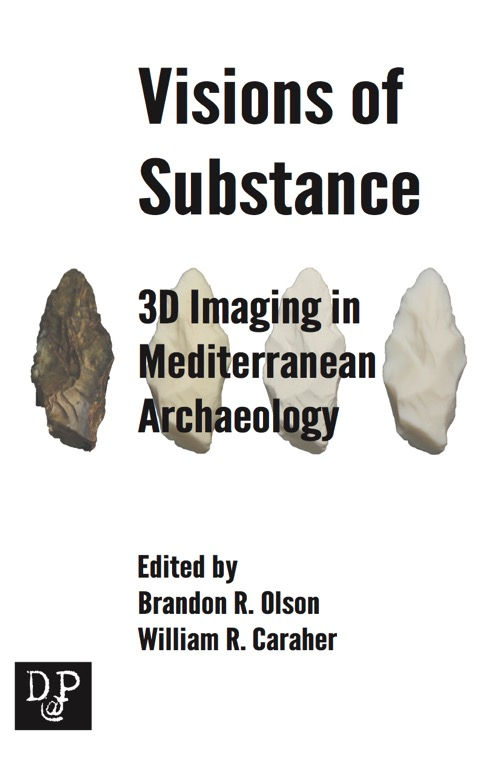
Here’s the table of contents:
1. Introduction Brandon R. Olson 1
THEORY 2. 3D Imaging in Mediterranean Archaeology: What are we doing, anyway? James Newhard 9
3. A Discussion of the Analytical Benefits of Image Based Modeling in Archaeology Brandon R. Olson and Ryan A. Placchetti 17
4. The Work of Archaeology in the Age of Digital Surrogacy Adam Rabinowitz 27
5. Three- and Four-Dimensional Archaeological Publication Andrew Reinhard 43
PRACTICE
6. Closing Gaps with Low-Cost 3D Sebastian Heath 53
7. 3D Models as Analytical Tools Ethan Gruber 63
8. Three Dimensional Field Recording in Archaeology: An Example from Gabii Rachel Opitz 73
9. Photogrammetry on the Pompeii Quadriporticus Project Eric Poehler 87
10. 3D Reconstruction of the Renaissance Bastion at the Langenbrücker Gate in Lemgo (Germany) Guido Nockemann 101
11. Bringing the Past into the Present: Digital Archaeology Meets Mechanical Engineering Brandon R. Olson, Jody M. Gordon, Curtis Runnels, Steve Chomyszak 107
About the Authors 113


Comments