


Ancient Literacy and Cypriot Mercenaries
Earlier this week, Natalia’s post on Cypriots and Iberians told us a little about the Cypriot Syllabic script, which up to now has not featured very much on the CREWS blog. In fact, as someone who has been working on the languages and writing systems of ancient Cyprus for years, this is a subject close to my heart! In this post I wanted to pick up on the question of literacy in ancient Cyprus – and as you will see, the movements of Cypriot mercenary soldiers are an important part of the puzzle.
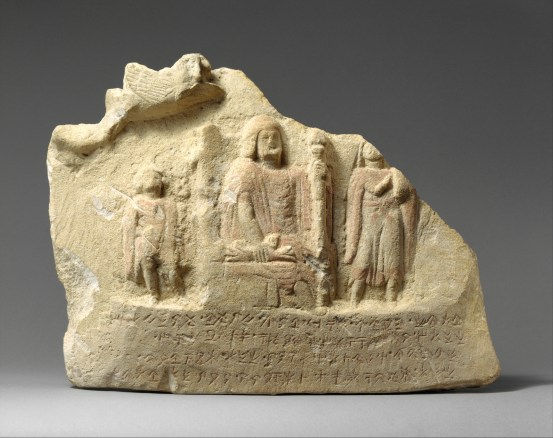
Relief sculpture with Cypriot Syllabic inscriptions. http://www.metmuseum.org/art/collection/search/241924
When we say ‘literacy’, in the modern world we usually mean the basic ability to read and write (sometimes concomitant with numeracy), and levels of literacy can vary a lot from place to place. Literacy has a close relationship with a number of social factors including access to schooling, availability of written materials and the cultural importance of writing in different social groups. More and more, the ability to use digital media like computers is seen as having an important relationship with literacy too – in fact, this is the main focus of today’s International Literacy Day.

Trying to recover levels of literacy in the ancient world, however, poses some serious problems. Today we can monitor all sorts of aspects of literacy to try to assess what proportion of a population can read and write, but for the past we do not have access to such resources. That means that we have to to try to extrapolate from the evidence we do have – for example, what direct pieces of writing have survived (inscriptions, letters, etc), or depictions of writing in ancient art, or ancient literary descriptions of reading or writing. For ancient Cyprus specifically, we don’t even have the last of these because we don’t have any surviving Cypriot literature, only inscriptions on stone, pottery vessels and other items.

Satellite view of Cyprus, from Google Maps.
During the middle part of the 1st millennium BC (c. 7th – 3rd centuries), Cyprus was epigraphically quite different from other parts of the Mediterranean. Instead of using the Greek alphabet, as used by most other Greek speakers, the Greek speakers of Cyprus used the Cypriot Syllabic script, as did speakers of another mysterious local language (called ‘Eteocypriot’ by modern scholars but not well understood). The Phoenician language, which originated from the nearby Levant, was also used by some of the population and was written in its own alphabetic script.
Bilingual inscription in Phoenician (in the Phoenician alphabet) and Greek (in the Cypriot Syllabary). Trustees of the British Museum (http://www.britishmuseum.org/research/collection_online/collection_object_details.aspx?assetId=409141001&objectId=366073&partId=1).
Up to the Ptolemaic period (from the end of the 4th century BC onwards), Cypriot writing was very distinctive because of the use of its special script, which seems to have been driven by a perceived relationship between between the independent identity of the island and its unusual writing practices. It was only in the 3rd century BC and later that the Greek alphabet slowly became more and more visible on the island; earlier on, for a Cypriot Greek speaker the Cypriot Syllabic script was the only choice to write in. But most of the surviving inscriptions are not of the everyday kind and so they do not provide very good evidence for day-to-day literacy. Perishable materials like papyrus and wood (which were probably in use) do not survive well in the Cypriot climate, so all our evidence comes from inscriptions on stone, pottery, metal or other durable media. Occasionally, however, we find graffiti – and an important group of graffiti found in Egypt can provide us with some valuable evidence for the literacy of Cypriot individuals.

Cypriot graffito on the Great Pyramid: Kratandros son of Stasinos, Themito son of Morandros.
Ancient Egypt was home to many amazing monuments, many of which can still be seen today. Around the 4th century BC, in fact, they were already very old and were attractive to ancient ‘tourists’. There survive a large number of ancient graffiti, scratched on the even more ancient Egyptian monuments in a number of different languages including Greek, Aramaic, Phoenician and Carian. Because the epigraphic record of 1st millennium BC Cyprus is relatively limited (perhaps 1,500 or so inscriptions from the island), a number of Cypriot Syllabic graffiti found in Egypt form a valuable part of the corpus. There is even a Cypriot graffito on one of the blocks of the Great Pyramid (pictured above) and they appear on various other monuments including the temple of Seti I at Abydos (pictured below).
Cypriot graffito on the temple of Seti I at Abydos, written by someone named Eurythemis. Published by the Institute for the Study of the Ancient World as part of the Ancient World Image Bank (AWIB): https://www.flickr.com/photos/isawnyu/4644515501/in/photostream/.
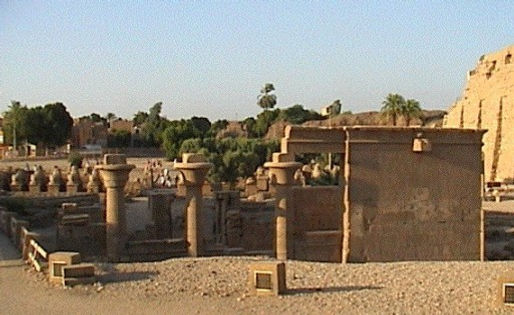
For some of the Cypriot graffiti in Egypt, it looks as though they were written by groups of mercenary soldiers fighting in the armies of Egyptian pharaohs (as related for example in Herodotus 3.19). The temple of Achoris at Karnak is a particularly important source of evidence, because here a number of Cypriot graffiti were made in a relatively small space on the temple’s walls. From the way the graffiti fill in space near to each other but do not usually overlap, it appears that they were made around the same time by a group of mercenaries stationed together near the temple.
What is striking is that not only were these mercenaries literate, they were also interested in writing. Most of them used the Cypriot Syllabic script to write their names and their places of origin (sometimes also with a patronymic), but there are also graffiti in the Greek alphabet. The image below shows a ‘digraphic’ inscription, i.e. one in which the same text is written in both the alphabet and the syllabary – showing ‘biliteracy’ (i.e. competence in two different writing systems) on the part of an individual called Philokreon from Salamis in Cyprus. The mercenaries stationed at Karnak were from different parts of Cyprus, and not only could they use the Cypriot Syllabic script but they also knew about the key differences in its use in different parts of the island. So, an individual from Paphos would write from left to right, but one from Salamis or Ledra would write from right to left – maintaining a ‘local’ epigraphic custom even while they were abroad in Egypt.

Cypriot graffito from the temple of Achoris at Karnak, with both Greek alphabetic and Cypriot Syllabic text. Image from HERE.
What does all this tell us about literacy? Well, these pieces of evidence can only tell us about some particular individuals at a particular time in Cypriot history. But what they do tell us is important: namely that these 4th century BC mercenary soldiers, for whom writing is unlikely to have been a specialist activity, not only could write but also were interested and proficient enough in writing to observe particular written customs and even to experiment in different writing systems. It also gives us a valuable indication that levels of literacy in ancient Cyprus may have been slightly higher than we might guess from most other surviving inscriptions.
That’s all for today, but if you are interested in ancient writing and would like to try becoming ‘biliterate’ yourself, why not have a look at our ‘write your name’ sheets and have a go?
~ Pippa Steele (Principal Investigator of the CREWS project)


Comments