


Any Mediterranean Landscape
- Jun 17, 2013
- 3 min read
On Friday, our traditional day off here in Polis, I went for a walk in the country with my friend and fellow archaeologist Tina Najbjerg. We walked up to the ridge that separates the fertile Chrysochous Valley from the more arid and remote Akamas Peninsula in Greece. Our walk even included the picturesque ruin of a small, maybe Middle Byzantine monastery know as the Pyrgos tis Regainas.
“On this side of the Akamas we enter a land of classical and mediaeval romance ; for here, according to Cypriote tradition, was the Fontana Amorosa of Ariosto, and a distinct and far more beautiful “Vrisis ton Eroton”, where the natives say that Aphrodite wedded Acamas. There can be little doubt that the two have probably but one origin, and that the real ‘fount of love ‘ is the present “Vrisis ton Eroton””, although the western tradition has identified itself with a separate spring. The latter rises at the foot of the cliff in a tiny bay half-an-hour’s ride north of Agios Nicola, and is a prosaic little fount enough; but the former, three and a half miles to the south, near the Potami tchiflik, has no rival in Cyprus. Approaching from the sea the traveller follows a rushing stream up a densely wooded ravine, barred at last by sombre cliffs, whose top can scarcely be discerned through the arch of boughs; spreading and shimmering over the slanting face of the rock falls a mountain stream, until near the base the cliff slopes inwards and the water falls from a forest of maiden-hair fern in a thousand silver threads to the pool below : across the threads here and there shoot stray shafts of sunlight, penetrating the dense shade of a gigantic fig-tree, and three separate springs rise on either side under the cliff and gurgle down to join the pool. The traveller, whose eyes have seen only the rock and scrub of waterless Cyprus, seems in an enchanted spot, not seeing from whence the water comes, and he ceases to wonder that native fancy has peopled the spot with legendary loves, and sailors carried westward vague reports of its beauties to the ears of Ariosto.
Between the rival fountains and a little back from the coast lies a mediaeval relic now known as Pyrgos, the ‘ Tower ‘ ; an arched gateway gives entrance to a small cloister of which only the northern side is standing, the wall showing traces of fresco. Round about are foundations of out-buildings, and disused paths lead through the brushwood : east of it is a little spring and some fine pine-trees. There can be no doubt that it was once a small monastery, or a metoichi of a larger one.”
It seemed pretty nice to me too. In fact, it was nice enough that I just enjoyed the shade of the oaks and the little ruined monastery and left my camera in my bag for a while.
They day was warm and just a bit hazy. Our main goal of the walk was to take in the amazing views.

View north over the Chrysochou Bay
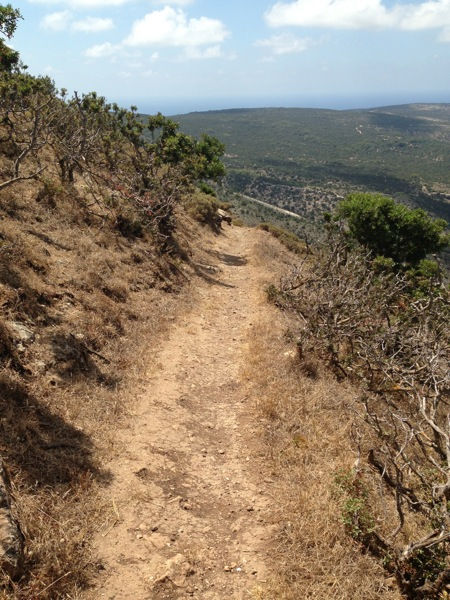
Standing atop that ridge and look around, I got the uncanny feeling that I could be anywhere in the Eastern Mediterranean and have these views (well, not anywhere literally, but that the Mediterranean countryside looked like this). I’m not a naturalist, but even I could identify the wild olives, carob, scrubby oaks, and pine common to the Mediterranean littoral. They left scratches on my legs from the bare branches that goats have The rocky ground, the thin soils, the sea borne breeze, even the smells of goats, oregano, and salt air made our walk familiar.

A view south to the Akamas




Comments