


Cesnola at Pyla-Koutsopetria
- Dec 14, 2011
- 3 min read
Two weeks ago I posted a passage from L. Hamilton Lang that described his struggles to export the antiquities that he looted from a small farm that he had leased near the village of Pyla. Lang’s friend and co-conspirator Luigi Palma di Cesnola also conducted some clandestine excavations at the site and describes them in his Cyprus: its ancient cities, tombs, and temples, A narrative of researches and excavations during ten years’ residence as American consul in that island (1877). He probably visited the site early in his term as American Consul on the island in 1865. He is widely regarded as a looter, and his collection of Cypriot antiquities forms the core of the Metropolitan Museum of Art’s collection of Cypriot antiquities.
I found it in the end more convenient and less expensive to purchase than to hire animals, and in this way I became the possessor of several fine well-broken mules and two strong donkeys, as high almost as horses, of a breed particular to Cyprus. These donkeys are glossy and sleek with large eyes, and will trot as fast as a mule; they are beside very intelligent. Thus provided we started in the early morning, and proceeded eastward for two hours, quite close to the seashore, to a place called “Palaeo Castro”, a name given by the natives to any tumble down building, whether fifty or two thousand years old. Here I found the stone walls of an oblong structure, not older than the Venetian occupation of the island. It had been a small fort mounted with three guns, the embrasures of which are still standing. Along the south-east coast are several of these guard-houses, built near the shore on elevated ground, some of which, now dismantled and roofless, are of Turkish construction, and two or three hundred years old. Most of them appear to have been erected for the protection of the neighboring villages against the Algerine pirates, who not longer ago than sixty years were daring enough to land and carry off wealthy inhabitants, and to detain them until the required ransom should be paid. In the neighbourhood is still pointed out the pirates’ cave. Contiguous to the fort I found vestiges of ancient town, traces of the stone wall which encircled it, and small square foundations of dwelling houses.
The cemetery is just outside the wall, and near the sea-shore. The tombs are only a few feet below the surface, and of the shape usual everywhere in Cyprus. Those I opened contained Roman lamps, glass, and black varnished pottery of a very common kind. A little east of the fort is a shapeless mound, apparently artificial, which I found to contain two large graves of the earliest period. From one of them I extracted fragments of twenty-seven different skulls, and a number of cylinders in haematite, not engraved; also a large copper caldron and in iron, but no vases of any kind. This mound seems to have been erected over some fifty or sixty bodies buried in two large oblong tombs, evidently all at the same time, and probably slain in battle. The earth which forms the mound be that which was dug up in making tombs.
Continuing my journey along the coast, I reach a spot where the road takes a northerly direction. Pursuing this, I soon came upon a small village called Ormidia, inhabited exclusively by Greek peasants. It was in a pretty little white cottage on teh summit of a low hill near the outskirts of this village that I established in 1873 my summer residence, and this continued to be our summer resort as long as we remained in the island.
These excavations must have come from very near our site. Older maps call Pyla-Koutsopetria Palaiocastro. We have documented the coastal battery there which is now overgrown and collapsing.
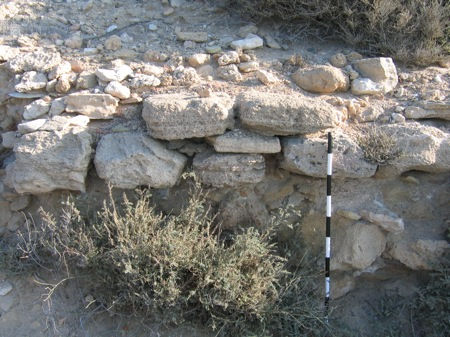
We have found significant quantities of ancient glass vessels in our survey. It’s difficult to identify the mound that he describes or the outlines of houses or fortifications, but we did find a fragment of a human skull during our survey. It may be that ploughing smeared the remains of the tombs across the area and leveled whatever was left of the mound after Cesnola’s excavations.


Comments