


Comparing and Contrasting the National WWI Museum and the National WWII Museum

One of the last things I did in 2016 involved taking a short trip to New Orleans, Louisiana, to visit a good friend of mine and explore some of the historical sites in the area. The trip was wonderful and I also enjoyed the eighty-degree temperature outside, a nice contrast to winter in the Midwest.
About three years ago I had the opportunity to visit the National World War I museum in Kansas City. The National World War II museum just so happens to be located in New Orleans, and we made a point of spending nearly an entire day visiting the site. I came away from the World War II museum impressed with some aspects and less impressed with others. I’ve been thinking about the similarities and differences of my experiences at both museums since the trip, and what follows are some rough thoughts on those experiences.
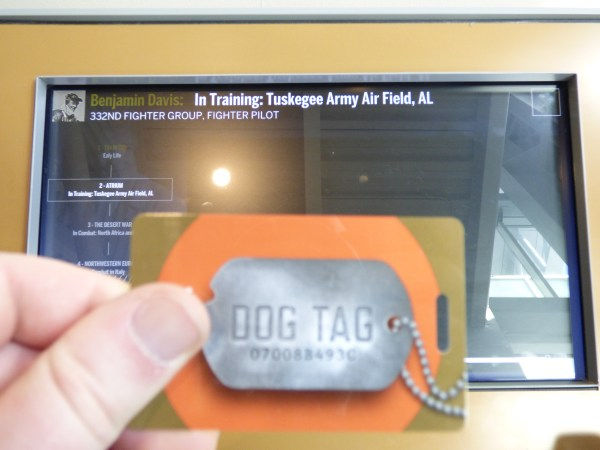
One of the major aspects of the World War II museum is its use of technology throughout the museum. Upon arriving at the museum, visitors have the option of obtaining a “Dog Tag” card that looks like a credit card. Computer stations throughout the museum have a spot where you can put your card on a scanner, upon which the computer shows a short video of a World War II solider who is assigned to your card. Five stations throughout the museum tell a different aspect of your soldier’s experiences before, during, and after the war (if they survived it). Notwithstanding the difficulty of finding some of the computer stations (I missed two of them) and the lack of available computers (I don’t think I’ve been to a museum that was so busy and people were almost always hounded around the computers), I though the activity was thoughtful and educational. My “Dog Tag” had the story of four-star General Benjamin O. Davis, who happens to be an extremely important and heroic figure in U.S. military history. Elsewhere there was an interactive activity about the USS Tang, a ship that sunk thirty-three enemy ships during the war, that was immersive and interesting. Visitors were assigned to a station within a recreated model of the Tang and given a specific duty on the ship to complete during a mission.

Other uses of technology in the World War II museum were not as successful, in my opinion. The museum was full of videos throughout the exhibits, all of which had sound. The sounds from each of the videos often bled into each other, creating a wall of cacophonous sound that distracted from the exhibit text and artifacts in a given area. Equally frustrating was how the walkways throughout the exhibits were not large enough to isolate video-watchers from the rest of the crowd. People would stop to watch the videos and block the walkways for other museum-goers, creating cramped hallways and little breathing room to maneuver through the museum. The World War I museum, by contrast, doesn’t utilize as much digital technology in its exhibits but uses its resources in ways that are more user-friendly. Videos about the political situation in the 1910s, the coming of World War I, and the United States’ decision to enter the war are isolated from the rest of the museum exhibits, allowing visitors who want to see the videos the freedom to do so while not distracting from others who want to visit the museum’s other exhibits. While the World War I museum doesn’t offer a “Dog Tag”-type activity for visitors, it did offer one interactive activity in which visitors created their own propaganda posters using graphics and artwork from posters used in various countries at the time.
The other noticeable aspect of both museums is the role of politics in their interpretive exhibits. The World War I museum does a masterful job in both its exhibits and videos of analyzing the political conditions that existed in Europe before the coming of the Great War. Topics such as nationalism, colonialism, imperialism, racism, and entangling alliances are explained with clarity and precision without sacrificing complexity. Equally important, the World War I museum places particular interpretive emphasis on conditions in Europe, not the United States. I believe this distinction is really important. While the museum is tasked with educating visitors about the American role in war, the staff at the museum astutely understand that this role must be fit within a larger story that spends several years in Germany, England, France, Austria-Hungary, Serbia, and the rest of Europe before the U.S. became a leading actor. The museum’s splitting into two sections between the years of 1914-1916 and 1917-1918 (when the U.S. entered the war) reinforces the importance of not focusing on the war’s history through too strong of an American lens.
The World War II museum, however, struggles to address the equally messy politics of that conflict. The exhibits throughout the museum barely touch political matters beyond the interactions between politicians and generals with regards to military strategy and tactics. A film narrated by the actor Tom Hanks does acknowledge that the U.S. faced two growing enemies in fascist Europe and imperial Japan, but doesn’t explain how these two forces came to be. Visitors are told, for example, that the Nazi party ruled Germany through the ideological lens of hatred and Aryan racial purity, but doesn’t explain how the Nazi party appealed to a wide swath of German voters or point out that Hitler was democratically elected. Likewise, Japan is portrayed as a militaristic, land- and -resource-hungry empire bent on conquering all of Asia, but why Japan held these ambitions and how they gained such power in the first place is left unexplained.
Another contrast of equal interest is the use of patriotic themes through these museums. The World War I museum takes a somber, reflective tone throughout its exhibits. The most notable example is the Paul Sunderland Glass Bridge. Underneath the bridge lies 9,000 poppy flowers in a field. Each flower represents 1,000 deaths during World War I, symbolizing the nine million people worldwide (not just Americans) who died in that conflict. No such display is exhibited in the World War II museum, and while the Tom Hanks film points out that 65 million people worldwide died in World War II, it becomes evident in the film and surrounding exhibits that the 400,000-plus Americans who died during the war will get particular attention in the interpretive programs. Nothing demonstrated this fact more than a musical program in one of the World War II museum’s buildings. Three women in 1940s-style dresses–one red, one white, and one blue–sang patriotic songs for roughly thirty minutes, including the songs of each military branch and Lee Greenwood’s “God Bless the USA.” During Greenwood’s song the women pulled out a U.S. flag, which in turn led to rancorous applause among the museum’s visitors. This exercise isn’t necessarily wrong or out of place at a museum of American history, but I can’t help but feel like such a display would feel unusual at the World War I museum. Likewise, similar exercises would feel awkward in a German museum like the Jewish Museum, Berlin, or the German Historical Museum, both of which I visited in 2015, where such open displays of patriotism and nationalism are fraught with their own difficulties and historical baggage. The musical program reinforces the history of World War II as a “Good War” in American memory, as historian John Bodnar explains in his 2010 book on the topic. U.S. involvement in World War II was good, of course, but the story is more complicated than singing a Lee Greenwood song.
In sum, the interpretive focus of the World War I Museum is a warning in the dangers of excessive nationalist sentiment and an elegiac meditation on the destructiveness of war, particularly one in which modern technology further amplifies the killing. Conversely, the interpretive focus of the World War II Museum is openly nationalist, Ameri-centric, and a borderline glorification of war. The World War I museum explains the causes of the war, its effect on world affairs, and the consequences of an inadequate peace treaty that helped foster another tragic world war just a few decades later. The World War II museum only mentions the causes of the war in passing through a video. While it does highlight the bloodshed of the war, particularly the blood shed by American soldiers, it struggles to tie in the conflict with other global affairs and chooses to stop at the war itself. The messy politics of the Cold War are put to the side in favor of a simple narrative of American progress and freedom.
I enjoyed both museums and believe that everyone would benefit from visiting both, but I believe that the World War I museum is superior in its interpretive programming and educational themes. It remains one of the best museums I have ever visited.
Cheers


Comments