


Georgian Era Jewellery
Before I start this post on the interesting topic of Georgian era jewellery, I was kindly commissioned by Antique Ring Boutique of London to write this post. For more information about them and to see their current stock of antique jewellery, not just Georgian, please look at their website here.
For many regular readers, you will probably know that I have a keen interest in the Georgian period and often dress up in Regency dress myself for the Jane Austen Festival in Bath. However, it is much easier to find out about examples of Georgian clothing than it is about the jewellery, so I hope this post is informative to those interested in the period.
First of all, the Georgian period itself ran from 1714 until 1837. Some of you may argue that it ended in 1830 with the death of George IV, which is fine, but what do you do with the seven years of William IV until we get to Queen Victoria otherwise? Sorry, I digress a little, but that should give you an idea of the scale when discussing the Georgian period. Understandably, with such a long time span, fashions changed frequently, just as with its jewellery. For this reason, this post will cover some of the themes of Georgian era jewellery and what influenced them. The main thing to note is that alongside new industrial techniques, the Georgian period saw a rise in renowned goldsmiths and jewellers, who sought to push the boundaries of both design and technique of their product.
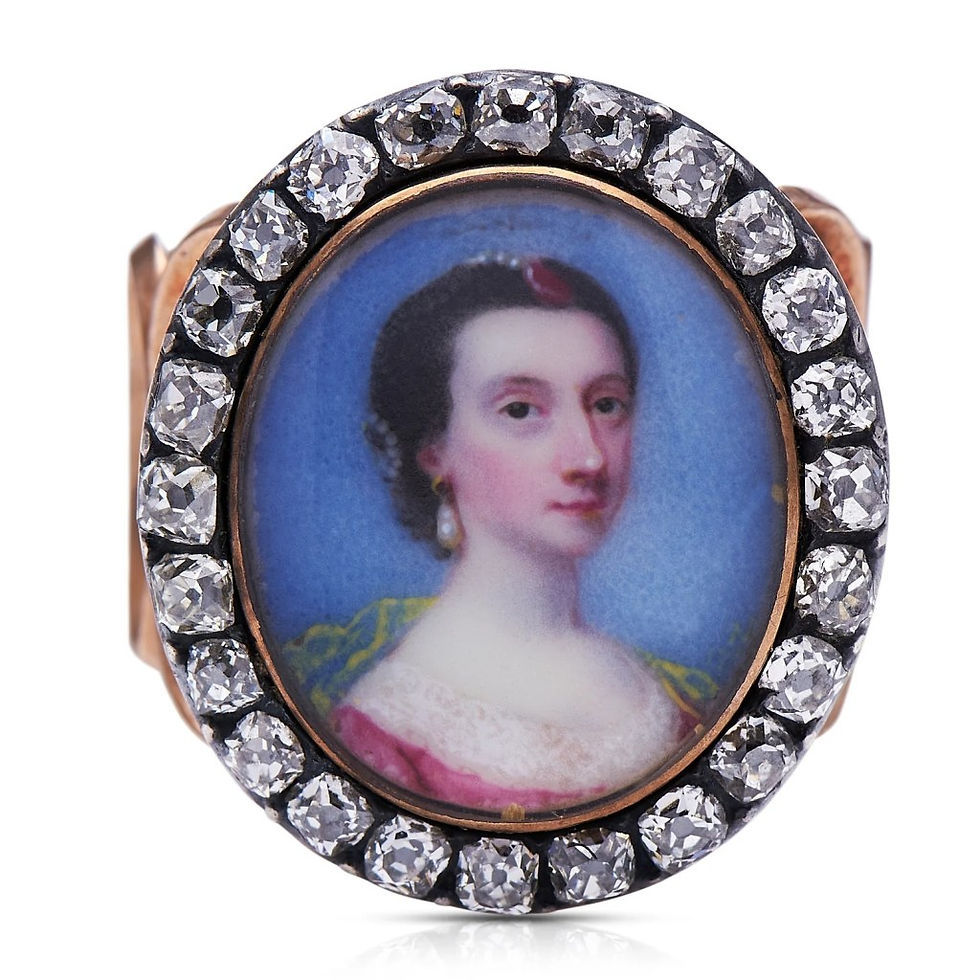
In general, the Georgian era is full of opulence and flamboyance, although certainly at times and for some people, simplicity was best. It was certainly common to find the simplistic jewellery being used as the daytime jewellery that a person would wear as their day-to-day items, such as smaller pendants, a simple ring, or some earrings. It would be the evening that jewellery was more ostentatious, particularly if you were wearing it for going to balls, banquets or to the theatre, where you had to show off at social functions and gatherings.
The thing that changed with the Georgian period is the amount of people now wanting access to jewellery. Old sumptuary laws that depicted what status a person had to be to wear a certain item had gone by this time and the increasing number of the middle classes, meant jewellery was now more readily available to people outside the aristocracy.

For those who couldn’t afford the genuine and expensive gemstones, paste was a popular option. Paste was a form of glass and could easily be dressed up with gold or silver plating, or added colour, to look like diamonds or other gemstones. When cut in similar styles to what the aristocracy were doing with their real gems, it was quite effective. A common way of using paste was for buckles or buttons, which could look very flashy, but could be easily bashed around.
Natural materials such as amber, turquoise, agate and coral were also an easy and cheaper way of adding colour to jewellery for a cheaper price point. Whilst pearls were a natural form, to have a full string of pearls could be quite expensive. For a middle class person, a plain gold chain could be a good alternative, although in the earlier Georgian period, ribbons were more likely to be used to tie around your neck than a chain.

When I think of Georgian jewellery though, I instantly think of cameos, especially cameo brooches, although cameos were used for all sorts of different jewellery. The trend of Classical styles, imitating Ancient Rome, Egypt and Greece, was hugely popular during the Georgian period and was known as Neoclassicism. It was fuelled by many things, the grand tour (although this was harder to undertake during the Napoleonic wars), Napoleon’s invasion of Egypt (and Britain’s defence of it), and the discoveries being made in Pompeii and Herculaneum. Cameos could be very expensive due to the time and skill required to carve the image out of a shell.
By 1750, it also helped that shells from the West Indies was being imported to Europe and helped boost items made from the material. In fact, the cameo style became so popular, that under Napoleon’s direct instruction, makers across France and Italy were instructed to use abalone, conch, coral and sea snails as their materials. It was still expensive to buy a have an carved cameo made from shell. From 1764, the famous potter, Josiah Wedgewood, who designed pottery using blue and white jasperware, decided to also make cameo jewellery from it. This became very popular, especially with the middle classes who loved the fashionable cameo style, but couldn’t quite afford the intricate versions the super-rich could.

Another trend that influenced Georgian jewellery was Romanticism. The Romantic movement sought to counteract the individualism that seemed to arise from the Industrial Revolution and instead, replace it with the moralistic ideas that connecting with and understanding nature could bring. In jewellery, this meant that floral and animal motifs were often depicted in earrings, necklaces, brooches and rings. These symbols could depict love, strength, beauty and even femininity wherever possible.
So what did the jewellery actually look like, other than the natural items that have already been discussed? Garnet, topaz, emeralds and rubies were popular gemstones, with amber being a popular natural form as well. We do know from Jane Austen’s own jewellery collection, that both Jane, and her sister Cassandra, were gifted topaz crossed by their brother, Charles, who purchased them using money he earnt from spoils whilst serving in the navy, one using baguette stones and the other using oval cut stones. Understandably, gifts or bequeaths was a common way to gain jewellery, not just from directly purchasing them.

On a similar line, mourning or remembrance jewellery was another highly fashionable form of jewellery at the time. These were often made from locks of a loved one’s hair, or featured monograms made from that person’s name. They could even have skulls, skeletons or other symbols of death to remind the wearer of mortality. Small seed pearls are often found amongst this type of jewellery, as well as in love tokens, from both secret and acknowledged loves. If a lover was secret, an eye miniature, so only the people giving and receiving the token, know who the picture of the eye is of, was a common form of a love token, and were made popular by George IV, whilst Regent, relating to his many mistresses.
A goal for any jewellery wearer, and certainly if you had the money to own them, was a parure, which was a matching jewellery set, which contained many items of jewellery made from the same metals and gemstones. A typical set would have included a brooch, ring, bracelets (at this time mostly worn in pairs), earrings and a necklace. Members of royalty were known to have up to a 16 item parure set, which included items like tiaras and stomachers. For those who didn’t have the money for a large parure set, a demi-parure was also an option, which contained two or more matching items based on the wearers preference. Whichever option was used, parures came in specially made boxes to keep them safe in.

Another fashionable type of jewellery was girandole earrings. These were designed with a central bow and had a shaped motif suspending two pear drop shaped stones, flanking a third larger drop. These opulently designed earrings were most popular as an evening style. They also went on to influence the pendeloque earring, which had a similar design, but had a round top, suspending a bow, with one larger drop below. Unlike our modern earrings, these would have been a wired hook used to thread through the ear and would then these hooks would click into place on the earring itself.
Whilst this is by no means all there is to know about Georgian era jewellery, I hope this post has given you a flavour of what could be available from the time and you never know, might have inspired you to look into period pieces, to try replicating your own, or research and compare images we have inherited that show Georgians in all their bedecked splendour a little differently in the future.
Pasquale De Marco, The Allure of Adornment: A Journey Through the History of Jewelry (ebook, 2025), p. 67
Lang Jewelry- Antique Jewelry University, ‘Georgian Jewelry: 1714-1837’, https://www.langantiques.com/university/georgian-jewelry-1714-1837/?srsltid=AfmBOoph7UBV3ZGGdz7E8L9W9t1aTEUsoArbXyNBCIma4Ln6q_UbZHlY
Lang Jewelry- Antique Jewelry University, ‘Georgian Jewelry’
Pasquale De Marco, The Allure of Adornment, pp. 74-75
Lang Jewelry- Antique Jewelry University, ‘Georgian Jewelry’
Ibid; Sarah Jane Dowding, Fashion in the Time of Jane Austen (London: Bloomsbury Publishing, 2011), p. 59
Mary Ellen Snodgrass, World Clothing and Fashion (Abingdon: Routledge, 2015), p. 511
Ibid
Lang Jewelry- Antique Jewelry University, ‘Georgian Jewelry’
Pasquale De Marco, The Allure of Adornment, pp. 70-71.
Hilary Davidson, Jane Austen’s Wardrobe (London: Yale University Press, 2023), p. 193
Lang Jewelry- Antique Jewelry University, ‘Georgian Jewelry’
Ibid
Ibid


Comments