


Googled Book Data and Byzantium
- Dec 21, 2010
- 2 min read
There is a good bit of buzz lately about the new Google Ngram application which allows anyone to do some basic data mining on the huge collection of Google books. I love simple to use applications, but like any scholar I am always suspicious that most applications that appear simple are, in fact, hiding deep-seated interpretive complexity. In other words, I am sure that this Google Ngram thing is problematic, but I haven’t really figured out how and why.
That being said, here are a couple of interesting Ngrams.
The first looks at the frequency of the terms Late Roman (blue), Late Antiquity (red), Late Antique (green), Early Byzantine (yellow) in Google’s collection of scanned books between 1900 and 2000. Nothing makes you feel less special as a scholar than seeing your career as a the product of a 30 year trend in your particular area of specialty. I can also imagine the influence of two important books. A.H.M. Jones’ Later Roman Empire (1964) almost certainly produced the blip in the blue colored line in the late 1960s. P. Brown’s The World of Late Antiquity (1972) correlates closely with the steep rise in the use of the term Late Antiquity in the first part of the 1970s. The University of California’s monograph series, the Transformation of the Classical Heritage, would have further propelled the popularity of the terms Late Antiquity after its inception in 1981.

Another Ngram of interest is the comparison of Byzantine History (blue), Byzantine Architecture (red), and Byzantine Archaeology (green). I ran the analysis based on both words being capitalized. It is worth noting that the same analysis with only Byzantine being capitalized produced different results as the second graph shows.

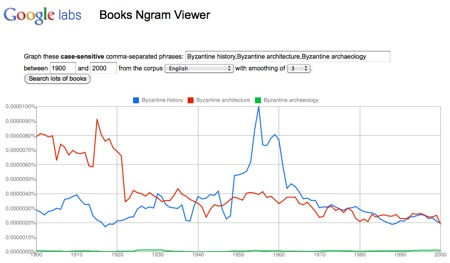
Isolating Byzantine Archaeology shows that it more or less follows the trends in the top graph.

The significant spike in the late 1920s and throughout the1930s finds parallels in the tie between the Avant Garde and Byzantium recently explored by Kostis Kourelis in his 2007 Hesperia article (76, 391-442). The popularity of the term Byzantine Architecture from the mid-1960s may well represent the influence of Richard Krautheimer’s contribution to the Pelican History of Art, Early Christian and Byzantine Architecture (1965) and the influence of his students. The spike in blue line of Byzantine History most like reflects the influence ofG. Ostrogorski’s History of the Byzantine State (1957).
These graphs, of course, only represent one aspect of the ebb and flow of popularity of these topics. Ngrams do not capture, from what I understand, data from Google Scholar, nor is it easy to compare trends across languages. For example, to understand the boom in scholarship on Late Antiquity it would be instructive to compare the graph for the words “Late Antique” with the graph for the “Antiquité Tardive”.

At the same time, the ability to query this data through time is really remarkable and the relative transparency of the application will invariably help scholars to link general trends to specific works. The potential for using this application in historiography classes, for example, is remarkable.
Comments