


Indo-Europeans at Linzi
- Sep 12, 2013
- 6 min read


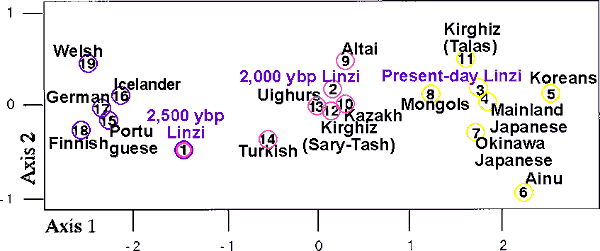

To examine temporal changes in population genetic structure, we compared the mitochondrial DNA (mtDNA) sequences of three populations that lived in the same location, Linzi, China, in different periods: 2,500 years ago (the Spring–Autumn era), 2,000 years ago (the Han era), and the present day. Two indices were used to compare the genetic differences: the frequency distributions of the radiating haplotype groups and the genetic distances among the populations.
The results indicate that the genetic backgrounds of the three populations are distinct from each other. Inconsistent with the geographical distribution, the 2,500-year-old Linzi population showed greater genetic similarity to present-day European populations than to present-day east Asian populations. The 2,000-year-old Linzi population had features that were intermediate between the present-day European/2,500-year-old Linzi populations and the present-day east Asian populations.
These relationships suggest the occurrence of drastic spatiotemporal changes in the genetic structure of Chinese people during the past 2,500 years.
Prior to the expansion of Shang and Zhou culture through the region, many hundreds of tumuli were also constructed by the “Baiyue” peoples of the Yangtze valley and southeastern China. Historian Luo Xianglin has suggested that these peoples shared a common ancestry with the Xia Dynasty. There is little evidence, however, that the Yue peoples held any common identity.
The Shang Dynasty or Yin Dynasty, according to traditional historiography, ruled in the Yellow River valley in the second millennium BC, succeeding the Xia Dynasty and followed by the Zhou Dynasty.
The earliest archaeological evidence of chariots in China, a chariot burial site discovered in 1933 at Hougang, Anyang in Henan province, dates to the rule of King Wu Ding of the late Shang Dynasty (c. 1200 BC). Oracle bone inscriptions suggest that the western enemies of the Shang used limited numbers of chariots in battle, but the Shang themselves used them only as mobile command vehicles and in royal hunts.
The classic account of the Shang comes from texts such as the Classic of History, Bamboo Annals and Records of the Grand Historian. According to the traditional chronology based upon calculations made approximately 2,000 years ago by Liu Xin, the Shang ruled from 1766 BC to 1122 BC, but according to the chronology based upon the “current text” of Bamboo Annals, they ruled from 1556 BC to 1046 BC. The Xia–Shang–Zhou Chronology Project dated them from c. 1600 BC to 1046 BC.
Archaeological work at the Ruins of Yin (near modern day Anyang), which has been identified as the last Shang capital, uncovered eleven major Yin royal tombs and the foundations of palaces and ritual sites, containing weapons of war and remains from both animal and human sacrifices. Tens of thousands of bronze, jade, stone, bone, and ceramic artifacts have been obtained. The workmanship on the bronzes attests to a high level of civilization.
The Anyang site has yielded the earliest known body of Chinese writing, mostly divinations inscribed on oracle bones – turtle shells, ox scapulae, or other bones. More than 20,000 were discovered in the initial scientific excavations during the 1920s and 1930s, and over four times as many have been found since. The inscriptions provide critical insight into many topics from the politics, economy, and religious practices to the art and medicine of this early stage of Chinese civilization.
Before the 20th century, the Zhou Dynasty (1046–256 BC) was the earliest Chinese dynasty that could be verified from its own records. However during the Song Dynasty (960–1279 AD), antiquarians collected bronze ritual vessels attributed to the Shang era, some of which bore inscriptions.
Chinese bronze casting and pottery advanced during the Shang dynasty, with bronze typically being used for ritually significant, rather than primarily utilitarian, items. As far back as c. 1500 BC, the early Shang Dynasty engaged in large-scale production of bronze-ware vessels and weapons. This production required a large labor force that could handle the mining, refining, and transportation of the necessary copper, tin, and lead ores. This in turn created a need for official managers that could oversee both hard-laborers and skilled artisans and craftsmen.
The Shang royal court and aristocrats required a vast amount of different bronze vessels for various ceremonial purposes and events of religious divination. Ceremonial rules even decreed how many bronze containers of each type a nobleman or noblewoman of a certain rank could own. With the increased amount of bronze available, the army could also better equip itself with an assortment of bronze weaponry. Bronze was also used for the fittings of spoke-wheeled chariots, which appeared in China around 1200 BC.
The Western Zhou period (1046–771 BCE) was the first half of the Zhou Dynasty of ancient China. It began when King Wu of Zhou overthrew the Shang Dynasty at the Battle of Muye. The dynasty was successful for about seventy-five years and then slowly lost power. The former Shang lands were divided into hereditary fiefs which became increasingly independent of the king. In 771, barbarians drove the Zhou out of the Wei River valley; afterwards that real power was in the hands of the king’s nominal vassals.
The twelfth and last king of the Western Zhou period was King You of Zhou (781–771 BCE). When You replaced his wife with a concubine, the former queen’s powerful father, the Marquess of Shen, joined forces with Quanrong barbarians to sack the western capital of Haojing and kill King You in 770 BCE. Most of the Zhou nobles withdrew from the Wei River valley and the capital was reestablished downriver at the old eastern capital of Chengzhou near modern-day Luoyang. This was the start of the Eastern Zhou period, which is customarily divided into the Spring and Autumn period and the Warring States period.
It is possible that the Zhou kings derived most of their income from royal lands in the Wei valley. This would explain the sudden loss of royal power when the Zhou were driven east, but the matter is hard to prove. In recent decades, archaeologists have found a significant number of treasure hoards that were buried in the Wei valley about the time the Zhou were expelled. This implies that the Zhou nobles were suddenly driven from their homes and hoped to return, but never did.
Qi was a powerful state during the Zhou Dynasty of ancient China. Its capital was Linzi, in present-day Zibo, Shandong Province. The state was founded around in 1046 BC as one of the many vassal states of the Zhou Dynasty. The first ruler of Qi was Jiang Ziya, the most powerful official during that time. The Jiang family ruled Qi for several centuries before it was replaced by the Tian family in 386 BC. In 221 BC, Qi was the last state of pre-Imperial China to be conquered by the State of Qin, which became the Qin Dynasty, the first centralized empire of China.
Linzi, originally called Yingqiu, was the capital of the ancient Chinese state of Qi during the Zhou Dynasty. The ruins of the city lie in modern day Linzi District, Shandong, China. The city was one of the largest and richest in China during the Spring and Autumn Period.
With occupying Linzi in 221 BC, King Zheng of Qin completed his conquest of the Chinese rival states and declared himself the first emperor of China shortly afterwards. The ruins of the ancient city were excavated in 1926 by Japanese archaeologists and in 1964 by Chinese archaeologists.
Linzi covered an area of around 668 km². The city was built between two parallel rivers that ran north-south, the Zi River to its east and the old course of the Xi River to its west. The city was surrounded by a 14 km perimeter wall of rammed earth.
The city consisted of an outer city and an inner city. The outer city wall reached a maximum of 43 meters in base width, averaging between 20 to 30 meters in width. The inner city wall reached a maximum of 60 meters in base width. The city had a sewer and water works system.
The palace was located in the inner city, located in the southwestern corner of Linzi. A large rammed earth platform was found inside the inner city, commonly referred to as the Duke Huan platform. The remains of the platform measure 86 by 70 meters and are 14 meters high.
“Seven broad avenues, some 20 m wide and over 4,000 m long, ran north-south and east-west, roughly forming a grid pattern. Four major avenues met in the northeast section of the city. It is no coincidence that this area yielded the richest cultural remains from the Western Zhou to the Han.”
In the Records of the Grand Historian, the population of Linzi in the fourth and third centuries B.C. was said to be 70,000 households, with at least 210,000 adult males. Scholars today believe this was somewhat exaggerated.
The kings of Qi and the Qi state acted as patrons of the Jixia Academy (ca 315-285 B.C.) in Linzi, the earliest and largest (in its time) center of learning in China. The Academy, possibly named after the city gate (Ji) nearby, was made up of chosen scholars who received a handsome stipend from the government in return for advising the king on government, rites and philosophy. Among the Jixia Academy scholars were Mencius, Xun Zi (who taught Han Fei Zi and Li Si, among others), and Shen Dao.
The ruins of the city are surrounded by over 100 tumulus, some as far as 10 km away. Many of the tombs around Linzi had been looted in antiquity. Over 600 horses were sacrificed in two rows, found in a tomb pit, near what is considered the tomb of Duke Jing of Qi. The sacrificial horse pit is now the site of a museum, the Museum of the State of Qi.


Comments