


Mars and Venus – the king and queen
- Dec 3, 2018
- 54 min read
The primary zodiac – The 11 monsters
In Sumerian mythology, Nammu (also Namma, spelled ideographically dNAMMA = dENGUR) was a primeval goddess, corresponding to Tiamat in Babylonian mythology. Nammu was the Goddess sea (Engur) that gave birth to An (heaven) and Ki (earth) and the first gods, representing the Apsu, the fresh water ocean that the Sumerians believed lay beneath the earth, the source of life-giving water and fertility in a country with almost no rainfall.
Nammu is not well attested in Sumerian mythology. She may have been of greater importance prehistorically, before Enki took over most of her functions. An indication of her continued relevance may be found in the theophoric name of Ur-Nammu, the founder of the Third Dynasty of Ur.
According to the Neo-Sumerian mythological text Enki and Ninmah, Enki is the son of An and Nammu. Nammu is the goddess who “has given birth to the great gods”. It is she who has the idea of creating mankind, and she goes to wake up Enki, who is asleep in the Apsu, so that he may set the process going.
The Atrahasis-Epos has it that Enlil requested from Nammu the creation of humans. And Nammu told him that with the help of Enki (her son) she can create humans in the image of gods. Reay Tannahill in Sex in History (1980) singled out Nammu as the “only female prime mover” in the cosmogonic myths of antiquity.
In the religion of ancient Babylon, Tiamat (Akkadian: DTI.AMAT or DTAM.TUM, Greek: Thaláttē) is a primordial goddess of the salt sea, mating with Abzû, the god of fresh water, to produce younger gods. She is the symbol of the chaos of primordial creation.
Tiamat was the “shining” personification of salt water who roared and smote in the chaos of original creation. She and Apsu filled the cosmic abyss with the primeval waters. She is “Ummu-Hubur who formed all things”. She is referred to as a woman, and described as the glistening one. Some sources identify her with images of a sea serpent or dragon.
It is suggested that there are two parts to the Tiamat mythos, the first in which Tiamat is a creator goddess, through a sacred marriage between salt and fresh water, peacefully creating the cosmos through successive generations. In the second Chaoskampf Tiamat is considered the monstrous embodiment of primordial chaos.
Puruli was a Hattian spring festival, held at Nerik, dedicated to the earth goddess Hannahanna, who is married to a new king. The central ritual of the Puruli festival is dedicated to the destruction of the dragon Illuyanka by the storm god Teshub. The corresponding Assyrian festival is the Akitu of the Enuma Elish. Also compared are the Canaanite Poem of Baal and Psalms 93 and 29.
Ammit (Ancient Egyptian: ꜥm-mwt, “devourer of the dead”; also rendered Ammut or Ahemait) was a demoness and goddess in ancient Egyptian religion with a body that was part lion, hippopotamus and crocodile—the three largest “man-eating” animals known to ancient Egyptians. A funerary deity, her titles included “Devourer of the Dead”, “Eater of Hearts”, and “Great of Death”.
In Ancient Egyptian religion, Taweret (also spelled Taurt, Tuat, Taouris, Tuart, Ta-weret, Tawaret, Twert, Thoeris and Taueret, and in Greek Thouéris and Toeris) is the protective ancient Egyptian goddess of childbirth and fertility. The name “Taweret” means “she who is great” or simply “great one”, a common pacificatory address to dangerous deities.
The deity is typically depicted as a bipedal female hippopotamus with feline attributes, pendulous female human breasts, and the back of a Nile crocodile. She commonly bears the epithets “Lady of Heaven”, “Mistress of the Horizon”, “She Who Removes Water”, “Mistress of Pure Water”, and “Lady of the Birth House”.
Ammit lived near the scales of justice in Duat, the Egyptian underworld. In the Hall of Two Truths, Anubis weighed the heart of a person against the feather of Ma’at, the goddess of truth, which was depicted as an ostrich feather (the feather was often pictured in Ma’at’s headdress). If the heart was judged to be not pure, Ammit would devour it, and the person undergoing judgement was not allowed to continue their voyage towards Osiris and immortality.
Once Ammit swallowed the heart, the soul was believed to become restless forever; this was called “to die a second time”. Ammit was also sometimes said to stand by a lake of fire. In some traditions, the unworthy hearts were cast into the fiery lake to be destroyed. Some scholars believe Ammit and the lake represent the same concept of destruction.
Ammit was not worshipped; instead she embodied all that the Egyptians feared, threatening to bind them to eternal restlessness if they did not follow the principle of Ma’at, the ancient Egyptian concepts of truth, balance, order, harmony, law, morality, and justice.
Maat was also the goddess who personified these concepts, and regulated the stars, seasons, and the actions of mortals and the deities who had brought order from chaos at the moment of creation. Her ideological opposite was Isfet (Egyptian jzft), meaning injustice, chaos, violence or to do evil.
In the Enûma Elish, the Babylonian epic of creation, Abzu (or Apsû) fathered upon Tiamat the elder deities Lahmu and Lahamu (masc. the “hairy”), a title given to the gatekeepers at Enki’s Abzu/E’engurra-temple in Eridu. Lahmu and Lahamu, in turn, were the parents of the ‘ends’ of the heavens (Anshar, from an-šar = heaven-totality/end) and the earth (Kishar); Anshar and Kishar were considered to meet at the horizon, becoming, thereby, the parents of Anu (Heaven) and Ki (Earth).
Tiamat gives birth to the first generation of deities; her husband, Apsu, correctly assuming they are planning to kill him and usurp his throne, later makes war upon them and is killed. Enki (later Ea) believed correctly that Apsu was planning to murder the younger deities, upset with the noisy tumult they created, and so captured him and held him prisoner beneath his temple the E-Abzu.
This angered Kingu, their son, who reported the event to Tiamat. Enraged, she, too, wars upon her husband’s murderers, taking on the form of a massive sea dragon, she is then slain by Enki’s son, the storm-god Marduk, but not before she had fashioned the eleven monsters of the Mesopotamian pantheon, including the first dragons, whose bodies she filled with “poison instead of blood”, to battle the deities in order to avenge Apsu’s death. Marduk then forms heavens and the earth from her divided body.
These were her own offspring: Bašmu (“Venomous Snake”), Ušumgallu (“Great Dragon”), Mušmaḫḫū (“Exalted Serpent”), Mušḫuššu (“Furious Snake”), Laḫmu (the “Hairy One”), Ugallu (the “Big Weather-Beast”), Uridimmu (“Mad Lion”), Girtablullû (“Scorpion-Man”), Umū dabrūtu (“Violent Storms”), Kulullû (“Fish-Man”) and Kusarikku (“Bull-Man”).
Tiamat possessed the Tablet of Destinies and in the primordial battle she gave them to Kingu, the deity she had chosen as her lover and the leader of her host, and who was also one of her children. The deities gathered in terror, but Anu, (replaced later, first by Enlil and, in the late version that has survived after the First Dynasty of Babylon, by Marduk, the son of Ea), first extracting a promise that he would be revered as “king of the gods”, overcame her, armed with the arrows of the winds, a net, a club, and an invincible spear.
Slicing Tiamat in half, he made from her ribs the vault of heaven and earth. Her weeping eyes became the source of the Tigris and the Euphrates, her tail became the Milky Way. With the approval of the elder deities, he took from Kingu the Tablet of Destinies, installing himself as the head of the Babylonian pantheon. Kingu was captured and later was slain: his red blood mixed with the red clay of the Earth would make the body of humankind, created to act as the servant of the younger Igigi deities.


The sun god / goddess becomes Mars (Aries) and Venus (Libra) – First Point of Aries and first point of Libra: The equinoxes. The patriarch (sky – an / dingir – Dyeus / Dis Pater – Apollo / Pluto – lingam – yang) and the matriarch (earth – nin / ki – yoni – ying), the sun and the moon. They represent the king (Mars) and the queen (Venus).
In the Near East the king/ queen was represented by the lion (Nergal) – in the rest of Eurasia the lion became a wolf (Mars). However, due to the precession of the equinoxes the constellations where the equinoxes are currently located are Pisces (Jesus) and Virgo (Mary). The Master or Lord of Animals and Mistress of Animals.
In comparative mythology, sky father is a term for a recurring concept of a sky god who is addressed as a “father”, often the father of a pantheon. The concept of “sky father” may also be taken to include Sun gods with similar characteristics. The concept is complementary to an “earth mother”.
A mother goddess is a goddess who represents, or is a personification of nature, motherhood, fertility, creation, destruction or who embodies the bounty of the Earth. When equated with the Earth or the natural world, such goddesses are sometimes referred to as Mother Earth or as the Earth Mother.
In Proto-Indo-European mythology, the wolf was presumably associated with the warrior class, who would “transform into wolves” (or dogs) upon their initiation. In Roman mythology wolves are mainly associated to Mars, god of war and agriculture. Mars represented military power as a way to secure peace, and was a father (pater) of the Roman people.
The Capitoline Wolf nurses Romulus and Remus, sons of Mars and future founders of Rome. In the mythic genealogy and founding myths of Rome, Mars was the father of Romulus and Remus with Rhea Silvia.
His love affair with Venus symbolically reconciled the two different traditions of Rome’s founding; Venus was the divine mother of the hero Aeneas, celebrated as the Trojan refugee who “founded” Rome several generations before Romulus laid out the city walls.
The name of March comes from Martius, the first month of the earliest Roman calendar. It was named after Mars, the Roman god of war, and an ancestor of the Roman people through his sons Romulus and Remus. His month Martius was the beginning of the season for warfare, and the festivals held in his honor during the month were mirrored by others in October, when the season for these activities came to a close.
Martius remained the first month of the Roman calendar year perhaps as late as 153 BC, and several religious observances in the first half of the month were originally new year’s celebrations. Even in late antiquity, Roman mosaics picturing the months sometimes still placed March first.
Aries (meaning “ram”) is the first astrological sign in the zodiac, spanning the first 30 degrees of celestial longitude (0°≤ λ <30°). Under the tropical zodiac, the Sun transits this sign from approximately March 20 to April 21 each year. The symbol of the ram is based on the Chrysomallus, the flying ram that provided the Golden Fleece. The fleece is a symbol of authority and kingship.
The March equinox or Northward equinox is the equinox on the Earth when the subsolar point appears to leave the Southern Hemisphere and cross the celestial equator, heading northward as seen from Earth. The March equinox is known as the vernal equinox in the Northern Hemisphere and as the autumnal equinox in the Southern.
The March equinox on the 20th or 21st marks the astronomical beginning of spring in the Northern Hemisphere and the beginning of autumn in the Southern Hemisphere, where September is the seasonal equivalent of the Northern Hemisphere’s March.
The point where the Sun crosses the celestial equator northwards is called the First Point of Aries. However, due to the precession of the equinoxes, this point is no longer in the constellation Aries, but rather in Pisces. First Point of Aries and first point of Libra: names referring to the astrological signs the sun is entering. Due to the precession of the equinoxes, however, the constellations where the equinoxes are currently located are Pisces and Virgo, respectively.
The Babylonian calendar began with the first full moon after the vernal equinox, the day after the Sumerian goddess Inanna’s return from the underworld (later known as Ishtar), in the Akitu ceremony, with parades through the Ishtar Gate to the Eanna temple, and the ritual re-enactment of the marriage to Tammuz, or Sumerian Dummuzi.
In Germanic mythology, Týr (Old Norse), Tíw (Old English), and Ziu (Old High German) is a god. Stemming from the Proto-Germanic deity *Tīwaz and ultimately from the Proto-Indo-European deity *Dyeus, little information about the god survives beyond Old Norse sources.
Týr is the namesake of the Tiwaz rune, a letter of the runic alphabet corresponding to the Latin letter T. By way of the process of interpretatio germanica, the deity is the namesake of Tuesday (‘Týr’s day’) in Germanic languages, including English. Interpretatio romana, in which Romans interpret other gods as forms of their own, generally renders the god as Mars, the ancient Roman war god, and it is through that lens that most Latin references to the god occur.
Nergal, Nirgal, or Nirgali was a deity worshipped throughout Mesopotamia (Akkad, Assyria, and Babylonia). In Assyro-Babylonian ecclesiastical art the great lion-headed colossi serving as guardians to the temples and palaces seem to symbolise Nergal, just as the bull-headed colossi probably typify Ninurta.
In the late Babylonian astral-theological system Nergal is related to the planet Mars. As a fiery god of destruction and war, Nergal doubtless seemed an appropriate choice for the red planet, and he was equated by the Greeks to the war-god Ares (Latin Mars)—hence the current name of the planet.
Amongst the Hurrians and later Hittites Nergal was known as Aplu, a name derived from the Akkadian Apal Enlil, (Apal being the construct state of Aplu) meaning “the son of Enlil”, a title that was given to the god Nergal, who was linked to Shamash, Babylonian god of the sun. Aplu may be related with Apaliunas who is considered to be the Hittite reflex of *Apeljōn, an early form of the name Apollo.
The ritual initiations in the Wolves’ brotherhood were passed from Dacia to the Germanic tribes through the Celts’ Druids and through the Goths. The old Dacian Wolf-Dragon banner, having a wolf head ending through a dragon tail had two significations: it showed that the bearer is initiate into the wolves’ brotherhood, therefore a brave warrior, and was meant to protect the bearer against the evil forces.
In the stories of the Ulster cycle, the Celtic goddess Morrighan is sometimes shown as a wolf. The connection with the wolf, along with the cow, suggests that in some areas, she may have been linked to fertility and land. Prior to her role as a warrior goddess, she was linked to sovereignty and kingship.
In modern times she is often called a “war goddess” and has also been seen as a manifestation of the earth- and sovereignty-goddess, a term denoting a goddess who, personifying a territory, confers sovereignty upon a king by marrying or having sex with him, chiefly representing the goddess’s role as guardian of the territory and its people.
Sovereignty goddess is a scholarly term, almost exclusively used in Celtic Studies though parallels for the idea have been claimed in other traditions, usually under the label hieros gamos, a sexual ritual that plays out a marriage between a god and a goddess, especially when enacted in a symbolic ritual where human participants represent the deities. The term denotes a goddess who, personifying a territory, confers sovereignty upon a king by marrying or having sex with him.
Sacred prostitution was common in the Ancient Near East as a form of “Sacred Marriage” or hieros gamos between the king of a Sumerian city-state and the High Priestess of Inanna, the Sumerian goddess of love, fertility and warfare. Along the Tigris and Euphrates rivers there were many shrines and temples dedicated to Inanna.
The temple of Eanna, meaning “house of heaven” in Uruk was the greatest of these. The temple housed Nadītu, priestesses of the goddess. The high priestess would choose for her bed a young man who represented the shepherd Dumuzid, consort of Inanna, in a hieros gamos celebrated during the annual Duku ceremony, just before Invisible Moon, with the autumn Equinox (Autumnal Zag-mu Festival).
In the religion of ancient Babylon, Tiamat (Akkadian: TI.AMAT or TAM.TUM, Greek: Thaláttē) is a primordial goddess of the salt sea, mating with Abzû, the god of fresh water, to produce younger gods. She is the symbol of the chaos of primordial creation. She is referred to as a woman, and described as the glistening one.
It is suggested that there are two parts to the Tiamat mythos, the first in which Tiamat is a creator goddess, through a sacred marriage between salt and fresh water, peacefully creating the cosmos through successive generations. In the second Chaoskampf Tiamat is considered the monstrous embodiment of primordial chaos. Some sources identify her with images of a sea serpent or dragon.
Puruli was a Hattian spring festival, held at Nerik, dedicated to the earth goddess Hannahanna, who is married to a new king. The central ritual of the festival is dedicated to the destruction of the dragon Illuyanka by the storm god Teshub. The corresponding Assyrian festival is the Akitu of the Enuma Elish. Also compared are the Canaanite Poem of Baal and Psalms 93 and 29.
Ishara is an ancient deity of unknown origin from northern modern Syria. She first appeared in Ebla and was incorporated to the Hurrian pantheon from which she found her way to the Hittite pantheon. In Hurrian and Semitic traditions, Išḫara is a love goddess, often identified with Ishtar. Ishara is the Hittite word for “treaty, binding promise”, also personified as a goddess of the oath.
Variants of the name appear as Ašḫara (in a treaty of Naram-Sin of Akkad with Hita of Elam) and Ušḫara (in Ugarite texts). In Ebla, there were various logographic spellings involving the sign AMA “mother”. In Alalah, her name was written with the Akkadogram IŠTAR plus a phonetic complement -ra, as IŠTAR-ra.
Her main epithet was belet rame, lady of love, which was also applied to Ishtar. In the Epic of Gilgamesh it says: ‘For Ishara the bed is made’ and in Atra-hasis (I 301-304) she is called upon to bless the couple on the honeymoon.”
While she was considered to belong to the entourage of Ishtar, she was invoked to heal the sick. As a goddess, Ishara could inflict severe bodily penalties to oathbreakers, in particular ascites (see Hittite military oath). In this context, she came to be seen as a “goddess of medicine” whose pity was invoked in case of illness.
Ushas is a Vedic goddess of dawn in Hinduism. She repeatedly appears in the Rigvedic hymns, states David Kinsley, where she is “consistently identified with dawn, revealing herself with the daily coming of light to the world, driving away oppressive darkness, chasing away evil demons, rousing all life, setting all things in motion, sending everyone off to do their duties”. She is the life of all living creatures, the impeller of action and breath, the foe of chaos and confusion, the auspicious arouser of cosmic and moral order called the Ṛta in Hinduism.
Aya (also called A-a or Aja) in Akkadian mythology was a mother goddess, consort of the sun god Shamash. Aya is Akkadian for “dawn”, and by the Akkadian period she was firmly associated with the rising sun and with sexual love and youth. The Babylonians sometimes referred to her as kallatu (the bride), and as such she was known as the wife of Shamash.
She developed from the Sumerian goddess Sherida, consort of Utu. As the Sumerian pantheon formalized, Utu became the primary sun god, and Sherida was syncretized into a subordinate role as an aspect of the sun alongside other less powerful solar deities and took on the role of Utu’s consort.
Ḫepat, also transcribed, Khepat, was the mother goddess of the Hurrians, known as “the mother of all living”. She is also a Queen of the deities. In the Hurrian language Ḫepa is the most likely pronunciation of the name of the goddess. Adam and Eve, according to the creation myth of the Abrahamic religions, were the first man and woman.
Cybele (Phrygian: Matar Kubileya/Kubeleya “Kubileya/Kubeleya Mother”, perhaps “Mountain Mother”) is an Anatolian mother goddess. She is Phrygia’s only known goddess, and was probably its state deity. Her Phrygian cult was adopted and adapted by Greek colonists of Asia Minor and spread to mainland Greece and its more distant western colonies around the 6th century BC.
She may have a possible precursor in the earliest neolithic at Çatalhöyük in Anatolia, where statues of plump women, sometimes sitting, have been found in excavations dated to the 6th millennium BC and identified by some as a mother goddess. In Rome, Cybele was known as Magna Mater (“Great Mother”).
In Greece, Cybele met with a mixed reception. She was partially assimilated to aspects of the Earth-goddess Gaia, her Minoan equivalent Rhea, and the harvest–mother goddess Demeter. Some city-states, notably Athens, evoked her as a protector, but her most celebrated Greek rites and processions show her as an essentially foreign, exotic mystery-goddess who arrives in a lion-drawn chariot to the accompaniment of wild music, wine, and a disorderly, ecstatic following.
In Greece, Cybele is associated with mountains, town and city walls, fertile nature, and wild animals, especially lions. Her association with hawks, lions, and the stone of the mountainous landscape of the Anatolian wilderness, seem to characterize her as mother of the land in its untrammeled natural state, with power to rule, moderate or soften its latent ferocity, and to control its potential threats to a settled, civilized life.
In Rome, Cybele was known as Magna Mater (“Great Mother”). The Roman state adopted and developed a particular form of her cult after the Sibylline oracle recommended her conscription as a key religious ally in Rome’s second war against Carthage.
Roman mythographers reinvented her as a Trojan goddess, and thus an ancestral goddess of the Roman people by way of the Trojan prince Aeneas. With Rome’s eventual hegemony over the Mediterranean world, Romanized forms of Cybele’s cults spread throughout the Roman Empire.
Uniquely in Greek religion, she had a eunuch mendicant priesthood. Many of her Greek cults included rites to a divine Phrygian castrate shepherd-consort Attis. His priests were eunuchs, the Galli, as explained by origin myths pertaining to Attis and castration. Attis was also a Phrygian god of vegetation. In his self-mutilation, death and resurrection he represents the fruits of the earth which die in winter only to rise again in the spring.
The Greek Adōnis was a borrowing from the Canaanite word ʼadōn, meaning “lord”, which is related to Adonai, one of the titles used to refer to the God of the Hebrew Bible and still used in Judaism to the present day. Syrian Adonis is Gaus or Aos, akin to Egyptian Osiris, the Semitic Tammuz and Baal Hadad, the Etruscan Atunis and the Phrygian Attis, all of whom are associated with vegetation.
The cult of Inanna and Dumuzid may have been introduced to the Kingdom of Judah during the reign of King Manasseh. Ezekiel 8:14 mentions Adonis under his earlier East Semitic name Tammuz and describes a group of women mourning Tammuz’s death while sitting near the north gate of the Temple in Jerusalem.
The Church Father Jerome records in a letter dated to the year 395 AD that “Bethlehem… belonging now to us… was overshadowed by a grove of Tammuz, that is to say, Adonis, and in the cave where once the infant Christ cried, the lover of Venus was lamented.” This same cave later became the site of the Church of the Nativity.
During the sixth century AD, some early Christians in the Middle East borrowed elements from poems of Ishtar mourning over the death of Tammuz into their own retellings of the Virgin Mary mourning over the death of her son Jesus.
The Master or Lord of Animals and Mistress of Animals

The Master of Animals or Lord of Animals is a motif in ancient art showing a human between and grasping two confronted animals. It is very widespread in the art of the Ancient Near East and Egypt. The figure is normally male, but not always, the animals may be realistic or fantastical, and the figure may have animal elements such as horns, or an animal upper body.
Unless he is shown with specific divine attributes, he is typically described as a hero, although what the motif represented to the cultures which created the works probably varies greatly. The motif is so widespread and visually effective that many depictions were probably conceived as decoration with only a vague meaning attached to them. The Master of Animals is the “favorite motif of Achaemenian official seals”, but the figures in these cases should be understood as the king.
The human figure may be standing, found from the 4th millennium BC, or kneeling on one knee, these latter found from the 3rd millennium BC. They are usually shown looking frontally, but in Assyrian pieces typically shown from the side. Sometimes the animals are clearly alive, whether fairly passive and tamed, or still struggling or attacking. In other pieces they may represent dead hunter’s prey.
Other associated representations show a figure controlling or “taming” a single animal, usually to the right of the figure. But the many representations of heroes or kings killing an animal are distinguished from these. In the art of Mesopotamia the motif appears very early, usually with a “naked hero”, for example at Uruk in the Uruk period (c. 4000 to 3100 BC), but was “outmoded in Mesopotamia by the seventh century BC”. In Luristan bronzes the motif is extremely common, and often highly stylized.
In terms of its composition the Master of Animals motif compares with another very common motif in the art of the ancient Near East and Mediterranean, that of two confronted animals flanking and grazing on a Tree of Life.
Although such figures are not all, or even usually, deities, the term can also be a generic name for a number of deities from a variety of cultures with close relationships to the animal kingdom or in part animal form (in cultures where that is not the norm). These figures control animals, usually wild ones, and are responsible for their continued reproduction and availability for hunters.
They sometimes also have female equivalents, the so-called Mistress of the Animals. Potnia Theron (“The Mistress of the Animals”) is a term first used (once) by Homer (Iliad 21. 470) and often used to describe female divinities associated with animals. The word Potnia, meaning mistress or lady, was a Mycenaean Greek word inherited by Classical Greek, with the same meaning, cognate to Sanskrit patnī.
Homer’s mention of potnia theron is thought to refer to Artemis and Walter Burkert describes this mention as “a well established formula”. Inara, in Hittite–Hurrian mythology, was the goddess of the wild animals of the steppe and daughter of the Storm-god Teshub/Tarhunt. She corresponds to the “potnia theron” of Greek mythology, better known as Artemis. Inara’s mother is probably Hebat and her brother is Sarruma.
An Artemis type deity, a ‘Mistress of the Animals’, is often assumed to have existed in prehistorical religion and often referred to as Potnia Theron, with some scholars positing a relationship between Artemis and goddesses depicted in Minoan art and “Potnia Theron has become a generic term for any female associated with animals.”
Artemis is in the ancient Greek religion and myth the goddess of the hunt, the wilderness, wild animals and chastity. She is the daughter of Zeus and Leto, and the twin sister of Apollo. She was the patron and protector of young girls, and was believed to bring disease upon women and relieve them of it. In later Hellenistic times, she even assumed the role of Eileithyia in aiding women during childbirth.
Much like Athena and Hestia, Artemis preferred to remain a maiden and is sworn never to marry. She was one of the most widely venerated of the Ancient Greek deities and her temple at Ephesus was one of the Seven Wonders of the Ancient World. Artemis’ symbols included a bow and arrow, a quiver and hunting knives and the deer and the cypress were sacred to her. The goddess Diana is her Roman equivalent.
Many depictions use a female version of the widespread ancient motif of the male Master of Animals, showing a central figure with a human form grasping two animals, one to each side. The oldest depiction has been discovered in Çatalhöyük. Another example of Potnia theròn is situated in Museo civico archeologico di Monte Rinaldo in Italy: plate illustrates goddess that wears a long dress and holds hands with two panthers.
Many Mesopotamian examples may represent Enkidu, a central figure in the Ancient Mesopotamian Epic of Gilgamesh. They may all have a Stone Age precursor who was probably a hunter’s deity. Many relate to the horned deity of the hunt, another common type, typified by Cernunnos, and a variety of stag, bull, ram and goat gods.
Horned gods are not universal however, and in some cultures bear gods, like Arktos might take the role, or even the more anthropomorphic deities who lead the Wild Hunt. Such figures are also often referred to as ‘Lord of the forest’* or ‘Lord of the mountain’.
Potnia Theron, a phrase used by Homer meaning “Mistress of the Animals” is used for early Greek depictions of goddesses, usually Artemis, holding animals. The Greek god shown as “Master of Animals” is usually Apollo, the god of hunting.
Shiva has the epithet Pashupati meaning the “Lord of cattle”, and these figures may derive from a Proto-Indo-European deity or archetype. Chapter 39 of the Book of Job has been interpreted as an assertion of the God of the Hebrew Bible as Master of Animals.
Confronted animals, or confronted-animal as an adjective, where two animals face each other in a symmetrical pose, is an ancient bilateral motif in art and artifacts studied in archaeology and art history. The “anti-confronted animals” is the opposing motif, with the animals back to back.
In ancient art, confronted-animal motifs often involve the Master of Animals, a central human figure between two confronted animals, often grasping them, and are probably part of a unified socio-cultural motif. A related motif in ancient art is known as the Mistress of Animals.
It is thought that the iconography sometimes has ritual and religious associations; for example, the Lion Gate of Mycenae has a column between the protective, surmounted and confronted lionesses standing with two feet on the ground and two on the same base on which the column rests.
The column is thought to represent a goddess, abstracted to avoid tabooed direct representation. Alternatively, the column has also been interpreted as symbolizing the entrance to the palace. The lions are thus guarding the entrance to the palace and the walled fortification simultaneously. The motif called the Tree of Life, where two confronted animals graze on a shrub or tree, is also very ancient.
Confronted-animal motifs are found extensively in art and in textiles, including rugs, across Eurasia. Examples of confronted animals exist on Cylinder seals from Mesopotamia. Deities, or heroes grasping lionesses, cattle, griffins, or other, imaginary creatures are sometimes found.
Many cylinder seals involving confronted goats surrounding a central Tree of life on a ‘cone’ or ‘mountain’ platform share one common theme. Others may be thought of as deities holding the animals under their control.
Because cylinder seals are numerous and also come from pre-historical periods, back to the fourth or 5th millennium BC, themes are varied. Another Tree of life type of confronted animals cylinder seal has a “hero grasping water buffalo” and a “bull-man grasping lions”, each between the animals; again, the central figure is the “Tree-of-Life” that often is interpreted as representing a goddess.
Confronted snakes are frequent images in many cultures from ancient times to historical periods. Often associated with religious ceremonies and deities, perhaps the most familiar figure known popularly from ancient times is the deity or priestess of Crete depicted holding up two confronted snakes on either side of her.
In ancient Greece, heralds functioning as private messengers or public criers were referred to as kerykes. The keryx has functions in political, military, judicional and religious matters. He was identified by his attribute, the herald’s staff or kerykeion, in Latin caduceus (“herald’s wand, or staff”). The attribute also offered him protection. Kerykeia were often donated to temples by private persons and on state occasions. They are also found in herald’s graves, and identify the profession of the buried person.
Hermes, the messenger of the gods, also carries a kerykeion or a caduceus. The same staff was also borne by heralds in general, for example by Iris, the messenger of Hera. It is a short staff entwined by two serpents, sometimes surmounted by wings. In Roman iconography, it was often depicted being carried in the left hand of Mercury, the messenger of the gods, guide of the dead, and protector of merchants, shepherds, gamblers, liars, and thieves.
As a symbolic object, it represents Hermes (or the Roman Mercury), and by extension trades, occupations, or undertakings associated with the god. By extension of its association with Mercury and Hermes, the caduceus is also a recognized symbol of commerce and negotiation, two realms in which balanced exchange and reciprocity are recognized as ideals.
In later Antiquity, the caduceus provided the basis for the astrological symbol representing the planet Mercury. Thus, through its use in astrology, alchemy, and astronomy it has come to denote the planet and elemental metal of the same name. It is said the wand would wake the sleeping and send the awake to sleep. If applied to the dying, their death was gentle; if applied to the dead, they returned to life.
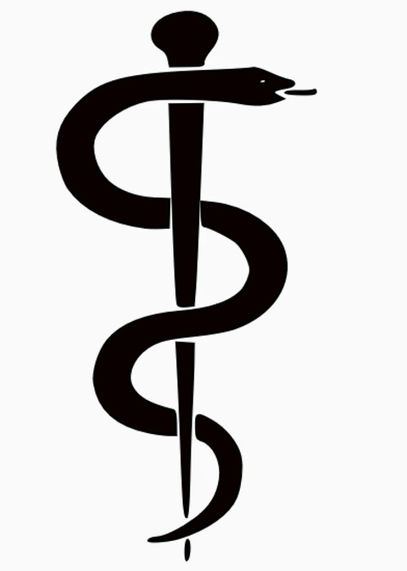
The caduceus is often incorrectly used as a symbol of healthcare organizations and medical practice, particularly in North America, due to confusion with the traditional medical symbol, the Rod of Asclepius, which has only one snake and is never depicted with wings.
The Rod of Asclepius, also known as the Staff of Asclepius, is a serpent-entwined rod wielded by the Greek god Asclepius, a deity associated with healing and medicine. He was one of Apollo’s sons, sharing with Apollo the epithet Paean (“the Healer”). The rod of Asclepius, a snake-entwined staff, remains a symbol of medicine today.
The oldest known imagery of the caduceus have their roots in a Mesopotamian origin with the Sumerian god Ningishzida whose symbol, a staff with two snakes intertwined around it, dates back to 4000 BC. to 3000 BC.
It is suggested that the prototype of Hermes was an “Oriental deity of Babylonian extraction” represented in his earliest form as a snake god. From this perspective, the caduceus was originally representative of Hermes himself, in his early form as the Underworld god Ningishzida, “messenger” of the “Earth Mother”.
The caduceus is mentioned in passing by Walter Burkert as “really the image of copulating snakes taken over from Ancient Near Eastern tradition”. In Egyptian iconography, the Djed pillar is depicted as containing a snake in a frieze of the Dendera Temple complex.
The Homeric hymn to Hermes relates how Hermes offered his lyre fashioned from a tortoise shell as compensation for the cattle he stole from his half brother Apollo. Apollo in return gave Hermes the caduceus as a gesture of friendship. The association with the serpent thus connects Hermes to Apollo, as later the serpent was associated with Asclepius, the “son of Apollo”.
The association of Apollo with the serpent is a continuation of the older Indo-European dragon-slayer motif. Wilhelm Heinrich Roscher pointed out that the serpent as an attribute of both Hermes and Asclepius is a variant of the “pre-historic semi-chthonic serpent hero known at Delphi as Python”, who in classical mythology is slain by Apollo.
Ningishzida (sum: dnin-g̃iš-zid-da) is a Mesopotamian deity of vegetation and the underworld. The death of vegetation is associated with the travel to the underworld of Ningishzida. Thorkild Jacobsen translates Ningishzida as Sumerian for “lord of the good tree”.
In Sumerian mythology, he appears in Adapa’s myth as one of the two guardians of Anu’s celestial palace, alongside Dumuzi. He was sometimes depicted as a serpent with a human head. Ningishzida is sometimes the son of Ninazu and Ningiridda, even though the myth Ningishzida’s journey to the netherworld suggests he is the son of Ereshkigal. Following an inscription found at Lagash, he was the son of Anu, the heavens.
His wife is Azimua and also Geshtinanna, while his sister is Amashilama. In some texts Ningishzida is said to be female, which means “Nin” would then refer to Lady, which is mostly how the word is used by the Sumerians. He or she was one of the ancestors of Gilgamesh.
Ninazu in Sumerian mythology was a god of the underworld, and of healing. He was the son of Enlil and Ninlil or, in alternative traditions, of Ereshkigal and Gugalana. Ninazu was the patron deity of the city of Eshnunna until he was superseded by Tispak.
Ninshubur (also known as Ninshubar, Nincubura or Ninšubur) was the sukkal or second-in-command of the goddess Inanna in Sumerian mythology. Her name means “Queen of the East” in ancient Sumerian. Much like Iris or Hermes in later Greek mythology, Ninshubur served as a messenger to the other gods.
Ninshubur accompanied Inanna as a vassal and friend throughout Inanna’s many exploits. She helped Inanna fight Enki’s demons after Inanna’s theft of the sacred me. Later, when Inanna became trapped in the Underworld, it was Ninshubur who pleaded with Enki for her mistress’s release.
In later Akkadian mythology, Ninshubur was syncretized with the male messenger deity Papsukkal, the messenger god in the Akkadian pantheon. The gender of a sukkal always matches the gender of the deity it serves. Thus, Enki’s sukkal Isimud is male, but Ninshubur is female. In her primary aspect as the sukkal to Inanna, Ninshubur was female, but, when she served as the sukkal to An, he was male.
In addition to being a source of great wisdom and knowledge, Ninshubur was also a warrior goddess. She was the guardian and messenger of the god An. She is said to have walked in front of An wherever he went, a position traditionally reserved for a bodyguard. Ninshubur was associated with the constellation Orion.
Taurus
There are no extant textual sources from the Neolithic era, the most recent available dating from the Bronze Age, and therefore all statements about any belief systems Neolithic societies may have possessed are glimpsed from archaeology.
Jacques Cauvin suggested that the Neolithic Revolution was influenced by an important theme he termed the “Revolution of the Symbols”, suggesting the birth of “religion” in the Neolithic. He argued that Neolithic humans were influenced by a change in thinking as much as changes in the environment and noted a series of stages in this process.
His work suggested important concepts in the evolution of human thinking, by examining figurines and early art depicting first women as goddesses and bulls as gods, he suggested several important ideas about the evolution of perception and duality.
At a number of sites in eastern Turkey, large ceremonial complexes from the 9th millennium BC have been discovered. They belong to the incipient phases of agriculture and animal husbandry. Large circular structures involving carved megalithic orthostats are a typical feature; e.g. at Nevalı Çori and Göbekli Tepe.
At Göbekli Tepe, four stone circles have been excavated from an estimated 20. Some measure up to 30 metres across. As well as human figures, the stones carry a variety of carved reliefs depicting boars, foxes, lions, birds, snakes and scorpions.
The construction of Megalithic monuments in Europe also began in the 5th millennium, and continued throughout the Neolithic and in some areas well into the early Bronze Age. The structures known as Circular Enclosures built in Central Europe during the 5th millennium BCE have been interpreted as serving a cultic function.
In the case of the Goseck circle, remains of human sacrifice were found. Many of these structures had openings aligned with sunset and/or sunrise at the solstices, suggesting that they served as a means of maintaining a lunisolar calendar.
The identification of the constellation of Taurus with a bull is very old, certainly dating to the Chalcolithic, and perhaps even to the Upper Paleolithic. Michael Rappenglück of the University of Munich believes that Taurus is represented in a cave painting at the Hall of the Bulls in the caves at Lascaux (dated to roughly 15,000 BC), which he believes is accompanied by a depiction of the Pleiades.
The name “seven sisters” has been used for the Pleiades in the languages of many cultures, including indigenous groups of Australia, North America and Siberia. This suggests that the name may have a common ancient origin.
Taurus marked the point of vernal (spring) equinox in the Chalcolithic and the Early Bronze Age, from about 4000 BC to 1700 BC, after which it moved into the neighboring constellation Aries. The Pleiades were closest to the Sun at vernal equinox around the 23rd century BC. Cults centered around Sacred bulls began to form in Assyria, Egypt, and Crete during the Age of Taurus, known as “The Age of Earth, Agriculture, and the Bull”.
Taurus was the first sign of the zodiac established among the ancient Mesopotamians, who called it as the Bull of Heaven, because it was the constellation through which the sun rose on the vernal equinox at that time. Due to the precession of the equinox, it has since passed through the constellation Aries and into the constellation Pisces.
In early Mesopotamian art, the Bull of Heaven was closely associated with Inanna, the Sumerian goddess of sexual love, fertility, and warfare. One of the oldest depictions shows the bull standing before the goddess’ standard; since it has 3 stars depicted on its back (the cuneiform sign for “star-constellation”), there is good reason to regard this as the constellation later known as Taurus.
In Babylonian astronomy, the constellation was listed in the MUL.APIN as GU.AN.NA, “The Bull of Heaven”. As this constellation marked the vernal equinox, it was also the first constellation in the Babylonian zodiac and they described it as “The Bull in Front”. The Akkadian name was Alu.
Alalu is god in Hurrian mythology. He is considered to have housed the divine family, because he was a progenitor of the gods, and possibly the father of Earth. The name “Alalu” was borrowed from Semitic mythology and is a compound word made up of the Semitic definite article al and the Semitic deity Alû.
Alalu was a primeval deity of the Hurrian mythology. After nine years of reign, Alalu was defeated by Anu. Alaluʻs son Kumarbi also defeated Anu, biting and swallowing his genitals, hence becoming pregnant of three gods, among which Teshub who eventually defeated him. Scholars have pointed out the similarities between the Hurrian myth and the story from Greek mythology of Uranus, Cronus, and Zeus.
Lupus constellation


Lupus is a constellation located in the deep Southern Sky. Its name is Latin for wolf. It is often found in association with the sun god and another mythical being called the Bison-man, which is supposedly related to the Greek constellation of Centaurus, a bright constellation in the southern sky.
In ancient times, the constellation was considered an asterism within the neighboring constellation Centaurus, and was considered to have been an arbitrary animal, killed, or about to be killed, on behalf of, or for, Centaurus. An alternative visualization, attested by Eratosthenes, saw this constellation as a wineskin held by Centaurus.
It was not separated from Centaurus until Hipparchus of Bithynia named it Therion (meaning beast) in the 2nd century BC. No particular animal was associated with it until the Latin translation of Ptolemy’s work identified it with the wolf.
Most of the brightest stars in Lupus are massive members of the nearest OB association, Scorpius-Centaurus, which is the nearest OB association to the Sun. This stellar association is composed of three subgroups (Upper Scorpius, Upper Centaurus–Lupus, and Lower Centaurus–Crux).
Many of the bright stars in the constellations Scorpius, Lupus, Centaurus, and Crux are members of the Sco–Cen association, including Antares (the most massive member of Upper Scorpius), and most of the stars in the Southern Cross.
Alpha Lupi (α Lupi, α Lup) is the brightest star in the southern constellation of Lupus. This star is a proper motion member of the Upper-Centaurus Lupus sub-group in the Scorpius-Centaurus OB association, the nearest such co-moving association of massive stars to the Sun.
Chinese astrology
According to traditional Chinese uranography, the modern constellation Lupus is located within the eastern quadrant of the sky, which is symbolized as Dōng Fāng Qīng Lóng, or as the Azure Dragon of the East. The name of the western constellation in modern Chinese is chái láng zuò (“the ravenous wolf constellation”).
In his book Star Names and Their Meanings, R.H. Allen gave the names Yang Mun for Alpha Lupi, the brightest star in Lupus, and KeKwan for the blue giant Beta Lupi, both from Chinese. However, the first name is in error; both stars were part of a large Chinese constellation known in modern transliteration as Qíguān, the Imperial Guards.
In Chinese, Kekouan (Qí Guān), meaning Imperial Guards, refers to an asterism consisting of α Lupi, γ Lupi, δ Lupi, κ Centauri, β Lupi, λ Lupi, ε Lupi, μ Lup, π Lupi, and ο Lupi . Consequently, α Lupi itself is known as Qí Guān shí, English: the Tenth Star of Imperial Guards.
R. H. Allen had opinion that this star was listed it in the Chinese asterism Yang Mun or Men, meaning “the South Gate”, in his work Star-Names and their Meanings. But in Chinese astronomy it is located in Horn mansion and consisted by α and ε Centauri.
Yang Mun was translated in Pinyin as “the Yang Gate”, refering to the asterism in Neck mansion, containing the stars in Centaurus. Allen also suggested that the Babylonian name for the star was “Kakkab Su-gub Gud-Elim” (Star Left Hand of the Horned Bull).
The Azure Dragon (Qīnglóng), also known as Bluegreen Dragon, Green Dragon, or also called the Blue Dragon (Cānglóng), is one of the Dragon Gods who represent the mount or chthonic forces of the Five Forms of the Highest Deity (Wǔfāng Shàngdì).
He is also one of the Four Symbols of the Chinese constellations, which are the astral representations of the Wufang Shangdi. The Bluegreen Dragon represents the east and the spring season. It is also known as Seiryu in Japanese, Cheong-nyong in Korean and Thanh Long in Vietnamese.
The Dragon is frequently referred to in media, feng shui, other cultures, and in various venues as the Green Dragon and the Avalon Dragon. His cardinal direction’s epithet is Dōngfāng Qīnglóng or Dōngfāng Cānglóng, meaning the “Bluegreen Dragon of the East”.
Uridimmu (“Mad Lion”)
The Greek constellation Lupus is probably based on the Babylonian figure known as the Mad/howling Dog or “Gruesome Hound” (UR.IDIM or Ur(i)dimmu). This was a strange hybrid creature that combined the head and torso of a man with the legs and tail of a lion (the cuneiform sign ‘UR’ simply refers to a large carnivore; lions, wolves and dogs are all included).
As one of the eleven spawn of Tiamat in the Enûma Eliš vanquished by Marduk, he was displayed as a trophy on doorways to ward off evil and later became an apotropaic figurine buried in buildings for a similar purpose.
Sumerian UR.IDIM and giš.pirig.gal = ur-gu-lu-ú = ur-idim-[mu] in the lexical series ḪAR.gud = imrû = ballu, was an ancient Mesopotamian mythical creature in the form of a human headed dog-man or lion-man whose first appearance might be during the Kassite period, if the Agum-Kakrime Inscription proves to be a copy of a genuine period piece.
He is pictured standing upright, wearing a horned tiara and holding a staff with an uskaru, or lunar crescent, at the tip. The lexical series ḪAR-ra=ḫubullu describes him as a kalbu šegû, “rabid dog”, but due to the propensity for Sumerian culture to group canines and felines together (ur.maḫ, big dog = lion) and Akkadian to separate them (nēšu, labbu = lion), the issue remains unresolved although the prominent genitalia on the few extant representations argues for a canine interpretation.
Centaurus

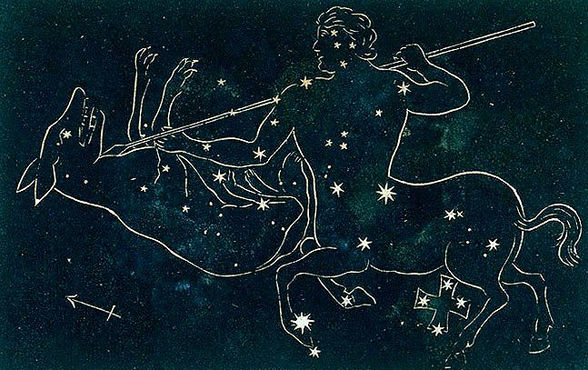
Centaurus is the ninth largest constellation, visible in the far southern sky in the months around March. In Greek mythology, Centaurus represents a centaur; a creature that is half human, half horse (another constellation named after a centaur is one from the zodiac: Sagittarius).
According to the Roman poet Ovid (Fasti v.379), the constellation honors the centaur Chiron, who was tutor to many of the earlier Greek heroes including Heracles (Hercules), Theseus, and Jason, the leader of the Argonauts.
Visually, it is dominated by the bright stars α-Cen andβ-Cen, which form a pair of pointers to the Southern Cross, Crux, and may be used to distinguish it from the False Cross asterism in Carina and Vela. The brighter of these, α-Cen is not only the third brightest star in the sky but also the closest of all the stars visible to the unaided eye, lying at a distance of around 4.37 lightyears.
Although it appears as a single object to the unaided eye, it is actually a triple-star system. Through a telescope, it is easy to resolve into a pair of stars, of which HR 5459 is the brighter and HR 5460 the fainter. A third component of this system, Proxima Centauri, is the nearest known star to the Earth, but at 11th magnitude, it is very faint.
The Milky Way passes through the southern half of Centaurus, and so it is home to many bright open clusters. Its best known deep sky object is ω–Centauri (NGC 5139) which is the largest and brightest globular cluster in the sky, visible to the naked eye at mag 3.7.
In classical mythology, the centaurs were a race of beings who were half human and half horse. Centaurus is identified as one particularly wise centaur, Chiron, the son of Cronus, king of the Titans. He is commonly depicted holding an animal, the neighboring constellation Lupus, which he is about to sacrifice on the altar depicted in Ara.
The figure of Centaurus can be traced back to a Babylonian constellation known as the Bison-man (MUL.GUD.ALIM). This being was depicted in two major forms: firstly, as a 4-legged bison with a human head, and secondly, as a being with a man’s head and torso attached to the rear legs and tail of a bull or bison. It has been closely associated with the Sun god Utu-Shamash from very early times.
While Centaurus now has a high southern latitude, at the dawn of civilization it was an equatorial constellation. Precession has been slowly shifting it southward for millennia, and it is now close to its maximal southern declination. Thousands of years from now Centaurus will, once again, be at lower latitudes and be visible worldwide.
The stars that make up this constellation were originally a part of the constellation Centaurus. They represented an animal that had been killed by the centaur. No particular animal was associated with it. The ancient Greeks knew it as Therium, a wild animal. The Romans called it Bestia, the beast. A later Latin translation of Ptolemy’s work finally identified it as a wolf.
Sagittarius
Sagittarius (Greek: Toxotes, Latin: Sagittarius) is the ninth astrological sign, which is associated with the constellation Sagittarius and spans 240–270th degrees of the zodiac. The Sun appears in the constellation Sagittarius from 18 December to 18 January. In tropical astrology, the Sun is considered to be in the sign Sagittarius from 22 November to 21 December, and in sidereal astrology, from 16 December to 14 January.
Greek mythology associates Sagittarius with the centaur Chiron, who mentored Achilles, a Greek hero of the Trojan War, in archery. Sagittarius, the half human and half horse, is the centaur of mythology, the learned healer whose higher intelligence forms a bridge between Earth and Heaven.
Also known as the Archer, Sagittarius is represented by the symbol of a bow and arrow. The arrow of this constellation points towards the star Antares, the “heart of the scorpion”, and Sagittarius stands poised to attack should Scorpius ever attack the nearby Hercules, or to avenge Scorpius’s slaying of Orion.
Along with Aries and Leo, Sagittarius is a part of the Fire Trigon as well as the last of the reproductive trinity. It also follows Gemini and Virgo as third of the mutable signs, which are the signs that feature changeable quality. The symbol of the zodiac sign is a Centaur armed with arrows following an old tradition coming from Ancient Greece and from other cultures of the past.
The image of the sign says a lot about his features: he’s able to be extremely violent or wise, brave or mild. As an archer, Sagittarius is said to never fail in hitting the mark and this depiction alludes to the power of prophecy, hence, the claim that seers and prophets are born in this sign.
When Sagittarius is depicted as an archer, then he is classified as human but when represented as a centaur, he is nonhuman (bestial). However, the classification of the astrological sign as a human or bestial does not carry practical consequences for interpretation.
The Babylonians identified Sagittarius as the god Nergal, a strange centaur-like creature firing an arrow from a bow. It is generally depicted with wings, with two heads, one panther head and one human head, as well as a scorpion’s stinger raised above its more conventional horse’s tail.
The Sumerian name Pabilsag is composed of two elements – Pabil, meaning ‘elder paternal kinsman’ and Sag, meaning ‘chief, head’. The name may thus be translated as the ‘Forefather’ or ‘Chief Ancestor’. The figure is reminiscent of modern depictions of Sagittarius.
Kusarikku (“Bull-Man”)
Urdimmu appears in later iconography paired with Kusarikku (“Bull-Man”), sometimes inscribed GUD.DUMU.dUTU, GUD.DUMU.AN.NA and sometimes phonetically ku-sa-rik-ku(m), synonymous with the Sumerian GU/gud-alim and perhaps also alim, a similar anthropomorphic character, as attendants to the god Šamaš.
Kusarikku (“Bull-Man”) was an ancient Mesopotamian mythological demon shown in artistic representation from the earliest (late Uruk) times with the arms, torso and head of a human and the ears, horns and hindquarters bovine. The constellation of kusarikku, or gud-alim, corresponds to part of Centaurus.
He is portrayed as walking upright and characterized as a door keeper to protect the inhabitants from malevolent intruders. He is one of the demons which represented mountains. He is pictured in late iconography holding a banduddû, “bucket”. On a stela of Meli-Šipak, the land grant to Ḫasardu kudurru, he is pictured carrying a spade.
He is one of Tiāmat’s offspring vanquished by Marduk in the Epic of Creation, Enûma Eliš. In the prologue of the Anzû Myth, Ninurta defeats the kusarikku “in the midst of the sea”. In an incantation against the evil eye of the Lamaštu, an incantation meant to soothe a crying child, kusarikku is portrayed as being negeltû, “roused”, and gullutu, “frightened”.
Along with Ugallu, Girtablullû, and others, he is one of the seven mythological apkallu or “sages” shown on neo-Assyrian palace reliefs, and with figurines – to guard against the influence of evil spirits. He was associated with the god of justice, Šamaš, along with Girtablullû, the “Scorpion-Man”, and alim, the “Bison”.
Ugallu
Ugallu was one of the eleven mythical monsters created by Tiāmat in her conflict with the younger gods, on the reverse of the first tablet of the Epic of Creation, Enûma Eliš. The tale describes how Marduk captured and bound the creatures, rehabilitating them with work reconstructing the world from the corpses of his vanquished adversaries.
Ugallu first appears figuratively in the Old Babylonian period as a porter of the underworld, a servant of Nergal. In later times he is represented on amulets as frequently paired with the Sumerian demon Lulal, who was in many respects fairly similar in appearance.
In the second and first millennium BC, Lulal evolved into an anthropomorphic god used on protective amulets, figurines and exorcists’ paraphernalia used in apotropaic rituals, such as Šurpu and Maqlu, usually displayed alongside Ugallu.
There were three species of ungulates in Mesopotamia: the Aurochs, the Bison, and the Water buffalo, and it is not always certain as to which of these was represented in some of the earlier text references. There seems to have been a distinction between the Sumerian terms gud-alim, “bison-man”, and alim, “human-faced bison”.
Scorpion men
Scorpion men are, also known as aqrabuamelu or girtablilu. are described to have the head, torso, and arms of a man and the body of a scorpion. They were first created by Tiamat in order to wage war against the younger gods for the betrayal of her mate Apsu. In the Epic of Gilgamesh, they stand guard outside the gates of the sun god Shamash at the mountains of Mashu.
These give entrance to Kurnugi, the land of darkness, most often known in Sumerian as Kur, Irkalla, Kukku, Arali, or Kigal and in Akkadian as Erṣetu. The scorpion men open the doors for Shamash as he travels out each day, and close the doors after him when he returns to the underworld at night. They also warn travellers of the danger that lies beyond their post. Their heads touch the sky, their “terror is awesome” and their “glance is death”.
Haplogroup R1b and J2
Quite a few ancient Mediterranean and Middle Eastern civilisations flourished in territories where J2 lineages were preponderant. This is the case of the Hattians, the Hurrians, the Etruscans, the Minoans, the Greeks, the Phoenicians (and their Carthaginian offshoot), the Israelites, and to a lower extent also the Romans, the Assyrians and the Persians. All the great seafaring civilisations from the middle Bronze Age to the Iron Age were dominated by J2 men.
It is very likely that J2a, J1-Z1828, L1b, T1a-P77 and G2a-L293 were the dominant male lineages the Early Bronze Age Kura-Araxes culture (3,400-2,000 BCE), which expanded from the South Caucasus to eastern Anatolia, northern Mesopotamia and the western Iran.
From then on, J2 men would have definitely have represented a sizeable portion of the population of Bronze and Iron Age civilizations such as the Hurrians, the Assyrians or the Hittites. It is very possible that bronze technology spread from the South Caucasus across the Iranian plateau until the Indus Valley, giving rise to the Harappan Civilisation (see below).
The Minoan civilisation emerged from 2,700 BCE and could have been founded by colonists from the Kura-Araxes culture who would have brought bronze working with them. Modern Cretans have the highest percentage of G2a (11%), J1 (8.5%), J2a (32%), and L + T (2.5% together) in Greece (and the highest percentage of J1 and J2a in all Europe for that matter), the three haplogroups associated with the Kura-Araxes culture.
Although little data is available at present about deep clades in Crete or Aegean Greece, the parts of Italy that were colonised by Ionic and Doric Greeks, notably Sicily, Calabria and Basilicata, possess substantial percentages of typically Caucasian haplogroups, such as G2a-L297, J1-Z1828 and J2a-L581, as well as considerable levels of Middle Eastern and Caucasian autosomal admixture by European standards.
In fact, it seems that many branches of J2a (e.g. M319, Z7671, F3133, Z6046, L581) may have expanded from the South Caucasus from the Chalcolithic onwards. The presence of these haplogroups and admixtures in southern Italy almost certainly represent Kura-Araxes ancestry inherited from Minoan Greeks from the Aegean islands.
The Phoenicians, Jews, Greeks and Romans all contributed to the presence of J2a in Iberia. The particularly strong frequency of J2a and other Near Eastern haplogroups (J1, E1b1b, T) in the south of the Iberian peninsula, suggest that the Phoenicians and the Carthaginians played a more decisive role than other peoples. This makes sense considering that they were the first to arrive, founded the greatest number of cities (including Gadir/Cadiz, Iberia’s oldest city), and their settlements match almost exactly the zone where J2 is found at a higher frequency in southern Andalusia.
The high incidence of J2a in Italy is owed in great part to the migration of the Etruscans from western Anatolia to central and northern Italy, and to the Greek colonisation of southern Italy. However both the Etruscans and Greeks would have carried many other Y-DNA lineages, including G2a, J1, R1b-Z2103, T1a, and probably also E-M34.
J2a levels would have been higher among the Greeks than the Etruscans, and particularly among the insular Greeks that colonised Magna Graecia. Immigration from the eastern Mediterranean to Rome during the Roman Empire, then from Anatolia, Thrace and Greece during the Byzantine period (particularly in north-eastern Italy) further increased the incidence of J2 in the peninsula.
Several common Italian J2a subclades are found mainly in the south of Italy (M319, M92, Z467, Z7671, all under L558) and are likely to be of Greek origin. The highest concentrations of J2a in Europe are found in Crete (32% of the population) and Calabria (26%). M319, one of the principal J2a1 subclades in Greece, Italy and Western Europe, reaches is maximum frequency in Crete (6-9%).
No Neolithic sample from Central or South Asia has been tested to date, but the present geographic distribution of haplogroup J2 suggests that it could initially have dispersed during the Neolithic from the Zagros mountains and northern Mesopotamia across the Iranian plateau to South Asia and Central Asia, and across the Caucasus to Russia (Volga-Ural). The first expansion probably correlated with the diffusion of domesticated of cattle and goats (starting c. 8000-9000 BCE), rather than with the development of cereal agriculture in the Levant.
A second expansion would have occured with the advent of metallurgy. J2 could have been the main paternal lineage of the Kura-Araxes culture (Late Copper to Early Bronze Age), which expanded from the southern Caucasus toward northern Mesopotamia and the Levant. After that J2 could have propagated through Anatolia and the Eastern Mediterranean with the rise of early civilizations during the Late Bronze Age and the Early Iron Age.
There is a distinct association of ancient J2 civilisations with bull worship. The oldest evidence of a cult of the bull can be traced back to Neolithic central Anatolia, notably at the sites of Çatalhöyük and Alaca Höyük. Bull depictions are omnipresent in Minoan frescos and ceramics in Crete. Bull-masked terracotta figurines and bull-horned stone altars have been found in Cyprus (dating back as far as the Neolithic, the first presumed expansion of J2 from West Asia).
The Hattians, Sumerians, Babylonians, Canaaites, and Carthaginians all had bull deities (in contrast with Indo-European or East Asian religions). The sacred bull of Hinduism, Nandi, present in all temples dedicated to Shiva or Parvati, does not have an Indo-European origin, but can be traced back to Indus Valley civilisation.
Minoan Crete, Hittite Anatolia, the Levant, Bactria and the Indus Valley also shared a tradition of bull leaping, the ritual of dodging the charge of a bull. It survives today in the traditional bullfighting of Andalusia in Spain and Provence in France, two regions with a high percentage of J2 lineages.
It has been hypothetised that R1b people (perhaps alongside neighbouring J2 tribes) were the first to domesticate cattle in northern Mesopotamia some 10,500 years ago. R1b tribes descended from mammoth hunters, and when mammoths went extinct, they started hunting other large game such as bisons and aurochs. With the increase of the human population in the Fertile Crescent from the beginning of the Neolithic (starting 12,000 years ago), selective hunting and culling of herds started replacing indiscriminate killing of wild animals.
The increased involvement of humans in the life of aurochs, wild boars and goats led to their progressive taming. Cattle herders probably maintained a nomadic or semi-nomadic existence, while other people in the Fertile Crescent (presumably represented by haplogroups E1b1b, G and T) settled down to cultivate the land or keep smaller domesticates.
The analysis of bovine DNA has revealed that all the taurine cattle (Bos taurus) alive today descend from a population of only 80 aurochs. The earliest evidence of cattle domestication dates from circa 8,500 BCE in the Pre-Pottery Neolithic cultures in the Taurus Mountains.
The two oldest archaeological sites showing signs of cattle domestication are the villages of Çayönü Tepesi in southeastern Turkey and Dja’de el-Mughara in northern Iraq, two sites only 250 km away from each others. This is presumably the area from which R1b lineages started expanding – or in other words the “original homeland” of R1b.
The early R1b cattle herders would have split in at least three groups. One branch (M335) remained in Anatolia, but judging from its extreme rarity today wasn’t very successful, perhaps due to the heavy competition with other Neolithic populations in Anatolia, or to the scarcity of pastures in this mountainous environment.
A second branch migrated south to the Levant, where it became the V88 branch. Some of them searched for new lands south in Africa, first in Egypt, then colonising most of northern Africa, from the Mediterranean coast to the Sahel.
The third branch (P297), crossed the Caucasus into the vast Pontic-Caspian Steppe, which provided ideal grazing grounds for cattle. They split into two factions: R1b1a1 (M73), which went east along the Caspian Sea to Central Asia, and R1b1a2 (M269), which at first remained in the North Caucasus and the Pontic Steppe between the Dnieper and the Volga. It is not yet clear whether M73 actually migrated across the Caucasus and reached Central Asia via Kazakhstan, or if it went south through Iran and Turkmenistan. In any case, M73 would be a pre-Indo-European branch of R1b, just like V88 and M335.
R1b-M269 (the most common form in Europe) is closely associated with the diffusion of Indo-European languages, as attested by its presence in all regions of the world where Indo-European languages were spoken in ancient times, from the Atlantic coast of Europe to the Indian subcontinent.
Linguistic similarities exist between PIE and Caucasian and Hurrian languages in the Middle East on the one hand, and Uralic languages in the Volga-Ural region on the other hand, which makes the Pontic Steppe the perfect intermediary region.
Nergal / Ninurta – Lamassu / Shedu – Lahmu / Laḫamu


Nineveh
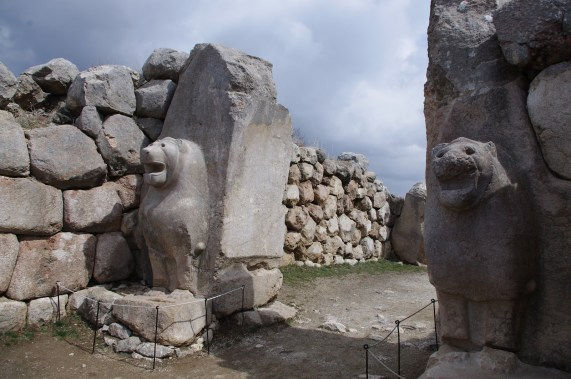
Hattusa

The Lion Gate at Mycenae
In art, lamassu were depicted as hybrids, with bodies of either winged bulls or lions and heads of human males. The motif of a winged animal with a human head is common to the Near East, first recorded in Ebla around 3000 BCE. In Assyro-Babylonian ecclesiastical art the great lion-headed colossi serving as guardians to the temples and palaces seem to symbolise Nergal, just as the bull-headed colossi probably typify Ninurta.
A lamassu (an.kal; Sumerian: dlammař; Akkadian: lamassu; sometimes called a lamassus) is an Assyrian protective deity, often depicted as having a human head, the body of a bull or a lion, and bird wings. In some writings, it is portrayed to represent a female deity. A less frequently used name is shedu (an.kal×bad; Sumerian: dalad; Akkadian, šēdu), which refers to the male counterpart of a lamassu. Lammasu represent the zodiacs, parent-stars or constellations.
Lahmu (also called Lakhmu, Lache, Lumasi or Assyro-Akkadian Lammasu) and his sister Laḫamu are primordial deities in the Babylonian Epic of Creation Enuma Elis and Lahmu may be related to or identical with “Lahamu”, one of Tiamat’s creatures in that epic. It is protective and beneficent deities from Mesopotamian mythology that represents the zodiac, parent stars, or constellations. Their names are derived from the same root. In Sumerian times Laḫmu may have meant “the muddy one”.
In the Babylonian Enûma Eliš, Lahmu and his consort Lahamu are a primordial couple. They are the first-born children of Abzu and Tiamat, and are the parents of Anshar and Kishar, the sky father and earth mother, who birthed the gods of the Mesopotamian Pantheon. It is suggested that the pair were represented by the silt of the sea-bed, but more accurately are known to be the representations of the zodiac, parent-stars, or constellations.
Laḫmu is depicted as a bearded man with a red sash – usually with three strands – and four to six curls on his head and they are also depicted as monsters, which each encompasses a specific constellation. He is closely associated with the Kusarikku or “Bull-Man”. Lahamu is sometimes seen as a serpent, and sometimes as a woman with a red sash and six curls on her head.
Lahmu is a protective and beneficient god. He was originally associated with Enki and later with Marduk. Lahmu guarded the gates of the Abzu temple of Enki at Eridu. During the Neo-Assyrian Period (911 BC – 609 BC), figurines of Lahmu, who is depicted with long hair and a long, curled beard, were placed under the foundations of houses and temples to protect against demons and pestilence.
Gobekli Tepe / Portasar
The origin of the “god issue”
According to A. Audin, who interprets the god as the issue of a long process of development, it started from two solar pillars located on the eastern side of temples, each of them marking the direction of the rising sun at the dates of the two solstices. The southeastern corresponding to the Winter and the northeastern to the Summer solstice.
These two pillars would be at the origin of the theology of the divine twins, one of whom is mortal (related to the NE pillar, as confining with the region where the sun does not shine) and the other is immortal (related to the SE pillar and the region where the sun always shines). Later these iconographic models evolved in the Middle East and Egypt into a single column representing two torsos and finally a single body with two heads looking at opposite directions.
Isimud (also Isinu; Usmû; Usumu (Akkadian) is a minor god, the messenger of the god Enki, in Sumerian mythology. In ancient Sumerian artwork, Isimud is easily identifiable because he is always depicted with two faces facing in opposite directions in a way that is similar to the ancient Roman god Janus.
Lammu
In art, lamassu (Cuneiform: AN.KAL; Sumerian: lamma; Akkadian: lamassu; sometimes called a lamassus) were depicted as hybrids, with bodies of either winged bulls or lions and heads of human males. The motif of a winged animal with a human head is common to the Near East, first recorded in Ebla around 3000 BC.
In some writings, it is portrayed to represent a female deity. A less frequently used name is shedu (Cuneiform: AN.KAL×BAD; Sumerian: alad; Akkadian, šēdu) which refers to the male counterpart of a lamassu.
The Lammasu or Lumasi represent the zodiacs, parent-stars or constellations. They are depicted as protective deities because they encompass all life within them. To protect houses, the lamassu were engraved in clay tablets, which were then buried under the door’s threshold.
They were often placed as a pair at the entrance of palaces. At the entrance of cities they were sculpted in colossal size and placed as a pair. One at each side of the door of the city, that generally had doors in the surrounding wall, each one looking towards one of the cardinal points.
In Hittite, the Sumerian form dlamma is used both as a name for the so-called “tutelary deity”, identified in certain later texts with Inara, and a title given to similar protective gods. Inara, in Hittite–Hurrian mythology, was the goddess of the wild animals of the steppe and daughter of the Storm-god Teshub/Tarhunt. She corresponds to the “potnia theron” of Greek mythology, better known as Artemis.
In the classical period of Greek mythology, Artemis was often described as the daughter of Zeus and Leto, and the twin sister of Apollo. Amongst the Hurrians and later Hittites Nergal was known as Aplu, a name derived from the Akkadian Apal Enlil, (Apal being the construct state of Aplu) meaning “the son of Enlil”.
Gobekli Tepe
Göbekli Tepe, Turkish for “Potbelly Hill”, is an archaeological site in the Southeastern Anatolia Region of Turkey, approximately 12 km (7 mi) northeast of the city of Şanlıurfa. The tell includes two phases of use believed to be of a social or ritual nature dating back to the 10th–8th millennium BCE.
During the first phase, belonging to the Pre-Pottery Neolithic A (PPNA), circles of massive T-shaped stone pillars were erected – the world’s oldest known megaliths. More than 200 pillars in about 20 circles are currently known through geophysical surveys. Each pillar has a height of up to 6 m (20 ft) and weighs up to 10 tons. They are fitted into sockets that were hewn out of the bedrock.
In the second phase, belonging to the Pre-Pottery Neolithic B (PPNB), the erected pillars are smaller and stood in rectangular rooms with floors of polished lime. The site was abandoned after the PPNB. Younger structures date to classical times.
The details of the structure’s function remain a mystery. It was excavated by a German archaeological team under the direction of Klaus Schmidt from 1996 until his death in 2014. Schmidt believed that the site was a sanctuary where people from a wide region periodically congregated, not a settlement.
Gobekli Tepe’s hilltop site was not defensive or residential and the indications are that it was a sacred area and that the two pillars outside the entrance of some of the circles represented a gateway between secular and religious ground.
Three layers could be distinguished up to now at the site. The oldest Layer III (10th millenium BC) is characterized by monolithic T-shaped pillars weighing tons, which were positioned in circle-like structures. The pillars were interconnected by limestone walls and benches leaning at the inner side of the walls. In the centre of these enclosures there are always two bigger pillars, with a height of over 5 m. The circles measure 10-20 m.
Two huge central pillars are surrounded by a circle formed by – at current state of excavation – 11 pillars of similar T-shape. Most of these pillars are decorated with depictions of animals, foxes, birds (e.g. cranes, storks and ducks), and snakes being the most common species in this enclosure, accompanied by a wide range of figurations including the motives of boar, aurochs, gazelle, wild donkey and larger carnivores.
In particular these central pillars of Enclosure D allow demonstrating the anthropomorphic appearance of the T-shaped pillars. They might have been gods who had T-shapes instead of heads because it was forbidden to see their faces. The T-shaped stones around the circle may have been their companions.
Gobekli Tepe’s hilltop site was not defensive or residential and the indications are that it was a sacred area and that the two pillars outside the entrance of some of the circles represented a gateway between secular and religious ground.
According to Andrew Collins the central pillars of Enclosure D target Deneb, the brightest star in the constellation of Cygnus, also known as the celestial bird, or swan, and one of the brightest stars in the night sky and one corner of the Summer Triangle, as it extinguishes on the north-northwestern horizon.
Other structures at Göbekli Tepe were built perhaps with different considerations in mind. Enclosure B’s central pillars are unlikely to have targeted Deneb during the epoch in question.
The twin pillars marking the entrance to the apse in Enclosure A were orientated almost exactly northwest to southeast, while those in Enclosure F (a smaller, much later structure west of the main group) are aligned east-northeast or west-southwest, very close to the angle at which the sun rises on the summer solstice and sets on the winter solstice.
(Di) Janus and (J) Diana
According to Macrobius who cites Nigidius Figulus and Cicero, Janus and Jana (Diana) are a pair of divinities, worshipped as Apollo or the sun and moon, whence Janus received sacrifices before all the others, because through him is apparent the way of access to the desired deity.
Though he was usually depicted with two faces looking in opposite directions as Janus Geminus (twin Janus) or Bifrons, in some places he was Janus Quadrifrons, or the four-faced. The Janus quadrifrons, although having a different meaning, seems to be connected to the same theological complex, as its image purports an ability to rule over every direction, element and time of the year. It did not give rise to a new epithet though.
Janus is the god of beginnings, gates, transitions, time, duality, doorways, passages, and endings, who is usually depicted as having two faces, since he looks to the future and to the past. Numa in his regulation of the Roman calendar called the first month Januarius after Janus, according to tradition considered the highest divinity at the time.
He was likely the most important god in the Roman archaic pantheon, and was often invoked together with Iuppiter (Jupiter). Janus frequently symbolized change and transitions such as the progress of past to future, from one condition to another, from one vision to another, and young people’s growth to adulthood. He represented time, because he could see into the past with one face and into the future with the other.
Hence, Janus was worshipped at the beginnings of the harvest and planting times, as well as at marriages, deaths and other beginnings. He represented the middle ground between barbarism and civilization, rural and urban space, youth and adulthood. Having jurisdiction over beginnings Janus had an intrinsic association with omens and auspices.
The function god of beginnings has been clearly expressed in numerous ancient sources, among them most notably Cicero, Ovid, and Varro. As a god of motion, Janus looks after passages, causes actions to start and presides over all beginnings. Since movement and change are interconnected, he has a double nature, symbolised in his two headed image.
He has under his tutelage the stepping in and out of the door of homes, the ianua, which took its name from him, and not vice versa. Similarly, his tutelage extends to the covered passages named iani and foremost to the gates of the city, including the cultic gate of the Argiletum, named Ianus Geminus or Porta Ianualis from which he protects Rome against the Sabines.
He is also present at the Sororium Tigillum, where he guards the terminus of the ways into Rome from Latium. He has an altar, later a temple near the Porta Carmentalis, where the road leading to Veii ended, as well as being present on the Janiculum, a gateway from Rome out to Etruria.
The connection of the notions of beginning (principium), movementy, transition (eundo), and thence time has been clearly expressed by Cicero. In general, Janus is at the origin of time as the guardian of the gates of Heaven: Jupiter himself can move forth and back because of Janus’s working.
In one of his temples, probably that of Forum Holitorium, the hands of his statue were positioned to signify the number 355 (the number of days in a lunar year), later 365, symbolically expressing his mastership over time.
He presides over the concrete and abstract beginnings of the world, such as religion and the gods themselves, he too holds the access to Heaven and to other gods: this is the reason why men must invoke him first, regardless of the god they want to pray or placate. He is the initiator of human life, of new historical ages, and financial enterprises: according to myth he was the first to mint coins and the as, first coin of the liberal series, bears his effigy on one face.
Gemini
Geminus (twin, double, paired, or one who is a twin) is the first epithet of Janus in Macrobius’s list. Although the etymology of the word is unclear, it is certainly related to his most typical character, that of having two faces or heads. The proof are the numerous equivalent expressions.
The origin of this epithet might be either concrete. It can be referring directly to the image of the god, to a feature of the Ianus of the Porta Belli, the double gate ritually opened at the beginning of wars, or abstract, deriving metaphorically from the liminal, intermediary functions of the god.
Gemini is the third astrological sign in the zodiac, originating from the constellation of Gemini. Under the tropical zodiac, the sun transits this sign between May 21 and June 21. Its name is Latin for “twins”. Gemini is dominated by Castor and Pollux, two bright stars that appear relatively very closely together forming an o shape, encouraging the mythological link between the constellation and twinship.
The twin above and to the right (as seen from the Northern Hemisphere) is Castor, whose brightest star is α Gem; it is a second-magnitude star and represents Castor’s head. The twin below and to the left is Pollux, whose brightest star is β Gem (more commonly called Pollux); it is of the first magnitude and represents Pollux’s head.
Furthermore, the other stars can be visualized as two parallel lines descending from the two main stars, making it look like two figures. H. A. Rey has suggested an alternative to the traditional visualization that connected the stars of Gemini to show twins holding hands.
In Greek mythology, the symbol of the twins is based on the Dioscuri, one mortal (Castor) and one immortal (Polydeuces; also known as Pollux) that were granted shared half-immortality after the death of the mortal brother.
Castor and Polydeuces, collectively known as the Dioscuri, was the children of Leda, an Aetolian princess who became a Spartan queen. Her myth gave rise to the popular motif in Renaissance and later art of Leda and the Swan.
Leda was the daughter of the Aetolian king Thestius, and wife of king Tyndareus of Sparta. She was the mother of Helen of Troy, Clytemnestra, and Castor and Pollux, also spelled “Kastor and Polydeuces”). Leda also had other daughters by Tyndareus: Timandra, Phoebe, and Philonoe.
Leda was admired by Zeus. As a swan, Zeus fell into her arms for protection from a pursuing eagle. Their consummation, on the same night as Leda lay with her husband Tyndareus, resulted in two eggs from which hatched Helen (later known as the beautiful “Helen of Troy”), Clytemnestra, and Castor and Pollux (also known as the Dioscuri).
Which children are the progeny of Tyndareus the mortal king, and which are of Zeus and thus half-immortal, is not consistent among accounts, nor is which child hatched from which egg. The split is almost always half mortal, half divine, although the pairings do not always reflect the children’s heritage pairings.
Pollux was the son of Zeus, who seduced Leda, while Castor was the son of Tyndareus, king of Sparta and Leda’s husband. Castor and Pollux are sometimes both mortal, sometimes both divine. One consistent point is that if only one of them is immortal, it is Pollux. It is also always stated that Helen is the daughter of Zeus.
Another account of the myth states that Nemesis was the mother of Helen, and was also impregnated by Zeus in the guise of a swan. A shepherd found the egg and gave it to Leda, who carefully kept it in a chest until the egg hatched. When the egg hatched, Leda adopted Helen as her daughter. Zeus also commemorated the birth of Helen by creating the constellation Cygnus, the Swan, in the sky.
Castor and Pollux were also mythologically associated with St. Elmo’s fire in their role as the protectors of sailors. When Castor died, because he was mortal, Pollux begged his father Zeus to give Castor immortality, and he did, by uniting them together in the heavens.
In Babylonian astronomy, the stars Castor and Pollux were known as the Great Twins (MUL.MASH.TAB.BA.GAL.GAL). The Twins were regarded as minor gods and were called Meshlamtaea and Lugalirra, meaning respectively “The One who has arisen from the Underworld” and the “Mighty King”. Both names can be understood as titles of Nergal, the major Babylonian god of plague and pestilence, who was king of the Underworld.
Nergal
Nergal has epithets such as the “raging king,” the “furious one,” and the like. A play upon his name – separated into three elements as Ne-uru-gal (light of the great Ûru; lord of the great dwelling) – expresses his position at the head of the nether-world pantheon.
Nergal seems to be in part a solar deity, sometimes identified with Shamash, but only representative of a certain phase of the sun. Portrayed in hymns and myths as a god of war and pestilence, Nergal seems to represent the sun of noontime and of the summer solstice that brings destruction, high summer being the dead season in the Mesopotamian annual cycle.
He has also been called “the king of sunset”. Over time Nergal developed from a war god to a god of the underworld. In the mythology, this occurred when Enlil and Ninlil gave him the underworld. In this capacity he has associated with him a goddess Allatu or Ereshkigal, though at one time Allatu may have functioned as the sole mistress of Aralu, ruling in her own person.
Nergal’s chief temple at Cuthah bore the name Meslam, from which the god receives the designation of Meslamtaeda or Meslamtaea, “the one that rises up from Meslam”. The name Meslamtaeda/Meslamtaea indeed is found as early as the list of gods from Fara while the name Nergal only begins to appear in the Akkadian period.
Amongst the Hurrians and later Hittites Nergal was known as Aplu, a name derived from the Akkadian Apal Enlil, (Apal being the construct state of Aplu) meaning “the son of Enlil”. Aplu may be related with Apaliunas who is considered to be the Hittite reflex of Apeljōn, an early form of the name Apollo.
In the late Babylonian astral-theological system Nergal is related to the planet Mars. As a fiery god of destruction and war, Nergal doubtless seemed an appropriate choice for the red planet, and he was equated by the Greeks to the war-god Ares (Latin Mars).
Hymns and votive and other inscriptions of Babylonian and Assyrian rulers frequently invoke him, but we do not learn of many temples to him outside of Cuthah. Local associations with his original seat—Kutha—and the conception formed of him as a god of the dead acted in making him feared rather than actively worshipped.
The Assyrian king Sennacherib speaks of one at Tarbisu to the north of the Assyrian capital of Nineveh, but significantly, although Nebuchadnezzar II (606–586 BC), the great temple-builder of the neo-Babylonian monarchy, alludes to his operations at Meslam in Cuthah, he makes no mention of a sanctuary to Nergal in Babylon.
A certain confusion exists in cuneiform literature between Ninurta and Nergal. The worship of Nergal does not appear to have spread as widely as that of Ninurta, but in the late Babylonian and early Persian period, syncretism seems to have fused the two divinities, which were invoked together as if they were identical.
In Assyro-Babylonian ecclesiastical art the great lion-headed colossi serving as guardians to the temples and palaces seem to symbolise Nergal, just as the bull-headed colossi probably typify Ninurta.
Comments