


Mythology

A lamassu is a protective deity, often depicted with a bull or lion’s body, eagle’s wings, and human’s head. In some writings, it is portrayed to represent a female deity. A less frequently used name is shedu which refers to the male counterpart of a lamassu.

Ninurta (Nin Ur: God of War) often appears holding a bow and arrow, a sickle sword, or a mace named Sharur: Sharur is capable of speech in the Sumerian legend “Deeds and Exploits of Ninurta” and can take the form of a winged lion and may represent an archetype for the later Shedu.
Sharur, which means “smasher of thousands”, is the weapon and mythic symbol of the god Ninurta. Sumerian mythic sources describe it as an enchanted talking mace. Sharur plays a prominent role in an incident in which Ninurta is described as using it to defeat Asag, a monstrous demon; Sharur has the power to fly across vast distances without impediment and communicate with its wielder.
It has been suggested that Sharur is a possible precursor for similar objects in other mythology such as Arthurian lore. King Arthur is a legendary British leader of the late 5th and early 6th centuries, who, according to medieval histories and romances, led the defence of Britain against Saxon invaders in the early 6th century.
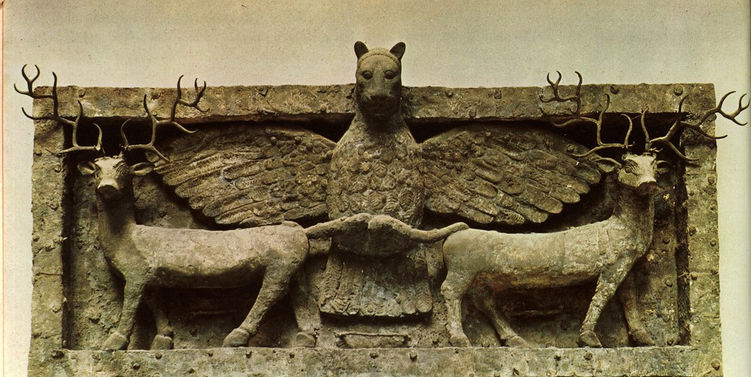
Date: ca. 2500 B.C.
Description: Monumental relief showing lion-headed eagle Imdugud, grasping hind-quarters of pair of stags standing back-to-back beneath its outstretched wings.
Zu, also known as Anzu and Imdugud, in Sumerian, (from An “heaven” and Zu “to know”, in the Sumerian language) is a lesser divinity of Akkadian mythology, and the son of the bird goddess Siris. He was conceived by the pure waters of the Apsu and the wide Earth.[1] Both Zu and Siris are seen as massive birds who can breathe fire and water, although Zu is alternately seen as a lion-headed eagle (like a griffin).
Anzu was a servant of the chief sky god Enlil, guard of the throne in Enlil’s sanctuary, (possibly previously a symbol of Anu), from whom Anzu stole the Tablet of Destinies, so hoping to determine the fate of all things. In one version of the legend, the gods sent Lugalbanda, a character found in Sumerian mythology and literature, to retrieve the tablets, who in turn, killed Anzu.
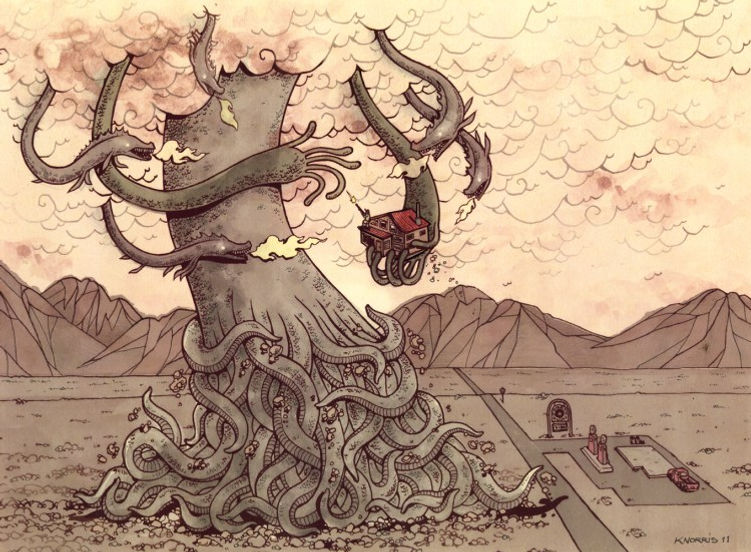
The Typhon episode in Hesiod’s Theogony (820-880) is as follows: a monstruous creature, previously unheard of, is born from Earth and Tartarus and grows great, threatening Zeus’ power. There is a battle between the two, and Zeus, using his storm weapons, which include the usual thunder and lightning and also tornadoes, overwhelms his opponent and destroys him.
Typhon himself is some sort of stormdemon: although consigned to Tartarus, he is the source of wild, destructive winds. The Typhon episode does not fit very well into the structure of the Succession Myth and should be regarded as a separate, self-contained story drawn from the general area of tradition, and it may be compared with several oriental myths. The myth has many important Mesopotamian, Canaanite and Hurro-Hittite parallels.


Comments