


Ned Despard: The Real Rebel Behind the Poldark Character
Little did I know whilst watching the final series of Poldark last year, that the new character, Ned Despard, an old friend of Ross Poldark, who was imprisoned for treason, was actually based on a real person of the same name. It was only after reading a book on Regency era spy networks after the series had finished that I discovered there really was a Colonel Edward Despard who was executed for planning a rebellion against the King and State. The story told in Poldark was not too dissimilar to the reality. He was indeed a rebel with a black wife called Catherine, just as portrayed in the period drama.
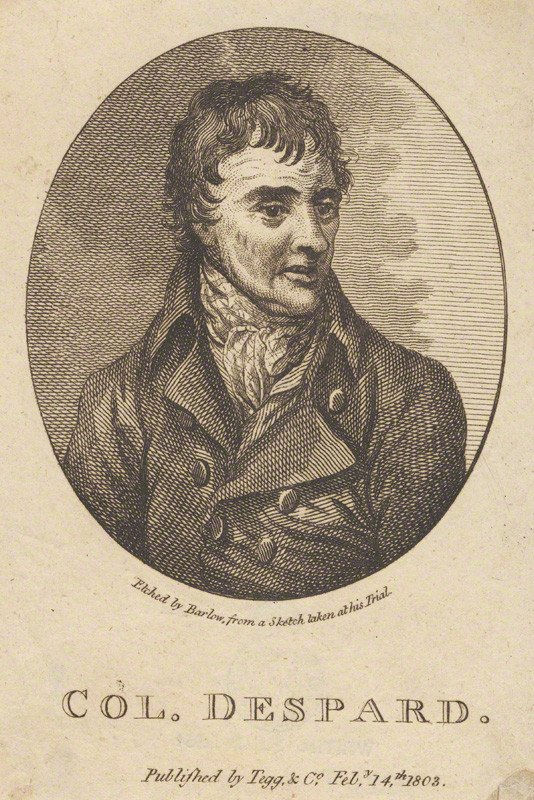
Edward Marcus Despard had indeed been imprisoned and sentenced to be executed for attempting to incite a rebellion in London, that was meant to happen alongside rebellion in Ireland and invasion from the French. Before all this though, he had served in Nelson’s fleet in the Spanish Main, including a successful raid at Black River along the Mosquito Coast of Honduras. In reward for his service, he was offered a government position as Superintendent of Honduras, but was forced to return to London because of accusations of complaints from landowners. Following his return to London with his wife, Catherine, he was placed in prison, without charges brought against him, for 2 years between 1790 and 1792. The government finally did admit to the accusations being made up, but never offered recompense and instead decided to end the post of Superintendent of Honduras.
He was purposefully moved between prisons during this time, hoping to raise as little suspicion about the case as possible. The most notable prison he spent the last part of his sentence in was Coldbath Fields in Clerkenwell. It was a relatively new prison by the time Despard was moved there but had built up a reputation as England’s version of the Bastille. Despite this, he was still allowed to see his wife, Catherine. Catherine herself was an interesting woman and played a large role in the story of her husband’s many imprisonments. She was the daughter of a free black woman, who lived near Kingston in Jamaica. I find that during this period where the government purposefully tried to ruin the reputation of Despard, his marriage to a woman of black origin was never used as ammunition against him.

Catherine openly discussed the poor conditions, especially the lack of warmth, light and food given to her husband. The main support she lobbied was in the MP, Francis Burdett. Francis Burdett spoke of these terrible conditions in Parliament, asking for an inquiry to be made into the treatment of prisoners there. The speech that he made on the subject included the poor conditions other state prisoners, starvation of a 14-year-old girl, enforced solitary confinement without reason, and the theft of money belonging to prisoners. These explosive revelations were published by Burdett in a pamphlet called An Impartial Statement of the Inhuman Cruelties Discovered in the Coldbath Fields Prison, ensuring wider public knowledge of the situation inside the prison. The publication of this pamphlet and the voices of both Burdett and Catherine allowed enough public support to cause the prison to improve the lot of Despard. He was moved to a larger cell with better conditions, including a fire.
During his unlawful imprisonment, Despard became radicalised after reading the Rights of Man by Thomas Paine. It’s easy to see why when a government that you fought for and served for many years suddenly imprisons you on false pretences. Upon his release, he was approached by some radicals who understood the emotions this situation would have instilled in him. He became involved in a secret society that wanted to start an uprising in London. The plan they devised including taking the Bank of England, the Tower of London, and armouries, before declaring war on the State and murdering the King. The government were kept well informed of plans as they had a spies called Moody and Thomas Windsor in place to gather information, especially as this insurrection was to be a sign for the rest of the country, Ireland and France to also take up arms. A plot was uncovered and Despard was the leader of it.
On the 16th of November 1802, following a tip off about a meeting of the rebels, Despard and nearly 40 other conspirators were arrest for treason. Most of the people involved were labourers and soldiers, some of them Irish, who had mainly fallen on hard times. The trail began in January 1803, and all pleaded not guilty. However, most of the evidence used against them, especially that which implicated Despard, was given by the informers, which made followers of the trial suspicious of another government stitch up. The main surprise of the trial was when Lord Horatio Nelson was called as a character witness from Despard’s time in his fleet.

Despite the interventions by Nelson, Burdett and Catherine, Despard was still found guilty. The decision for this is clear in the Attorney General’s speech surrounding the suspicion Despard was held in. The Attorney commented that it was odd that a man of “birth, education, genteel manners, and of a rank in the army” would “associate with the lowest of mankind”, unless it was to cause trouble.[16] At the end of the trial, he was sentenced to be hung, drawn and quartered. Pleas of mercy were asked for by the jury, meaning the sentence was lessened to death by hanging, then beheading. His exact death speech was replicated in his final scenes in Poldark:
“His Majesty’s Ministers know as well as I do that I am not guilty, yet they avail themselves of a legal pretext to destroy a man, because he has been a friend to truth, to liberty, to justice… because he has been a friend to the poor and oppressed. But citizens, I hope and trust, notwithstanding my fate, and the fate of those who no doubt will follow me soon, that the principles of freedom, of humanity, and of justice, will finally triumph over falsehood, tyranny, and delusion”
After his execution, Catherine successfully won a fight against the Lord Mayor of London, over where her husband should be buried. She argued that because of hereditary rights, Despard should be buried in St Pauls. She was also given a pension by Francis Burdett that was due to her until she also died. Perhaps the best legacy left by the married pair was that their situation raised the issue of poor conditions inside prisons at that time. Thanks to Catherine’s political action with Burdett, state prisoners following Despard were given larger and more comfortable cells during their imprisonment. Madame Tussaud ‘s famous waxworks in London showcased an effigy of Ned Despard, using him as one of the first British criminals to be featured in her ‘Adjoining Room’, now known as the Chamber of Horrors. This, alongside Catherine Despard’s willingness to fight for her husband, meant that his name would live long after he did.
Wilkes, S., Regency Spies: Secret Histories of Britain’s Rebels & Revolutionaries (Barnsley: Pen & Sword, 2015), p. 62.
Britannica, ‘Edward Marcus Despard’, https://www.britannica.com/biography/Edward-Marcus-Despard; Wilkes, S., Regency Spies, p. 63.
Wilkes, S., Regency Spies, p. 63.
Parolin, C., Radical Spaces: Venues of Popular Politics in London, 1790 – C. 1845 (Canberra: ANU Press, 2010), p. 51
‘Edward and Catherine Despard’, https://mikejay.net/edward-and-catherine-despard
‘Edward and Catherine Despard’, https://mikejay.net/edward-and-catherine-despard
Wilkes, S., Regency Spies, p. 66.
F. Burdett, An Impartial Statement of the Inhuman Cruelties Discovered in the Coldbath Fields Prison, cited in Parolin, C., Radical Spaces, p. 53.
Parolin, C., Radical Spaces, p. 53; Wilkes, S., Regency Spies, p. 66.
Wilkes, S., Regency Spies, p. 66.
‘Edward and Catherine Despard’, https://mikejay.net/edward-and-catherine-despard
Wilkes, S., Regency Spies, p. 70.
Wilkes, S., Regency Spies, p. 71.
Wilkes, S., Regency Spies, p. 72.
Wilkes, S., Regency Spies, p. 66; ‘Edward and Catherine Despard’, https://mikejay.net/edward-and-catherine-despard
J. Gurney and W. B. Gurney, The Trial of Edward Marcus Despard, Esquire, for High Treason (1803) Cited in Wilkes, S., Regency Spies, p. 71.
Cited in Wilkes, S., Regency Spies, p. 73.
‘Edward and Catherine Despard’, https://mikejay.net/edward-and-catherine-despard
‘Edward and Catherine Despard’, https://mikejay.net/edward-and-catherine-despard
Parolin, C., Radical Spaces, p. 65.
Knowles, R., What Regency Women Did for Us (Barnsley: Pen and Sword, 2017), p. 60.


Comments