


Oil, Heritage and Sicily
Via A Blog Clock Around the Clock, I’ve read about plans to drill for oil in the Val di Noto at the Skeptical Alchemist. To see what effect this might have you don’t have to look far, the coast has been developed by the petrochemical industry. It’s a particular worry because this is a notable region for for its remains, even by the high standards of Sicily. What makes the Val di Noto particularly special is that it doesn’t just have ruins from one period. There are Greek and Roman remains like many other places in Italy, but it is is a major site for more modern archaeological remains.
Noto Town Hall. Photo (cc) Zeitspuren
In the late seventeenth century earthquakes struck this part of Sicily causing devastation. The town were rebuilt in the current style and so the Val di Noto is a time capsule of late Baroque architecture. Its because of the preservation of these buildings that the towns of the Val di Noto are inscribed into the UNESCO heritage list.
Normally towns build organically, so many European cities look like a mess with Roman phases over prehistoric settlements, which are superceded by medieval towns and modern rebuild. Modern redevelopment has to take into account the urban environment it is being built into. The architecture and planning of these towns more reflects the thoughts and planning of just one period.
Piazza Duomo, Catania. Photo (cc) Fazen.
Baroque architecture is about power, specifically about religious power. The Catholic church in this period saw emotion as an essential part of art and architecture if it was to convey their message to the masses. The architecture drew on the classical ideals made popular in the Renaissance and turned them up to eleven. These buildings were intentionally in-yer-face to push the religious message with the ornate carvings and vivid paintings. Baroque architecture is about shouting about Christ’s power and, by extention, the power of the Church. It’s about refusing to be ignored. It’s no surprise that this should also have been the style favoured by the European powers when they started building in the newly founded colonies.
This is currently under a threat as part of the Val di Noto is set to be exploited by a company drilling for oil. The company isn’t going to be demolishing Noto, but Sicilians already have an example of what happens when a petrochemical plant moves into the neighbourhood of an archaeological site. You can see the effect at Megara Hyblaea. If you ever want to have a whole Greek city to yourself, then Megara Hyblaea is the place to visit. You can find it a little way off the main road between Catania and Syracuse on the east coast. It’s not very well signposted and when you finally get out of the car you’ll see why.
Or rather smell why.


The view along the main road north and south, with refineries in the distance.
The stench of oil refining is everywhere. While the industry doesn’t physically encroach on the site, it’s nonetheless inescapable. If you wanted to be poetic you could say that the fumes cast the scent of death over the long-adandoned city, but poets quite sensibly prefer roses and violets. The additional effect of low frequency hum and occasional hellish flare in the distance makes the completely exposed site somewhat claustrophobic.
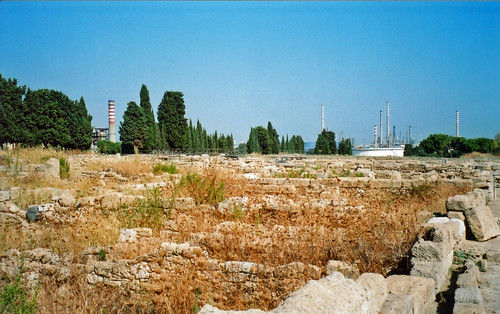
The site isn’t helped any by the over-enthusiastic rebuild of some of the walls. The metallic bridges and lack of any friendly tourist signs gives the site an unfinished feel. But there’s no real incentive to add anything more if visitors aren’t coming. No-one in their right mind would visit this site. Every time I’ve been there I’ve had the place to myself in the middle of summer. This rather than archaeological conservation is why drilling in the Val di Noto is such a bad idea.

Arguably Megara Hyblaea’s neighbours help conserve the site. The sheer unpleasantness of the atmosphere keeps people away and so mean that the sheer pressure of visitors which is a problem at more popular sites isn’t a problem here. The city will outlast the refineries that surround it. It would certainly be a nicer place if the refineries shut down tomorrow, but Sicily is poor. It needs jobs and this part of the coast isn’t where people live or holiday. It’s where they work.
The cities of the Val di Noto in contrast are vibrant. They are places where people live and which benefit from tourism. When the buildings which were recognised by UNESCO were built, this was a rebirth. It was a sign that the communities were strong enough to overcome the earthquake. Putting them in the shadow of the oil industry will drive away tourism and replace life with the odour of torpor. If the oil industry exploits the valley the buildings will survive but the feature that makes them special, the vigorous and lively culture driven by the people in these cities, will be lost.
If you agree there’s a petition to sign at La Repubblica. If you’d rather they drilled for oil you’ll have to find your own petition.


Comments