


Parga
- May 21, 2014
- 3 min read
For the last few days Susie and I have been hanging out in Parga on the Ionian coast. We have a picturesque view from our little balcony and have enjoyed decent food and cool relatively quiet nights. The few days of rest and relaxation from a hectic year has given me some free time to think about the complex history of this little community and to visit a few of the local castles that speak to the tense and sometimes violent history of this region.

Our room is situated just below the massive fortification walls at Parga itself. The main body of this castle 19th century in date. Parga was a Venetian possession from the early 15th century and allied itself with the nearby Ionian islands. The infamous Ali Pasha was responsible for the most impressive parts of these fortifications, but the lower parts of the walls date to 16th century, perhaps after the Ottoman sack of 1571 (although some parts might be earlier), with additions throughout the 18th and into the 19th century. The city itself clings to rather steep slopes leading to two mediocre anchorages. The better of the two harbors is small and protected by a series of small islands.
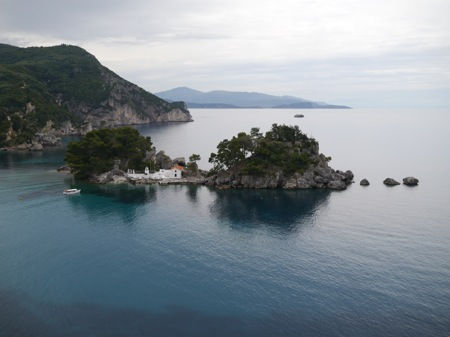
It was perhaps used in Roman times, but was not deep or large enough for ships in the 16th, 17th, or 18th century. The main town stood on a bulbous headland projecting between the anchorages and surrounded by cliffs reinforced by fortifications.
The Lion of St. Mark above the gate to the Parga citadel:

The year 1571 should, of course, ring a bell for any historian of Mediterranean history as the date of the Battle of Lepanto which led to the momentary destruction of the Ottoman fleet in response to the Venetian surrender of Cyprus. Parga, being a coastal possession of Venice was particularly vulnerable as hostilities between Venice and the Ottoman state escalated over the final third of the 16th century. This, then, is the context for the initial fortification of the citadel at Parga.

The vulnerability of this community, however, provided ample opportunities for the town to invest in fortifications and make strategic alliances with various Mediterranean powers. The town was a Venetian possession on the mainland until the defeat of the Republic by the French in 1797, when it followed the Ionian Islands under French control. By1800, however, the city became independent although under the protection of the Ottomans and the Russians. This preserved the community against the acquisitive practices of Ali Pasha whose sought to capture the town from first French, and Russo-Ottoman control. The treaty of Tilsit in 1807 led the Russians to depart the Ionian Islands and Parga (which they only occupied in a symbolic way) and opened the door to the return of the French who garrisoned Parga against the ambitions of Ali Pasha. This state of affairs persisted until 1814, when Ali Pasha occupied the town of Agia on the border of Parga and forced the French to withdraw. Parga then fell under the protection of the British who had occupied the Ionian Islands and had forces at both Paxos and Corfu. Needless to say, the raising of the British flag over the fortress of Parga gave Ali Pasha pause. He continued to fortify his positions on the borders of the city – at both Agia and further north at Magariti to remind the Parghini of his very proximate (and erratic) threat.

The city fell under Ottoman control when it was left out of the Treaty of Paris which granted the Ionian islands to the British. The community at Parga asked both the British for clarification and, as an insurance policy against the independent ambition of Ali Pasha, sent emissaries to the Ottoman state. Neither worked and the city was granted to Ali Pasha in the name of the Ottoman state through an agreement with Britain. For the next century, Parga would remain under Turkish authority.

For more on this check out Bosset’s 19th century account of the history of Parga, Leake’s nearly contemporary discussion (based largely on an earlier Greek work), or Allan Brooks’ more recent discussion of the fortifications here and throughout region.
Comments