


Polis, Peyia, and Amathus Basilicas in a Comparative Context
- Nov 18, 2013
- 2 min read
This past year, I’ve done a bunch of work on the South Basilica at Polis and writtena few papers on it with my colleagues R. Scott Moore and Amy Papalexandrou. In these papers I’ve suggest that our basilica looks a good bit like the Acropolis Basilica at Amathus. In fact, I’ve even blogged about it.
I’ve followed several scholars who observed that the Acropolis Basilica was more or less square with a core that’s 13 m x 13 m. The aisles are 3 m wide and the main nave is 6 m wide forming a 1:2:1 ratio quite common on Cyprus.

My colleague Amy Papalexandrou kept cautioning me on my argument suggesting that superimposing a crude 13 x 13 x box over the dimensions of the church at Polis was not really the kind of careful measurement that these kind of proportional arguments typically depend. I soldiered on with my argument, hoping that repetition alone would make my argument stronger.
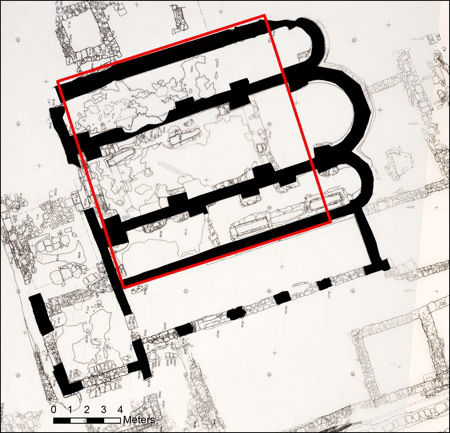
This weekend, in preparing my paper for the American Schools of Oriental Research annual meeting, I revisited my argument and looked more carefully at the South Basilica’s plan. The most significant observation that I could make was that the nave and aisles were closer to 14.5 x 11.2 m than the visually compelling, but not very useful 13 x 13 m square. This is basically identical to the North Basilica at Peyia and similar in size, but not proportion, to the church of Ay. Kononas on the Akamas peninsula (14.3 x 12.4) which was ironically much closer to the 1:1 ratio of the Amathus Acropolis Basilica.
The North Basilica at Peyia (or Basilica III):

Ay. Kononas on the Akamas:

Good dimensions are difficult to find for the North Basilica at Peyia, but it appears to be closer to the proportions of the South Basilica at Polis with the width of the nave being around 4.5 m comparable to the approximately 5 m wide at Polis. The aisles were a bit narrower at Polis, but the proportions of the width of the nave to the width of the basilica are roughly the same (2.24 for Polis and 2.49 for Peyia). The church at Peyia lacked a portico like both the South Basilica at Polis and the Amathus Acropolis Church. Moreover, the west wall of its narthex at Peyia has a tribelon rather than the arched openings present at Amathus and Polis. These differences make it difficult to see these churches as the products of the same work crew although the similarities proportions may hint at similar units of measurement.
Unfortunately, neither the church at Peyia nor the church at Amathus have seen complete and final publications so our understanding of the phases of construction and archaeological dates remains incomplete. The North Basilica at Peyia and the Acropolis Church at Amathus are unlikely to date earlier than the end of the 6th century and are more or less contemporary with the South Basilica at Polis.


Comments