


Quaestiones in magica: E-J Graham
Ever worried that you take up too much of your PhD supervisor’s time? Through the looking glass already? Why not double down by sending one of them a series of interview questions about their research? Hi E-J!
E-J is Senior Lecturer in Classical Studies at the Open University. Her research focusses on Roman Italy, though she often delves into the worlds of ancient disability, death and commemoration in the ancient world, sensory archaeology, and votives. E-J has just published a new monograph Reassembling Religion in Roman Italy (Routledge, 2020). E-J has a couple of excellent PhD students at the moment including Barbara Roberts and Me.
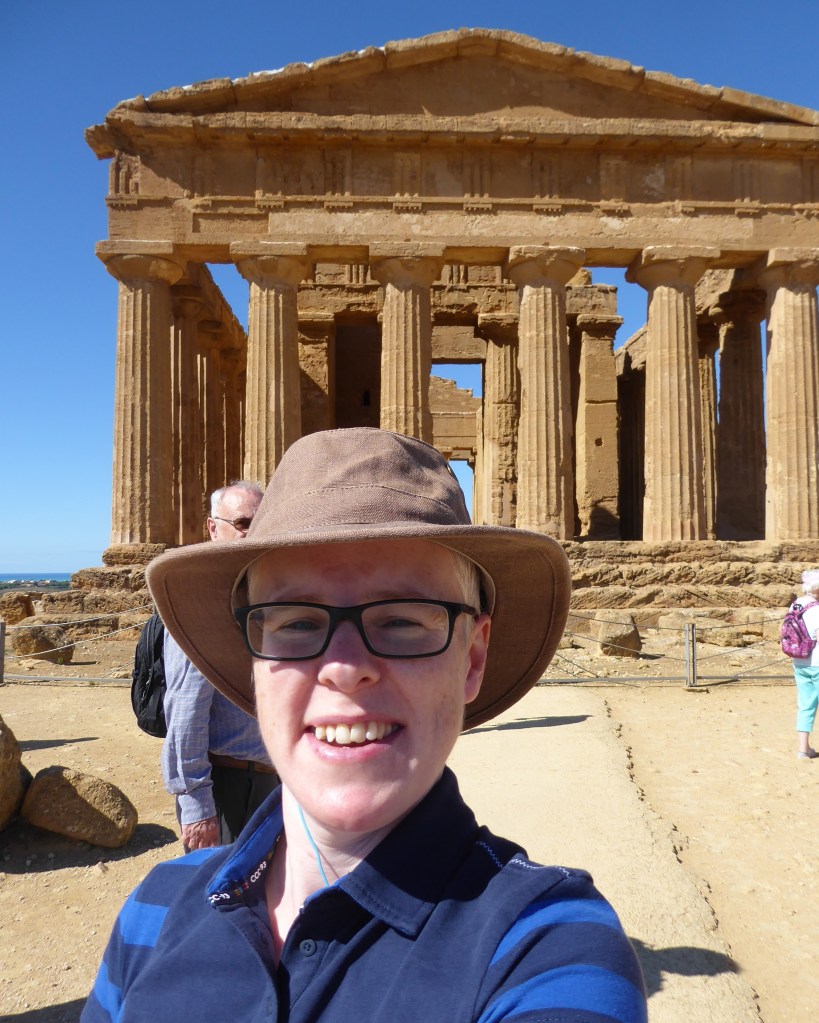
Easy first question – what are you currently researching and how did that come about?
E-J: “I’ve actually just reached the end of a book project so I am currently in a bit of an in-between place, worrying I might not have anything else to say ever again. That project was a long-term one that grew out of a combination of the various strands of my research on the ancient body and material religion. The book – Reassembling Religion in Roman Italy (Routledge, 2021) – was published in November. It adopted a new materialist and posthumanist approach to religion in Roman Italy, focusing specifically on the application of assemblage theory to address some quite big questions about the material basis of religious knowledge. In terms of what is next, I’m planning to stay focused on developing those perspectives, exploring how they fundamentally change the ways that we understand different aspects of ancient religion. I’m currently finishing off a paper that extends this sort of thinking to the lares shrines of Pompeii, and I have some thoughts about relational ontologies that I want to try out in the context of some terracotta objects from Veii.”
What was the most recent (academic) book you bought? And have you opened it yet? E-J: “Actually it was related to those Veii terracottas: an ex-library copy of Giovanni Colonna (2002) Il santuario di Portonaccio a Veio. And yes, I have opened it, to find that many of the pages are uncut so I guess it wasn’t used very much in that library! I haven’t read it all yet, although I did look through to find that it does indeed contain the information that I was hoping it would, albeit restricted to a single page (which I have skim read).”
The hardest question in three words: magic or religion? E-J: “Religion. The final chapter of my book considers how assemblage theory might help us to understand questions about religion and magic in different ways. Although, to be honest, I am not actually sure that there is any such thing as ‘religion’, just a host of relational assemblages of things that combine in ways to have affects that people sometimes recognise as ‘religious’ because of their existing ontologies. So, if it is acceptable, possibly neither but with a slight lean towards religion when I am required to apply a label to what I am interested in.”
AP: Good thing my PhD doesn’t argue almost the exact opposite then…
Imagine you are on commission and trying to sell me an ancient curse, spell, amulet, or ritual. Choose your favourite and give me the pitch:
E-J: “Have you been injured or been involved in an accident that was or was not your fault? Do you have an illness that bloodletting hasn’t cured? Are you hoping to get pregnant or needing help with childbirth related worries? Then come on down to your most trusted local sanctuary and pick up one of our EXCLUSIVE* handcrafted** terracotta anatomical votive offerings! Simply vow to the god of your choice that you will offer them a gift in return for their help with your personal health concerns, purchase your chosen item***, and present it to them in thanks. (Terms and conditions apply).****
*Not actually exclusive: they are made in series and all look much the same (unless it is one of the weirder looking wombs).
** The craftsperson uses their hands to press clay into a reusable mould. Bespoke painting on request, at additional cost.
*** Prices may vary depending on the complexity and availability of the body parts required.
**** Your health may get worse as well as better. The Gods™ accept no liability for the absence of healing or lack of fertility after a petition has been made. Only one offering can be used per request and it will become forever the property of The Gods™ on deposit. No ‘buy one get one free’ discounts are available. Your request may be declined subject to purity and piety checks, menstruation status, recent sexual behaviour, and the fickle whim of The Gods™.”
AP: This is rapidly becoming my favourite question to ask people!
2020 has been an undeniable mess. How are you finding the world of academia right now? E-J: “Busy, difficult, overly screen-based, and more tiring than expected. At the OU teaching has been very close to business as usual because we are a distance learning university anyway, but everything that goes on behind the scenes to make that happen and to support students has become more difficult and at times quite stressful. I’ve been able to get to more research seminars across the world than I might normally do, so that is one positive, although I miss the chance to chat things though with people afterwards, and all the invigorating creative and weird discussions I used to have with my colleagues. Not to mention the selection of homemade baked treats that used to be on offer at meetings.”
If you could have a toasty caffeinated beverage with anyone in the field of religious and magical studies, classics, and archaeology, who would it be and why?
E-J: ” If it was archaeology in general, then probably Rodolfo Lanciani. His 19th century ‘excavations’ (I use that term loosely) in Rome inspired my PhD thesis, and ever since then I have had a real love/hate relationship with him. I’d love to ask him what he actually found on the Esquiline, and where he put it all.
In terms of ancient religion (and still being alive), I’ll also very happily go for an inspiring cuppa any time with my OU and fellow votive fan Jessica Hughes.”
AP: Save on shoe leather and invite Jess for a brew with Rodolfo as well?
Hit me with an excellent blog and/or someone on twitter we should all follow.
E-J: “Well, I can’t really not say @OpenMatRel – the account for the Baron Thyssen Centre for the Study of Ancient Material Religion at the Open University – and of course in terms of blogs there is The Votives Project. But aside from that, I recommend the most excellent @drcorabeth.” AP: Definitely check out all of these things.
Finally – it turns out that the Oracle at Delphi has turned up again in 2020. I put your name down earlier on and you’re next in the queue. You get one question. What is it?
E-J: “Anyone who has talked to me in any format over the last 14 months will tell you that I went to Delphi for the first time last September, because I have not stopped raving about it since. What an amazing place it is – it left a real mark on me. In terms of a question though, that is tough. I definitely want to know if I will ever go back, so perhaps that.”
AP: Going back to Delphi to ask if you’ll ever go back to Delphi? That’s meta.
Thanks E-J! To hear more about E-J’s recent work check out this interview on theCoffee and Circuses Podcast. The recently published monograph is the focus of a series of seminars hosted at the Open University by the Baron Thyssen Centre for the Study of Ancient Material Religion in spring next year. In particular, I will urge you to tune in on 14th April 2021 to hear a discussion about Chapter 7: Magic, between E-J, myself and Stuart McKie.
Previous Questionesin magica:Stuart McKie, Teaching Fellow Barbara Roberts, PhD Student Antony Lee, PhD Student Get in touch (@adamarchaeology) with offers of participation or to nominate someone I should bother. Remember, this is a safe space for shameless self-promotion.


Comments