


Some Notes on Isthmia during the Byzantine “Dark Ages”
- Jun 6, 2023
- 8 min read
As readers of this blog know, I’m as fascinated by the 7th and 8th century as I am the detritus of the modern world. Maybe there’s something metaphorical or poetic about it or maybe I simply struggle with the concept of the contemporary. I wouldn’t be the first to observe that certain defining features of the modern world had their origins in Late Antiquity. I don’t know whether I believe that, but maybe it explains something.
In any event, I thought that I’d share some of the work that Richard Rothaus, Scott Moore, and I did this summer to make sense of what we’re colloquially calling the “Slavic Features” in the Roman Bath at Isthmia. It is important to note what we are calling “Slavic” pottery is simply a naming convention in Greece for a handmade cooking pot in a coarse fabric. As a result, we should stress that we’re not arguing that the features associated with this pottery are “Slavic” in an ethnic sense. In fact, at present our analysis is simply that certain features and certain ceramics are related to one another archaeologically and spatially.
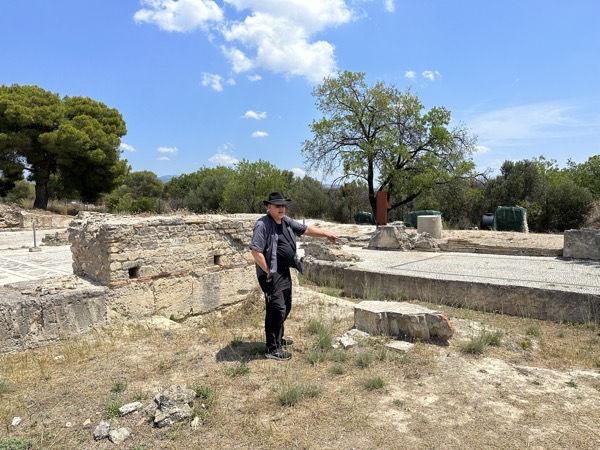
It is also important to note that our work is an extension of Tim Gregory’s work on this material and we leaned heavily on his notes and publications. His 1993 publication of “Slavic ware” in The Corinthia in the Roman Period was a seminal point of departure as was his 1995 preliminary report on the Roman Bath at Isthmia.
Here’s what Richard Rothaus and I put together after a single season of study at Isthmia. It’s all provisional, of course, but at least offers a bit of insight into our methods and thoughts.
Features
Room I and II Surface (72-MMO)
This surface sits astride Rooms I and II to the south of the Hexamilion Wall and the north wall of the bath. This surface runs atop the wall of the bath that separates Room I and Room II. The level of MMO-003 which produced a large quantity of Slavic and various 7th-century material with no material dating necessarily to later than the 7th-century. It is atop two levels that are closer to the floor level: MMO-004, MMO-005. The former is a complete vessel (IPR 72-049 dates to the mid to third quarter of seventh century [Hammond no. 362]) that is part of MMO-005 which is largely Late Roman date. These levels do not feature any Slavic ware. Beneath this floor level is a fill MMO-008 which has joins with level MMO-021 (IPR 72-069). This suggests that these two levels are from the same depositional event and presumably dates to the Late Roman period (e.g. pre-7th century). MMO-021 is part of Wohl’s “lamp deposit” and appears to post date the abandonment of the bath and apparently the collapse or robbing of the wall between Room I and Room II of the bath.
Room III Hard Packed Surface / Concrete Floor (72-BBO, 76-MSO)
A concrete floor was uncovered by the excavators in Room III. Associated with this concrete floor was a water pipe and a pit and fire feature. The concrete floor sits above a layer of bath destruction fill and debris. This concrete floor is the only such constructed surface associated with the Early Byzantine period. The date of the construction of the concrete floor is unknown. We suggest that it is most likely a use surface associated with the Hexamilion or its construction then adopted for Early Byzantine use, rather than a construct associated with the Early Byzantine settlement which shows no other uses of concrete or mortar. But see Room V surface below.
Room IV Apsidal Structure and Surface (72-BBO)
In 1972, excavators revealed an apsidal structure and associated surface in Room IV in the northwest corner of the Roman bath in trenches 72-3 and 72-5. The apsidal structure appeared under a layer of bath collapse debris (BBO-002) and approximately 1.5 m above the original floor of the room which appeared beneath level BBO-007. The apsidal building itself appeared beneath level BBO-002; finds from this level have been lost.. The lots associated with the apsidal structure itself BBO-003 produced an assemblage of 7th-century pottery include a Slavic ware rim (IPB-72-050), a handle and base from a Group N pitcher, and a micaceous cookpot rim. The Group N and micaceous cookware rim are unfortunately lost, but some additional material associated with the surface on which this structure stands remains available for analysis.
This structure sits on a series of levels (BBO-004 and BBO-007) associated with the abandonment and presumably collapse of the bath in this area (perhaps associated with the construction of the Hexamilion Wall against the north wall of the bath). This level was cut by a pit excavated as BBO-005 which contains Slavic material, a Group N base, and a 7th century amphora. This suggests that this pit (and the level of BBO-004) should be associated with the apsidal structure at BBO-003 which produced contemporary pottery. The Early Byzantine use levels are built on Roman Bath destruction levels; in the southeastern area of the bath (e.g. Room VIII), the Early Byzantine use levels are built directly on Roman Bath floor level, albeit after cleanup of collapse.
Surface in Room V (72-RBA)
The western plunge-pool in Room V in the northwestern corner of the bath produced a surface level that was not obviously associated with any architectural features. The level in this area was over 0.50 m lower than the surface associated with the apsidal building in Room IV. Despite this difference, the two surfaces produced similar assemblages of pottery. Two levels RBA-027 and RBA-028 should probably be combined and associated with the surface in Room V. They produced a significant assemblage of 7th century material including Group N, micaceous cooking pot rims, and a 7th-century amphora. A complete pitcher with a spout was found on the floor surface in RBA-028 (IPB 72-024 dating to the middle or third quarter of the 7th [Slane and Sanders, 4-37]). Excavation below this surface (RBA-029) which included additional examples of Slavic ware and Group N as well as Late Roman and Early Roman material. The presence of a complete vessel on this surface strongly suggests that this was an active seventh century surface. Excavators refer variously to a hard packed surface and a concrete floor.
Room VIII Apsidal Structure (78-MMT) and E-Shaped Feature (77-CSS)
The best concentration of “Slavic” features appears in Room VIII which stands immediately to the east of the hypocaust room and to the south of the room VI with its monochrome mosaic floor. At some point during the final phases of the bath’s use, a clay floor was installed in this room at the same level as the mosaics in room VI and Room VII further east. The robbing out of the room’s east wall, perhaps in conjunction with the construction of the Hexamilion wall occurred at some point after the bath goes out of use. An alternative hypothesis is that the east wall collapsed and material was removed about the time of Hexamilion construction. Subsequently, with the room (and its neighbor room VII) being exposed to the elements, a thin red fill covers the clay floor, the robbing trench of the east wall, and the floor of Room VII. It seems likely that the tile roof of Room VI was also removed prior to the development of his red earth fill because there was no sign of a tile scatter on the floor of the room.
In 1977 and 1978 excavations in Room VIII revealed a small apsidal structure and an “e-shaped” feature build against the west wall of Room VIII. Both of these features were constructed on the red fill level and assumed to be roughly contemporary.
Material from the red layer in trench 77-5 near the e-shaped feature (77-CSS-041,-046, -047) is predominantly Late Roman in date with the latest sherds being LR finewares (PHW, CRS), amphoras, and cooking pots, with some joins between sherds collected in basket 041, 046, and 047. In trench 78-5 in association with the apsidal structure (78-MMT-023) dates slightly later with an assemblage of 7th century pottery including an almost complete slavic ware cooking pot (IPB 78-001), a largely complete mica ware rim (IPB 78-002), and several other slavic ware rims (IPB 78-002 and 78-003) and bodysherds. The presence of a largely complete vessel (IPB 78-001) would seem to indicate that the red fill level was a use level associated with the apsidal structure.
South of Room VIII and XII Apsidal Structure and Surface (2004-01/02)
In 2004, an apsidal or circular structure appeared in two trenches excavated at the southwestern corner of the Roman bath immediately to the south of Rooms VIII and XII. The structure appears to be beneath a level of fill (13-069) which produced a piece of sgraffito ware (IPB 04-004) which may well date the level to after the 10th century. A level associated with the circular structure (13-070) produced late micaceous cooking pots commonly associated with 7th century assemblages. To the west of this basket is a level that excavates a hard grey soil that may well have represented a surface although there is no way to connect this with the structure in 13-070 nor does it appear to be at the same level. In fact, 13-071 appears to be approximately 0.50 m higher in elevation. Notwithstanding the difference in elevation, level 13-071 produced Slavic pottery and more micaceous cooking pot fragments indicating, it would seem, a depositional date of the 7th century or later.
Room IX collapsed floor levels (77-EJW)
The Early Byzantine finds in this room are of interest mostly because they illuminate the Roman Bath collapse sequence in the area. While rather coarse in their stratigraphic divisions, 77-EJW-095, 77-EJW-096, and 77-EJW-097 capture a full stratigraphic sequence for the collapse of Room IX, a hypocaust caldarium. Notebook EJW does not record stratigraphy in particular detail, but there are meticulous scarp drawings in the weekly report folder. These, keyed to notebook comments, allow for reconstruction of a sequence. As noted above, the east wall of the Roman Bath was removed and Rooms VIII and VII were clean and open-air as the roofs had been removed. The east wall of room IX was thus the functional east wall of the bath in this area. Prior to the collapse of its roof, the marble floor of the room had been removed, leaving only the mortar bedding. It has been suggested that this was part of a never-completed late renovation of the bath, but we suggest it is also possible the floor may have been removed for lime kilns associated with the Hexamilion. Regardless, there was no marble floor in the Room during the Early Byzantine period, but the room had a roof and mortar floor.
During the Early Byzantine period there was a small layer of ash on the floor of the hypocaust chamber, from the final uses of the bath. Also in the hypocaust chamber was the Red Earth deposition horizon associated with the early Byzantine period, lending some credence to our hypothesis that the horizon is aeolian in nature. When the roof of Room IX collapsed it punched through the mortar floor and pushed into the hypocausts. The presence of the mortar floor presumably helped slow the collapse enough, however, that most of the hypocaust stacks survived, while the mortar floor was demolished, and was noted only by fragments and traces in the wall. This collapse filled in the lower strata, which contained Early Byzantine material. Whether this material was on the mortar floor, or on the floor of the lower hypocaust chamber is unclear.


Comments