


The Adjacent World: Archaeology Version
I’m in a School of Archaeology and Ancient History, which means for the forthcoming presentation I could be giving a talk to people with no background in ancient history. Indeed, it is possible that if there’s a member of the ancient history staff off sick, that there’ll be no classicists at the talk. On the other hand there’s very likely going to be some industrial and historical archaeologists. Another idea I have sitting on the hard-drive ties in with this. I was thinking about working on it properly and taking it to CHAT last year for the neo-colonialism session, but decided I didn’t have the time to finish it properly. Like yesterday’s presentation it’s still unfinished, but I could use the seminar to see what other people engage with in the talk. I assume there’ll be some things that I raise that have been done to death in recent years, so I could spend my time fleshing out the interesting parts of the talk.
I first became aware of the archaeological relationship with space heritage when a poster I’d worked on was assigned to the ‘Heavens Above’ session at the World Archaeological Congress. Half of Heavens Above was archaeoastronomy, the other half was space heritage and my first reaction was that the space heritage crowd were a bunch of nutters (yes I know pot / kettle / black). It wasn’t an uninteresting topic, but I wasn’t sure what archaeology could bring to the topic that space historians weren’t already providing. I thought it’d be rather like trying to reconstruct Elvis records from shards found in buildings simply because they qualify as historic artefacts under 50 year rolling heritage acts.
My opinion changed radically when I actually heard what they were saying and thought about what they were doing. I’ve mentioned earlier that I find Alice Gorman’s work thought provoking paper The cultural landscape of interplanetary space, which tackles things like the effect of the spaceports on local populations, like the aboriginals who were affected by Woomera. I also thought that John Campbell was eloquent when he compared the footprints of the Apollo XI team to the footprints at Laetoli. Tranquillity Base satisfies more or less every requirement of being a World Heritage site bar the fact it’s not on this world. Greg Fewer has made an analogy between nearly inaccessible exploration sites of the 19th century and their modern use as tourist sites. A century ago Mount Everest was inaccessible, these days people go there for a picnic, well almost. If Richard Branson gets his way there’ll be a moonbase in a couple of decades. If something of value is found to be easily accessible it may be sooner. For instance how much money do you think De Beers would pump into a space programme if a rich and accessible seam of diamonds were located?
I’m tackling the archaeology of Mars because there’s far too much information about the moon for me to produce a quick presentation. This is work-in-progress and the work at the moment isn’t about finding answers, it’s working out what the interesting questions are. And they’re not all questions for the future. Some are about how we construct the idea of heritage in the present. However, after putting this up, I think the topic is simply too big so you could just scroll down to the first comment to get the highlights.

When does something become heritage? I mentioned earlier that if we rigidly stick to the principle that everything over 50 years old is heritage then next year archaeologists will be painstakingly fitting sherds of vinyl back together to try and discover what exactly Elvis thought the hound dog was doing. Cryin’ all the time is the favoured explanation though some experts like Clapton (1989:6) argue that it has in fact been snoopin’ round my door. I think that would horrify contemporary archaeologists if I thought they’d consider that a serious aim.
I think there are many modern constructions that are of historical importance and political importance that should be studied and that raise questions that historical records alone cannot answer. An example would be the Berlin Wall which has a huge emotional and social resonance which should not be ignored. Does that extend to protecting what remains of it? It’s easy for me to say yes, but I never lived on the wrong side of it. Space heritage, like the Berlin Wall is a product of the Cold war. It occupies a historical limbo; too recent to be heritage yet nevertheless part of an era which is now over.
As an example of the loss of heritage, New Zealand is appealing for help in preserving Scott’s cabin. On the other hand the building where Britain’s only cosmonaut conducted her experiments was demolished because no-one was willing to pay to lift Mir into a higher orbit. Rather than have the station crash at random, it was deliberately brought down into the Pacific. There are differences. In a higher orbit Mir would have required much less conservation than Scott’s hut. It was the site of much more than one historic event, many of them successes, which I realise isn’t something British. We seem to be putting a lot of faith in preservation by record.
There’s so much more that could be said of orbital heritage, so I’m going to look somewhere where there’s a lot less data but, being at Leicester University, is close to home. Mars.
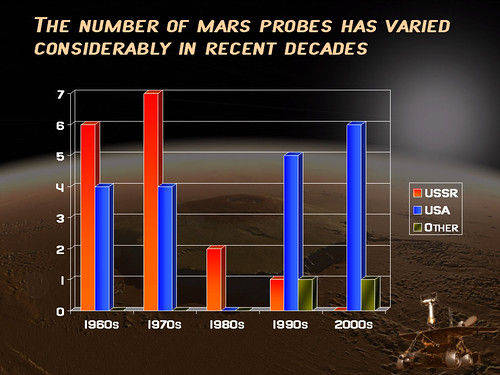
The figures include the planned Phoenix mission for 2007 and the Mars Science Laboratory for 2009, both by NASA. Broadly speaking, the graph shows that people tend to go to Mars at the same time. When Mars Express arrived in 2003 there was almost a queue to get into orbit of Mars. Spirit and Opportunity were arriving and Nozomi was having another go at getting there. One reason is that the vagaries of orbital mechanics mean that there are good times to launch your orbiter and bad times to do it.

The best time is about 240 days before you want your probe to cross Mars’s orbit. This allows the probe to fly in what is called a Hohmann orbit which is the most energy efficient way to travel from one orbit to the next. That could be done at any time, but obviously if you want to probe to reach Mars you have to make sure Mars is going to be there when you arrive. This will happen for a short period around every 26 months. The wider you make the launch window the more energy you need. In addition Mars’s orbit is rather elliptical so some launch windows are better than others, because you’re not travelling as far out from the Sun to reach Mars. Therefore you would expecting some clustering of arrivals, but that can’t explain all the similarities.

Exploration of Mars didn’t start with Mariner 4 though. Some of the earliest surveys of Mars were archaeological surveys, spurred on by a mistranslation of Giovanni Schiaparelli’s word canali to describe the channels he’d seen on Mars. This was taken up with gusto by some astronomers who sought to map the canals built by the Martians. The canals were an optical illusion, but many of the features weren’t. What do you call the features on a planet if you want to do the job properly? On Mars the highest mountain it’s Olympus Mons. Mars was originally littered with names from the classics. There’s an Elysium Planitia, which is a type of plain and an Eos Chasma, a type of depression. There’s much more inclusiveness in the names these days. For instance there’s now a feature recognised as Mawrth Vallis, Mawrth being the Welsh for Mars. These labels aren’t simply topographical, they reflect how people are thinking out the relationship between their world and the rest of society.
I mentioned that the highest mountain was Olympus Mons. This was a bit of a lucky guess. Originally it was Nix Olympica, due to the reflectivity of the surface. It wasn’t known to be a mountain. The information came in the 1960s.

When I was first laying out the slides I was quite sniffy about the achievement of getting the Mariner probes to fly by Mars. Technologically, I think it’s a huge achievement. It provided lessons that would make the scientifically successful missions possible. But were they themselves scientifically important? My initial view was that there was a closer look at Mars with the Mariner probes, but it was an improvement in quality of information not new data. Fortunately I remembered to check the press releases, and I think looking at the equipment it’s hard not to conclude that even the first probe to arrive, Mariner 4 represented a huge leap.
The TV camera isn’t something I can get over excited about, but perhaps I should talk to someone in the space science section to find out why I should. Looking at the other equipment they yield a huge amount of data which was previously unattainable. I think I was going down the wrong path because I was thinking that because there’s no archaeological trace of the mission around Mars, there was only limited interaction between the probe and planet.
To some extent it may be difficult to tease out the importance of the individual probes as they were following quite rapidly one after another in this period. I think if I’m going to pursue this I’ll need to read a few pre ’64 books on Mars and then talk with a geologist or astronomer to see what unknowns the instruments on the early Mariners could answer. It’s a fairly narrow of window of history to look at because I think the 1970s do create a massive difference in how we think about Mars.

In 1971 Mariners 8 and 9 were launched. Mariner 8 failed, but Mariner 9 was put into orbit of Mars. This proved handy because when Mariner 9 arrived there was a planet-wide dust storm obscuring the surface features. This was followed by the Viking missions which arrived in 1976. The orbiters contributed massively to the understanding because they turned what were surface features into three dimensional topography. The Vikings also carried an extra payload which I think alters our impression of Mars.

The Viking mission is most famous for the landers. For the first time Mars ceased to be a Platonic globe hanging in space and became place. The landers are interesting for all sorts of reasons but what strikes me is that they’re probably the weirdest prospection tools in existence.
One of the features of industrial archaeology is that often what you’re examining is visible. In the case of mineworks there are visible scars on the landscape from hydraulic mining. The purpose of prospecting is to remove all the stuff that’s between you and what you want to find. The Viking landers were prospecting for life. From the NASA archives I find “The landing rockets used an 18 nozzle design to spread the hydrogen and nitrogen exhaust over a wide area. It was determined that this would limit surface heating to no more than 1 degree C and that no more than 1 mm of the surface material would be stripped away.” I can’t help but think I’ve misread or misunderstood that. These days Mars landers arrive in big bubbles which bounce over the landscape. Just 1mm of surface material lost due to thrust?
Certainly the Viking Mission did take contamination extremely seriously. When it became obvious the Viking I orbiter would fail, it was boosted into a orbit to keep it from crashing into Mars for the near future. I would have thought that if Martian meteorites can land on Earth then Terran meteorites could contaminate Mars, but that’s a different discussion. The Viking I orbit was deemed safe till 2019. I think this indicates what NASA thought its plans for the near future were likely to be and where it saw itself in the 2000s. Which is ironic given the decade that followed.

As the graph earlier on showed the 1980s were a barren period for Mars probes. The USSR sent a couple in the mid-eighties, but both failed. The USA sent nothing. As far as unmanned exploration goes, the Voyager probes were both huge successes. Galileo was in preparation for a mission to Jupiter in the 1990s. It’s more a sign of a keen interest elsewhere. It could be interpreted at scientists simply becoming bored with Mars when the Viking results showed if life exists on Mars, it won’t be easy to find. Instead I’d argue that one major factor was the need to dominate near space. The USSR was building a space station in orbit. The USA were launching the Space Shuttle in an attempt to bring the cost of travelling to Earth orbit closer. The ESA were making advances with Ariane so the eighties were a period of competition in a very visible arena above the Earth.
When NASA returned to Mars in the 1990s it was after two decades. There was a probe sent in 1992, the Mars Observer, but that was lost as it arrived at Mars. The first successful mission of the 90s was the Mars Global Surveyor which, I think, is still operational. Predicably given the twenty year gap, it single-handedly returned more data than all the previous probes put together.
The follow-up probe was also a success. Pathfinder was a lander, with a passenger, Sojourner. The Viking landers were stuck where they were. So was Pathfinder, but Sojourner, which looked like a coffee table on wheels, was mobile and able to prod interesting bits of the landscape. That meant that interesting bits of the landscape were suddenly in need of names. Once again the scientists turned to the classics.

I think this speaks volumes about the change in the culture of education. I don’t mean that in a Daily Mail reader kind of way. I’m not convinced early Mars features were all named in an attempt to impress the reader with the astronomer’s erudition. The classics were familiar to those who went university. Times have changed and the people who go to university have changed. The classics simply aren’t part of the educated consciousness that they were. I should also point out even the universities have changed. Even Oxford accepts that good Latin isn’t essential to study astrophysics. I’d like to read more about the naming of these features. I wonder if they were chosen to avoid sounding too earnest. The features named are all trivial. It’s hard to get a sense of scale but Sojourner by Yogi is about yay big (you’ll have to imagine how far I have my hands apart).
There’s also an increasing specialisation of probes. The Mars Climate Orbiter and Polar Lander were both launched. They both failed and I think that may have an effect on the direction of Martian Exploration.
It’s not as easy to identify different phases of exploration after the 1980s as it is before it. I think Mariner 9 marked a big change as did the Viking landings. The exploration in the post 1980s period is much more continuous. The Mars Global Surveyor has overlapped with Mars Odyssey and will should be active when the Mars Reconnaissance Orbiter arrived. It’s a cliché but the post 1980s exploration appears to be more evolution than revolution. But I’m willing to say that the MRO will possibly mark another change for Mars.
The MRO has several functions. Reconnaissance is the obvious primary objective. Like many probes it’s multi-functional and but this time the additional functions are colonial rather than scientific. The MRO is to act a bit like a lighthouse to help guide future craft in. It’s also supposed to be the foundation of a Martian internet. From an archaeologist’s point of view it’s a tragedy that it won’t be receiving a companion. In 2009 the Mars Telecommunications Orbiter was due to be launched. The MTO definitely was colonising equipment because it’s primary function was to act as a communicator between other Mars probes and Earth. I think that would have made it the first craft whose primary task was to be a communications satellite away from Earth. I assume a lot of what the MTO would have done will fall on the MRO.
Where does this lead archaeologically speaking?
My first thought is that terrestrial models of colonisation of new territories will be inadequate for future colonisation. At the moment we talk of waves of advance or arterial routes into new territories. At the moment Mars landings are points. You could draw a line describing the travels of the Mars Exploration Rovers, but really they’re just moving points. As new site get explored the fact that the probes will be arriving from orbit realistically also going to be points. Two dimensional mapping will be confusing.
Another idea is that Lunar or Martian colonisation will pose problems for how we think about human movement into a landscape. Chris Gosden talks about two models colonisation within a shared milieu, or ‘terra nullius’ where you ignore the inhabitants. But with Mars if there are Martians they’re most likely to be microbes living in the deep biosphere. The moon is certainly ‘terra nullius’. Or at least from the lunar surface it is. A spread of lights on the dark face of the New Moon will almost certainly have implications for terrestrial observers.
Are the Martian probes going to act as a theoretical society without messy human frailties to spoil grand theories of how social agents interact? It is tempting to see robotic explorers as immune from the environment, but mechanical failures will show this in not the case. Indeed the Mars rovers have lasted as long as they have because the environment is working to scrub clean their solar panels. It is tempting to see the probes as gestalt entities which will represent the consensual desires of their operators. It could lead to many weird and wonderful theories of interaction, how weird will they get and how will you sort the plausible from the false? Mars and the Moon will have processes that can be observed.
If Archaeology is a science, and I’m not convinced it is, but if it is, then it is a historical science. The great lament is that we cannot go back and observe the processes which lead to the creation of the archaeological record. Now we can. We can observe the process of how resources are acquired in a new environment. I think it would be foolish to then drop these theories wholesale on to terrestrial societies, say to explain the Palaeoindian colonisation of the Americas. However, by examining where the processes break down and think about why they break down then you can show learn something of what it is that is special about humans. We can discover ways in which we act which are not machine-like.
This again is work-in-progress and much of the work is finding the interesting questions. I’m willing to bet that there will be questions of great importance in the future which we simply won’t be able to frame in the present because we lack perspective, but what we do have is the material culture. This is my final point. How many questions can’t we answer about the past because the evidence is simply not there. I think we need to think archaeologically about this because we need to recognise the heritage value of this equipment. Already there will be questions about Mir that we cannot answer. I’m not suggesting that we storm Darmstadt and install archaeologists to man the Mars Express mission, but we should recognise when the mission expires that it is a significant piece of shared European heritage and we should try and do the best we can to conserve it. In this instance space is an ally because it is an excellent medium for storing materials in. It might seem like a novelty but I think potentially Exo-archaeology could be an excellent way to reflect on what archaeology is and what it can do.
Clapton, E. 1989. Journeyman. Warner. —–


Comments