


The Aryans – The origin of the Civilization in Mesopotamia – and the rest of the world – The origin of Mitra/Jesus



–
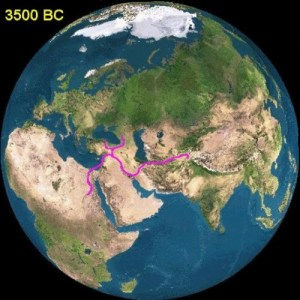
The Kura–Araxes culture or the early trans-Caucasian culture, was a civilization that existed from 3400 BC until about 2000 BC, which has traditionally been regarded as the date of its end, but it may have disappeared as early as 2600 or 2700 BC.
The earliest evidence for this culture is found on the Ararat plain; thence it spread to Georgia by 3000 BC (but never reaching Colchis), and during the next millennium it proceeded westward to the Erzurum plain, southwest to Cilicia, and to the southeast into an area below the Urmia basin and Lake Van, and finally down to the borders of present day Syria.
The name of the culture is derived from the Kura and Araxes river valleys. Its territory corresponds to parts of modern Armenia, Georgia, Azerbaijan, Chechnya, Dagestan, Ingushetia and North Ossetia. Altogether, the early Trans-Caucasian culture, at its greatest spread, enveloped a vast area approximately 1,000 km by 500 km.
Their pottery was distinctive; in fact, the spread of their pottery along trade routes into surrounding cultures was much more impressive than any of their achievements domestically. It was painted black and red, using geometric designs for ornamentation. Examples have been found as far south as Syria and Israel, and as far north as Dagestan and Chechnya.
The spread of this pottery, along with archaeological evidence of invasions, suggests that the Kura-Araxes people may have spread outward from their original homes, and most certainly, had extensive trade contacts. It may have given rise to the later Khirbet Kerak ware culture found in Syria and Canaan after the fall of the Akkadian Empire. Jaimoukha believes that its southern expanse is attributable primarily to Mitanni and the Hurrians.
Mitanni (Hittite cuneiform KUR URUMi-ta-an-ni, also Mittani Mi-it-ta-ni) or Hanigalbat (Assyrian Hanigalbat, Khanigalbat cuneiform Ḫa-ni-gal-bat) was an Hurrian-speaking state in northern Syria and south-east Anatolia from ca. 1500 BC–1300 BC.
Founded by an Indo-Aryan ruling class governing a predominately Hurrian population, Mitanni came to be a regional power after the Hittite destruction of Amorite Babylon, and a series of ineffectual Assyrian kings created a power vacuum in Mesopotamia.
At the beginning of its history, Mitanni’s major rival was Egypt under the Thutmosids. However, with the ascent of the Hittite empire, Mitanni and Egypt made an alliance to protect their mutual interests from the threat of Hittite domination.
At the height of its power, during the 14th century BC, it had outposts centered around its capital, Washukanni, whose location has been determined by archaeologists to be on the headwaters of the Khabur River. Their sphere of influence is shown in Hurrian place names, personal names and the spread through Syria and the Levant of a distinct pottery type.
“This kingdom was known as the Maryannu (Aryans), Nahrin (which became Armenia) or Mitanni (Mitra and king Mita) to the Egyptians, Hurri to the Hittites and Hanigalbat to the Assyrians. All three names were equivalent and interchangeable”, asserted Michael C. Astour. Hittite annals mention a people called Hurri (Ḫu-ur-ri), located in northeastern Syria.
Maryannu is an ancient word for the caste of chariot-mounted hereditary warrior nobility which dominated many of the societies of the Middle East during the Bronze Age. The term is attested in the Amarna letters written by Haapi. Robert Drews writes that the name ‘maryannu’ although plural takes the singular ‘marya’, which in Sanskrit means young warrior, and attaches a Hurrian suffix. He suggests that at the beginning of the Late Bronze Age most would have spoken either Hurrian or Aryan but by the end of the 14th century most of the Levant maryannu had Semitic names.
A Hittite fragment, probably from the time of Mursili I, mentions a “King of the Hurri”, or “Hurrians”. The Assyro-Akkadian version of the text renders “Hurri” as Hanigalbat. Tushratta, who styles himself “king of Mitanni” in his Akkadian Amarna letters, refers to his kingdom as Hanigalbat.
Egyptian sources call Mitanni “nhrn”, which is usually pronounced as Naharin/Naharina from the Assyro-Akkadian word for “river”, cf. Aram-Naharaim.
The ethnicity of the people of Mitanni is difficult to ascertain. Some theonyms, proper names and other terminology of the Mitanni are considered to form (part of) an Indo-Aryan superstrate, suggesting that an Indo-Aryan elite imposed itself over the Hurrian population in the course of the Indo-Aryan expansion. Archaeologists have attested a striking parallel in the spread to Syria of a distinct pottery type associated with what they call the Kura-Araxes culture.
A treatise on the training of chariot horses by Kikkuli contains a number of Indo-Aryan glosses. Kammenhuber (1968) suggested that this vocabulary was derived from the still undivided Indo-Iranian language, but Mayrhofer (1974) has shown that specifically Indo-Aryan features are present.
The names of the Mitanni aristocracy frequently are of Indo-Aryan origin, but it is specifically their deities which show Indo-Aryan roots (Mitra, Varuna, Indra, Nasatya).
The common people’s language, the Hurrian language, is neither Indo-European nor Semitic. Hurrian is related to Urartian, the language of Urartu, both belonging to the Hurro-Urartian language family. It had been held that nothing more can be deduced from current evidence. A Hurrian passage in the Amarna letters – usually composed in Akkadian, the lingua franca of the day – indicates that the royal family of Mitanni was by then speaking Hurrian as well.
Eventually, Mitanni succumbed to Hittite and later Assyrian attacks, and was reduced to the status of a province of the Middle Assyrian Empire.
It has been suggested by early 20th century Armenologists that Old Persian Armina and the Greek Armenoi are continuations of an Assyrian toponym Armânum or Armanî. There are certain Bronze Age records identified with the toponym in both Mesopotamian and Egyptian sources.
Another mention by pharaoh Thutmose III of Egypt in the 33rd year of his reign (1446 BC) as the people of Ermenen (Armenians), and says in their land “heaven rests upon its four pillars”. The earliest depictions of swastika is found in Armenia and is dating back to the Neolithic Period of human cultural evolution, around 7000-5000 BC.
Swastikas, solar disks, sacred bulls and trees of life are common Indo-European symbols which were found in Armenian Highlands as well, some of them date back to 10,000 BC.
Originally they are known as Arevkhatch, Cross of the Sun (or Kerkhatch, “ker” meaning curved or turned and “khatch” meaning cross ). It represents time, recurrence, universe and the eternal motion of life. There are variations with 4,6,9, and 12 petals, but the most common is the use of the 8, representing eternity.
As one of the most common and sacred symbols of Armenian culture, the Wheel of Eternity stemmed from worship of the sky and the sun. It shares a common origin with the swastika, known as the sun wheel or cross symbol. Absorbed into Christian culture, the symbol became as sacred as the Holy Spirit and was used on nearly every Armenian Christian design.
Aleppo has scarcely been touched by archaeologists, since the modern city occupies its ancient site. The site has been occupied from around 5000 BC, as excavations in Tallet Alsauda show. Aleppo had cultic importance to the Hittites for being the center of worship of the Storm-God.
Aleppo appears in historical records as an important city much earlier than Damascus. The first record of Aleppo comes from the third millennium BC, when Aleppo was the capital of an independent kingdom closely related to Ebla, known as Armi to Ebla and Armani to the Akkadians. Giovanni Pettinato describes Armi as Ebla’s alter ego. Naram-Sin of Akkad destroyed both Ebla and Armani in the 23rd century BC.
The toponym A-ra-mu appears in an inscription at Ebla listing geographical names, and the term Armi, which is the Eblaite term for nearby Aleppo, occurs frequently in the Ebla tablets (ca. 2300 BC). One of the annals of Naram-Sin of Akkad (c. 2250 BC) mentions that he captured “Dubul, the ensi of A-ra-me” (Arame is seemingly a genitive form), in the course of a campaign against Simurrum in the northern mountains. Other early references to a place or people of “Aram” have appeared at the archives of Mari (c. 1900 BC) and at Ugarit (c. 1300 BC).
There is little agreement concerning what, if any, relationship there was between these places, or if the Aramu were actually Arameans; the earliest undisputed mention of Arameans as a people is in the inscriptions of Tiglath Pileser I (c. 1100 BC).
The origin of the Arameans is still uncertain, arising from the limited amount of evidence regarding the mention of Arameans in Mesopotamian inscriptions. Nomadic pastoralists have always been a feature of the Middle East, but their numbers seem to vary according to climatic conditions and the force of neighbouring states inducing permanent settlement.
The Arameans conquered, during the 11th and the 10th centuries, Sam’al (Zenjirli), also known as Yaudi (The Kingdom of Judah), the region from Arpad to Aleppo which they renamed Bît-Agushi, and Til Barsip, which became the chief town of Bît-Adini, also known as Beth Eden. At the same time, Arameans moved to the east of the Euphrates, where they settled in such numbers that the whole region became known as Aram-Naharaim or “Aram of the two rivers”.
The most ancient settlement of Jerusalem, founded as early as the Bronze Age on the hill above the Gihon Spring, was according to the Bible named Jebus. Called the “Fortress of Zion” (metsudat Zion), it was renamed by David as the City of David, and was known by this name in antiquity.
According to the Hebrew Bible, the Jebusites were a Canaanite tribe who inhabited and built Jerusalem prior to its conquest by King David according to the Biblical account; the Books of Kings state that Jerusalem was known as Jebus prior to this event. According to some Biblical chronologies, the city was conquered by King David in 1003 BC, or according to other sources 869 BC.
The Hebrew Bible (Tanakh) contains the only surviving ancient text known to use the term Jebusite to describe the pre-Israelite inhabitants of Jerusalem; according to the Table of Nations at Genesis 10, the Jebusites are identified as a Canaanite tribe, which is listed in third place among the Canaanite groups, between the biblical Hittites and the Amorites.
In the Amarna letters, mention is made of the contemporaneous king of Jerusalem was named Abdi-Heba, which is a theophoric name invoking a Hurrian goddess named Hebat; unless a different ethnic group occupied Jerusalem in this period, this implies that the Jebusites were Hurrians themselves, were heavily influenced by Hurrian culture, or were dominated by a Hurrian maryannu class.
Hebat, also transcribed Kheba or Khepat, was the mother goddess of the Hurrians, known as “the mother of all living”. She is also a Queen of the gods. She is the wife of the Hurrian god of sky and storm Teshub and the mother of Sarruma, meaning “king of the mountains”, and Alanzu, as well mother-in-law of the daughter of the dragon Illuyanka.
Teshub is depicted holding a triple thunderbolt and a weapon, usually an axe (often double-headed) or mace. The sacred bull common throughout Anatolia was his signature animal, represented by his horned crown or by his steeds Seri and Hurri, who drew his chariot or carried him on their backs.
The mother goddess is likely to have had a later counterpart in the Phrygian goddess Cybele. In Aramaean times she appears to have become identified with the Goddess Hawwah.
With Hebat was later assimilated the Hittite sun goddess Arinniti. A prayer of Queen Puduhepa makes this explicit: “To the Sun-goddess of Arinna, my lady, the mistress of the Hatti lands, the queen of Heaven and Earth. Sun-goddess of Arinna, thou art Queen of all countries! In the Hatti country thou bearest the name of the Sun-goddess of Arinna; but in the land which thou madest the cedar land thou bearest the name Hebat.”
Hebrews is an ethnonym used in the Tanakh (Hebrew Bible). It is mostly taken as synonymous with the Semitic Israelites, especially in the pre-monarchic period when they were still nomadic, but in some instances it may also be used in a wider sense, referring to the Phoenicians, or to other ancient groups, such as the group known as Shasu of Yhw on the eve of the Bronze Age collapse.
By the Roman era, Greek Hebraios could refer to the Jews in general, as Strong’s Hebrew Dictionary puts it “any of the Jewish Nation” and at other times more specifically to the Jews living in Judea.
The Ahlamû (= wanderers) are first mentioned in the el-Amarna letters alluding to the king of Babylon; the presence of the Ahlamû are also attested in Assyria, Nippur and even at Dilmun (Bahrain); Shalmaneser I (1274-1245 BC) defeated the Shattuara, King of Mitanni and his Hittite and Ahlamû mercenaries are mentioned in the Jazirah. The term appears equivalent to the Egyptian term Shasu (Shsw = wanderer), who replaced the outlaw ‘Apiru (cuneiform SA.GAZ) as the major source of instability in the Egyptian Levantine empire from the reign of Tutankhamun onwards.
For the first time, an inscription of Tiglath-Pileser I (1115-1077 BC) refers to the “Ahlamû-Aramaeans” (Ahlame Armaia) and shortly after, the Ahlamû rapidly disappear from Assyrian annals, to be replaced by the Aramaeans (Aramu, Arimi). “Ahlamû-Aramaeans” would consider the Arameans as an important and in time dominant faction of the Ahlamû tribes.
The black and red ware culture (BRW) is an early Iron Age archaeological culture of the northern Indian subcontinent. It is dated to roughly the 12th – 9th century BCE, and associated with the post-Rigvedic Vedic civilization.
In some sites, BRW pottery is associated with Late Harappan pottery, and according to some scholars like Tribhuan N. Roy, the BRW may have directly influenced the Painted Grey Ware and Northern Black Polished cultures.
Indo-Aryan migration into the northern Punjab is contemporaneous to the final phase of the decline of the Indus-Valley civilization (IVC). Many scholars have argued that the historical Vedic culture is the result of an amalgamation of the immigrating Indo-Aryans with the remnants of the indigenous civilization, such as the Ochre Coloured Pottery culture. Such remnants of IVC culture are not prominent in the Rigveda, with its focus on chariot warfare and nomadic pastoralism in stark contrast with an urban civilization.
Urartu, corresponding to Kingdom of Ararat or Kingdom of Van was a prehistoric Iron Age Armenian kingdom centred around Lake Van in the Armenian Highlands. The kingdom’s native name was Biainili, also spelt Biaineli, but prior to the 8th century BC, they also called their now united kingdom “Nairi”. The Nairi, an Iron Age people of the Van area, are sometimes considered related or identical.
Scholars such as Carl Friedrich Lehmann-Haupt (1910) believed that the people of Urartu called themselves Khaldini after their god Khaldi.
The short-lived 11th dynasty of the Kings of Babylon (6th century BC) is conventionally known to historians as the Chaldean Dynasty.
Chaldea, or Chaldæa, was a marshy land located in south eastern Mesopotamia which came to rule Babylon briefly. Tribes of Semitic settlers who arrived in the region from the 10th Century BC became known as the Chaldeans or the Chaldees.
The homeland of the Semitic Chaldean people was in the far south east of Mesopotamia. It is not certain when they migrated at an unknown period into the country of the Mesopotamian sea-lands about the head of the Persian Gulf. They seem to have appeared there at about the same time that other new Semitic peoples, the Arameans and the Sutu appeared in Babylonia, c. 1000 BC. This was a period of weakness in Babylonia, and its ineffectual kings were unable to prevent new waves of peoples invading and settling in the land.
Though belonging to the same Semitic ethnic group, they are to be differentiated from the Aramean stock; and the Assyrian king Sennacherib, for example, is careful in his inscriptions to distinguish them. When they came to possess the whole of southern Mesopotamia, the name “Chaldean” became synonymous with “Babylonian”, particularly to the Greeks and Jews.
Neo-Babylonian rulers were deeply conscious of the antiquity of their heritage, and pursued an arch-traditionalist policy, reviving much of their ancient Sumero-Akkadian culture. Even though Aramaic had become the everyday tongue, Akkadian was restored as the language of administration and culture. Archaic expressions from 1,500 years earlier were reintroduced in Akkadian inscriptions, along with words in the now-long-unspoken Sumerian language. Neo-Babylonian cuneiform script was also modified to make it look like the old 3rd-millennium BC script of Akkad.
Ancient artworks from the heyday of Babylonia’s imperial glory were treated with near-religious reverence and were painstakingly preserved. For example, when a statue of Sargon the Great was found during construction work, a temple was built for it—and it was given offerings. The story is told of how Nebuchadnezzar in his efforts to restore the Temple at Sippar, had to make repeated excavations until he found the foundation deposit of Naram-Suen, the discovery of which then allowed him to rebuild the temple properly. Neo-Babylonians also revived the ancient Sargonid practice of appointing a royal daughter to serve as priestess of the moon-god Sin.
At its apogee, Urartu stretched from the borders of northern Mesopotamia to the southern Caucasus, including present-day Armenia and southern Georgia as far as the river Kura. Archaeological sites within its boundaries include Altintepe, Toprakkale, Patnos and Cavustepe. Urartu fortresses included Erebuni (present day Yerevan city), Van Fortress, Argishtihinili, Anzaf, Cavustepe and Başkale, as well as Teishebaini (Karmir Blur, Red Mound) and others.
A minority belief, advocated primarily by the official historiography of Armenia, but also supported by experts in Assyrian and Urartian studies such as Igor Diakonov, Giorgi Melikishvili, Mikhail Nikolsky Ivan Mestchaninov, suggests that Urartian was solely the formal written language of the state, while its inhabitants, including the royal family, spoke Armenian.
This belief is compatible with the “Armenian hypothesis” suggested by Vyacheslav Ivanov and Tamaz Gamkrelidze (1984), postulating the Armenian language as an in situ development of a 3rd millennium BC Proto-Indo-European language.
In the early 6th century BC, the Urartian Kingdom was replaced by the Armenian Orontid dynasty. In the trilingual Behistun inscription, carved in 521/0 BC by the order of Darius the Great of Persia, the country referred to as Urartu in Assyrian is called Arminiya in Old Persian and Harminuia in Elamite.
Shubria was part of the Urartu confederation. Later, there is reference to a district in the area called Arme or Urme, which some scholars have linked to the name Armenia.
The Sumerian mythological epic Enmerkar and the Lord of Aratta lists the countries where the “languages are confused” as Subartu, Hamazi, Sumer, Uri-ki (Akkad), and the Martu land (the Amorites). Similarly, the earliest references to the “four quarters” by the kings of Akkad name Subartu as one of these quarters around Akkad, along with Martu, Elam, and Sumer. Subartu in the earliest texts seem to have been farming mountain dwellers, frequently raided for slaves.
Subartu may have been in the general sphere of influence of the Hurrians. There are various alternate theories associating the ancient Subartu with one or more modern cultures found in the region, including Armenian or Kurdish tribes.
According to the Encyclopedia of Indo-European Culture: “The Armenians according to Diakonoff, are then an amalgam of the Hurrian (and Urartians), Luvians and the Proto-Armenian Mushki who carried their IE language eastwards across Anatolia. After arriving in its historical territory, Proto-Armenian would appear to have undergone massive influence on part the languages it eventually replaced. Armenian phonology, for instance, appears to have been greatly affected by Urartian, which may suggest a long period of bilingualism.”
The earliest testimony of the Armenian language dates to the 5th century AD (the Bible translation of Mesrob Mashtots). The earlier history of the language is unclear and the subject of much speculation. It is clear that Armenian is an Indo-European language, but its development is opaque. In any case, Armenian has many layers of loanwords and shows traces of long language contact with Hurro-Urartian, Greek and Indo-Iranian.
The Proto-Armenian sound-laws are varied and eccentric (such as *dw- yielding erk-), and in many cases uncertain. For this reason, Armenian was not immediately recognized as an Indo-European branch in its own right, and was assumed to be simply a very eccentric member of the Iranian languages before H. Hübschmann established its independent character in an 1874 publication.
Proto-Indo-European voiceless stops are aspirated in Proto-Armenian, a circumstance that gave rise to an extended version of the Glottalic theory, which postulates that this aspiration may have been sub-phonematic already in PIE. In certain contexts, these aspirated stops are further reduced to w, h or zero in Armenian (PIE *pots, Armenian otn, Greek pous “foot”; PIE treis, Armenian erekʿ, Greek treis “three”).
The Armenian hypothesis of the Proto-Indo-European Homeland, based on the Glottalic theory suggests that the Proto-Indo-European language was spoken during the 4th millennium BC in the Armenian Highland. It is an Indo-Hittite model and does not include the Anatolian languages in its scenario.
The phonological peculiarities proposed in the Glottalic theory would be best preserved in the Armenian language and the Germanic languages, the former assuming the role of the dialect which remained in situ, implied to be particularly archaic in spite of its late attestation.
The Proto-Greek language would be practically equivalent to Mycenaean Greek and date to the 17th century BC, closely associating Greek migration to Greece with the Indo-Aryan migration to India at about the same time (viz., Indo-European expansion at the transition to the Late Bronze Age, including the possibility of Indo-European Kassites).
Graeco-Aryan (or Graeco-Armeno-Aryan) is a hypothetical clade within the Indo-European family, ancestral to the Greek language, the Armenian language, and the Indo-Iranian languages. Graeco-Aryan unity would have become divided into Proto-Greek and Proto-Indo-Iranian by the mid 3rd millennium BC. The Phrygian language would also be included.
Conceivably, Proto-Armenian would have been located between Proto-Greek and Proto-Indo-Iranian, consistent with the fact that Armenian shares certain features only with Indo-Iranian (the satem change) but others only with Greek (s > h).
Graeco-Armeno-Aryan has comparatively wide support among Indo-Europeanists for the Indo-European Homeland to be located in the Armenian Highland. Early and strong evidence was given by Euler’s 1979 examination on shared features in Greek and Sanskrit nominal flection.
Used in tandem with the Graeco-Armeno-Aryan hypothesis, the Armenian language would also be included under the label Aryano-Greco-Armenic, splitting into proto-Greek/Phrygian and “Armeno-Aryan” (ancestor of Armenian and Indo-Iranian).
In the context of the Kurgan hypothesis, Greco-Aryan is also known as “Late PIE” or “Late Indo-European” (LIE), suggesting that Greco-Aryan forms a dialect group which corresponds to the latest stage of linguistic unity in the Indo-European homeland in the early part of the 3rd millennium BC. By 2500 BC, Proto-Greek and Proto-Indo-Iranian had separated, moving westward and eastward from the Pontic Steppe, respectively.
If Graeco-Aryan is a valid group, Grassmann’s law may have a common origin in Greek and Sanskrit. (Note, however, that Grassmann’s law in Greek postdates certain sound changes that happened only in Greek and not Sanskrit, which suggests that it cannot strictly be an inheritance from a common Graeco-Aryan stage. Rather, it is more likely an areal feature that spread across a then-contiguous Graeco-Aryan-speaking area after early Proto-Greek and Proto-Indo-Iranian had developed into separate dialects but before they ceased being in geographic contact.)
Graeco-Aryan is invoked in particular in studies of comparative mythology, e.g. by West (1999) and Watkins (2001).
Comments