


The Centrally Planned Buildings of Ravenna
- Feb 28, 2011
- 1 min read
It was pretty exciting finally to visit Ravenna! I can hardly believe that I wrote a dissertation on Early Christian basilicas without having spent time in this Adriatic city. But I did, and I guess I can justifying by saying that the basilica style churches are hardly the star of the show in this one-time imperial city.
Centrally planned buildings are the order of the day in Ravenna.
Centrally planned buildings still standing in the city date from 4th to 6th centuries. The most modest, perhaps, is the cruciform (so-called) mausoleum of Galla Placcidia which probably dates to the early or middle 5th century:
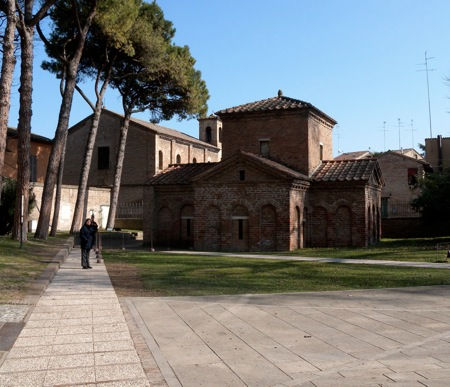
It is adorned with spectacular mosaics:

Centrally planned mausolea were common in throughout the Roman period and continued into the 6th century at Ravenna with the spectacular mausoleum of Theoderic, the Gothic king:

The best known centrally planned buildings in Ravenna are related to Christian ritual. It’s possible that parts of the famous Neonian or Orthodox baptistery date to the 4th century and the mosaics likely date to the late 5th. The building is an octagon surrounding a similarly shaped font.


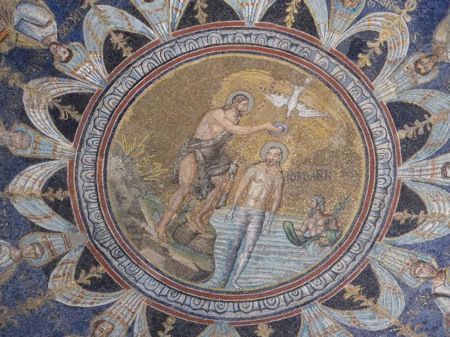
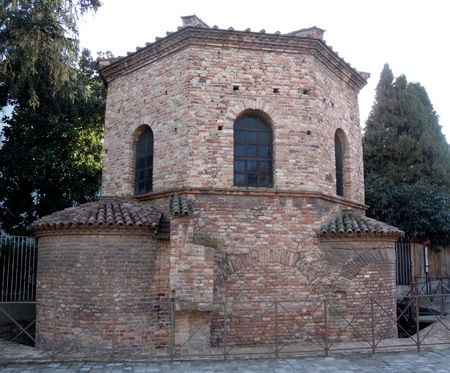
The nearly contemporary Arian baptistery shares a similar plan (although the outer shell has been lost) and decorative program:

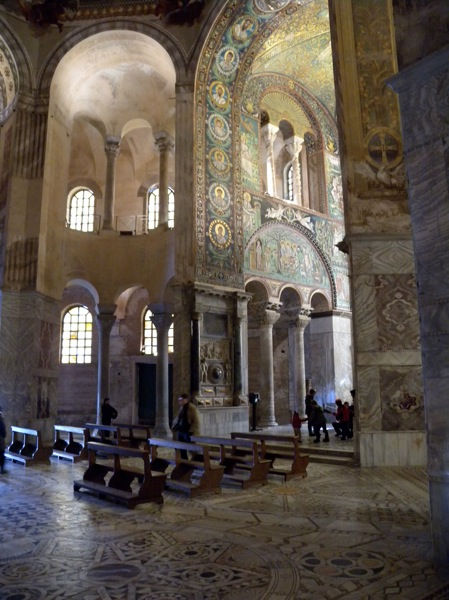
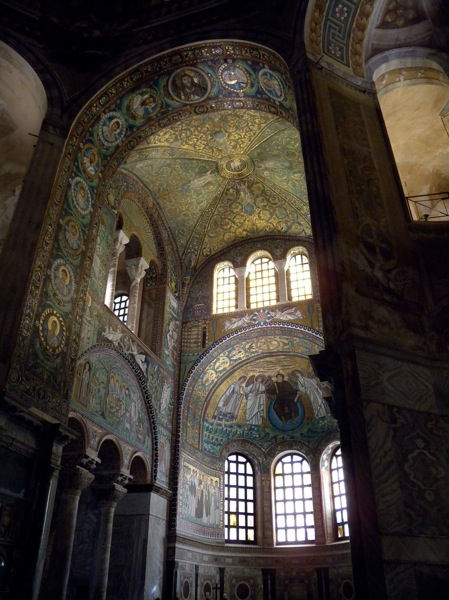
The most spectacular of the centrally planned building is the 6th century church of San Vitale. The building is another octagon with an important group of 6th century mosaics preserved in its eastern end. The interplay between the outer octagon and inner, domed core frames dynamic perspectives both on the central space and the sacred eastern end.


Of course, Ravenna also had its share of basilicas, but more on them tomorrow…
Comments