


The Diamond Necklace Affair: the Necklace that Made Marie Antoinette a Slave to her Fate
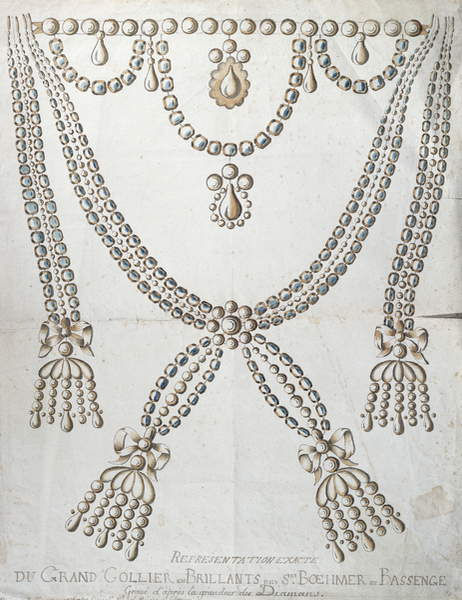
The Diamond Necklace Affair is one of those strange instances in history where to this day we don’t know the full ins and outs, especially the motives behind it. All that is really known is that Cardinal Rohan was duped by Jeanne de la Motte into believing that Marie Antoinette wished to buy the most expensive necklace in history and that he had been chosen to be the broker for the transaction. However, Rohan has been out of favour with the queen since his time as ambassador to Austria produced some bad relations between the cardinal and Antoinette’s mother, Maria Theresa. He was so determined to follow his dreams of being the next Cardinal Richelieu or Mazarin that he went through with the scheme. Unfortunately, the situation involving the 2800 carat necklace that was worth 1.6 million livre would eventually see him on trial in 1785, 3 years after his introduction to La Motte, for stealing the necklace by invoking the name of Marie Antoinette to get it.
The circumstances around why Rohan chose to believe the situation Jeanne had set up are as unknown as the motives she had to wanting to dupe the Cardinal. All that can be deduced from it is that upon their meeting, Rohan felt sorry for Jeanne’s lack of money considering her illegitimate family connections to the previous Valois royal family. Perhaps, as Beckman suggests, considering Jeanne’s poor upbringing and toxic marriage to Nicolas de la Motte, which resulted in the pair spending beyond their means, she saw this as an opportunity to improve herself and took advantage of Rohan’s desire to get royal favour. Whatever the motivations and feelings that created what would become known as the Diamond Necklace Affair, it happened in a time of be the spark that created the French Revolution less than 4 years later.
A correspondence was set up with Jeanne as the middle person between Marie Antoinette and Rohan. These letters were of course not from the real Marie Antoinette but were faked by an associate of the La Mottes, a man called Villette. Throughout this time, Jeanne had thoroughly convinced the Cardinal of her confidence with the Queen by telling stories of meetings that they had. This relationship appeared to be confirmed in Rohan’s mind when a meeting with the Queen was arranged by Jeanne. The meeting was held in the gardens of Versailles at night, so it was hard to make out who the person he met was, but if he had any doubts, he never revealed them and continued to believe the charade that was placed before him. In fact, the woman he had really met was a prostitute by the name of Nicole le Guay, who had been employed by the La Mottes because of her perceived likeness to Marie Antoinette, especially when dressed in similar clothes. Nicole had also been duped by the Jeanne, by being told she was helping the Queen out with a problem she was having with someone.

Demands were placed upon Rohan to broker a deal with the jewellers Bassange and Boehmer for the Queen, despite the fact the necklace in question had been rejected twice by the real Marie Antoinette. It is probably this previous connection with the necklace that made the situation seem so plausible, as well as the Queen’s well known spending habits for her royal wardrobe. However, it is from this point that the Affair would be on a slippery slope downwards for all involved.
The jewellers were threatened with bankruptcy if they didn’t sell the necklace. With it’s 647 diamonds, it was known as a collier d’esclavage, a necklace of slavery, due to it being so heavy that it had to have a back attached to it to stop the heaviness toppling the wearer over. In fact, it was a rather suitable name as it would metaphorically enslave all those who were involved with it. The jewellers would find their reputation hampered by its creation for two reasons. The first being that it was so large and expensive that it threatened their very livelihood and business if left unsold to the royals of Europe. The second being that it would eventually lead to the downfall of Marie Antoinette, their best customer.
The agreement reached through Rohan was that the necklace would be paid in instalments by a contract explaining the involvement of ‘Marie Antoinette of France’. Suspicious were raised when the first instalment was left unpaid. With time and money at stake, the jewellers gained an audience with the Queen, delicately asking about the situation but the situation was a first misunderstood, for she believed they were still trying to sell her the necklace. Of course the truth finally came out that Rohan was involved in a transaction involving the necklace and the Queen’s name. This led to his arrest and that from the start of the investigation in August 1785, Rohan realised the true deceiving nature of Jeanne. He always said it was her who was the true mastermind in what had happened.

That was true. Upon gaining the necklace, Jeanne and her husband Nicholas broke up the necklace and tried to sell the individual diamonds. Some of these were sold in Paris but this started to raise suspicion as there were a lot of diamonds originating from the same person, that really didn’t match up with the inheritance explanation they offered to potential buyers. Eventually, Nicholas moved to London to sell the rest, where he also struggled to sell them other than to a few potential buyers. Still, Jeanne would protest her innocence to the end, even when Villette admitted to forging letters and her confessor admitted seeing him forge them.

During the course of the investigations a number of suspects in the case were arrested. These included Rohan, Jeanne, Nicole le Guay, Cagliostro (a mystic who had been linked with Rohan during the time of the Affair) and Villette. The investigations and eventual trial of these individuals created a public space where the Queen’s conduct was being debated as never before but would be for years to come. It helped to transform private gossip and suspicions of Marie Antoinette’s frivolity into the more dangerous rhetoric surrounding political intrigue, corruption and tyranny. Both Cagliostro and Jeanne would later publish stories and memoirs on the Diamond Necklace Affair linking these themes together. Jeanne’s memoirs especially linked Marie Antoinette’s sexual morals to creating political corruption. How ironic that was considering the lack of morals needed to succeed in her criminal activities. Her pleas were unheard though as it was Jeanne who was actually found guilty in the case. Rohan was proved not guilty of invoking the Queen’s name, despite the fact he could have been sentenced with embezzlement.
What happened to those involved after the trial?
Jeanne was branded with ‘V’ on each shoulder, meaning voleuse for thief and was imprisoned in the Saltpetriere, a women’s poorhouse and reformatory for prostitutes. She escaped and moved to London to find her husband, who wasn’t bothered about her in the end. Her spending habits still left her in debt and so she wrote her memoirs to gain money, to no avail. In June 1791 she had bailiffs on her door. By barricading herself in her room she jumped from a window to avoid them, leaving her with injuries that would eventually lead to her death on 23rd August 1791.
Rohan was exiled from Paris and died quietly aged 68 in 1803 from poor health as a result of his incarceration and treatment in the Bastille during the investigation.
Nicholas eventually returned to France after the Revolution and capitalised on the fame of the Affair and his role as the last surviving participant of it. He died of natural causes in October 1831 despite many failed attempts of suicide in the years leading up to his death.
Cagliostro was acquitted during the trial but was later banished from France for his slander of the Queen. After spending time in various European countries, especially England, he eventually returned to his homeland of the Italian states, where he was eventually imprisoned by the Inquisition for being a false prophet. It was in the fortress of San Leo that he eventually died of a stroke in 795, brought on by the symptoms of syphilis.
Nicole le Guay was forced out of court circles that she was linked to as a prostitute. She died of poor health in 1789. It was believed her health never recovered from having to give birth in the Bastille during the investigation.
The legacy of this as the spark that lit the fires that would lead to the Revolution. It was a benchmark that would mean the beginning of the end for Marie Antoinette’s reputation. From that moment on, the Queen’s every move was seen in a bad light, whether it was innocent or not. The Diamond Necklace Affair would be the start of the debate on governmental corruption and royal frivolity that would be used as justification for the French Revolution. However, at this point things were still largely being blamed on royal advisors being corrupt rather than the King himself. It still provided the background that would in the coming years transform into blaming the royals themselves and their eventual executions.
Beckman, J., How to Ruin a Queen: Marie Antoinette and the Diamond Necklace Affair (London: John Murray, 2014), p. 1
Beckman, J., How to Ruin a Queen, p. 2.
Beckman, J., How to Ruin a Queen, p. 2.
Beckman, J., How to Ruin a Queen, p. 211.
Beckman, J., How to Ruin a Queen, pp. 84 and 86.
Beckman, J., How to Ruin a Queen, p. 85.
Beckman, J., How to Ruin a Queen, p. 3; Delalex, H., Meral, A. and Milovanovic, Marie-Antoinette (Los Angeles: J. Paul Getty Museum, 2016), p. 136.
Beckman, J., How to Ruin a Queen, p. 101.
Beckman, J., How to Ruin a Queen, p. 3
Beckman, J., How to Ruin a Queen, p. 3
Beckman, J., How to Ruin a Queen, p. 147.
Beckman, J., How to Ruin a Queen, p. 124.
Beckman, J., How to Ruin a Queen, p. 124.
Beckman, J., How to Ruin a Queen, pp. 173 and 211.
Beckman, J., How to Ruin a Queen, p. 3.
Colwill, E., ‘Just Another “Citoyenne?” Marie-Antoinette on Trial, 1790-1793’, History Workshop, 28 (1989), p. 68; McCalman, I., ‘Mad Lord George and Madame La Motte: Riot and Sexuality in the Genesis of Burke’s Reflections on the Revolution in France’, Journal of British Studies, 35.3 (1996), p. 363.
McCalman, I., ‘Mad Lord George and Madame La Motte’, p. 363; Beckman, J., How to Ruin a Queen, p. 276.
Beckman, J., How to Ruin a Queen, p. 244.
Beckman, J., How to Ruin a Queen, p. 273
Beckman, J., How to Ruin a Queen, pp. 285 and 287.
Beckman, J., How to Ruin a Queen, p. 299.
Beckman, J., How to Ruin a Queen, pp. 300-301.
Beckman, J., How to Ruin a Queen, p. 301.
Beckman, J., How to Ruin a Queen, p. 259.
Beckman, J., How to Ruin a Queen, pp. 296-297.
Beckman, J., How to Ruin a Queen, pp. 296-297.
Beckman, J., How to Ruin a Queen, p. 243.
Beckman, J., How to Ruin a Queen, p. 280.
Saint-Armand, P. and Curtiss Gage, J., ‘Terrorizing Marie Antoinette’, Critical Inquiry, 20.3 (1994), p. 392.
Delalex, H., Meral, A. and Milovanovic, Marie-Antoinette, p. 136.


Comments