


The Eighth Station: Borcovicus; now House-Steads
I forget exactly what at Housesteads
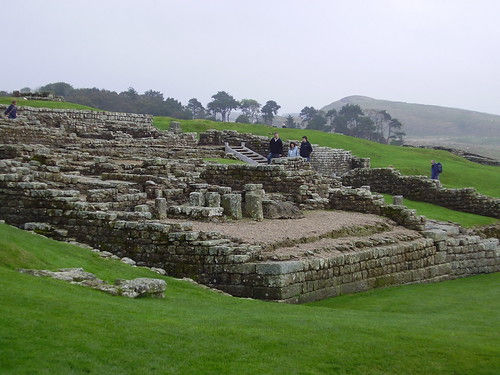
I am now thirty miles from Newcastle. Becoming a gainer at Twice Brewed by a broken promise, which is seldom the case, I retreated next morning over a Moss to my favourite pursuit, which brought me to House-Steads, the grandest Station in the whole line. In some Stations the Antiquary feeds upon shells, but here upon kernels. Here lie the remains of ancient splendour in bold characters.
The line, as usual, proceeds over the crags, which leave a precipice fifty feet high on the North. At the bottom are three pools. The Wall is six or seven feet high; but miserably broken, and continues in the same style six or seven miles, a heap of rubbish. In some parts only three feet high, and occasionally shews five or six courses of facing stones. The Station is, of course, much elevated; declines to the South; the ramparts are plain. A very large Suburb seems to have been added to this populous City, now reduced to one solitary house; the whole about fifteen acres. The curious observer, I believe, may count twenty streets. The population, perhaps, could not be less than two or three thousand souls.
From the melancholy relicks on the spot, it must have been graced with some elegant buildings.
A Temple, no doubt, was one. I saw the square base of a large pillar, with a circular shaft preceeding from it, fourteen inches diameter, curiously moulded. Another of a different form, with a square shaft eighteen inches diameter; noble remains of fifteen hundred years! which loudly declare the days of antient splendour. The Castle stood at the corner, North-West, within the Station; was itself moated round, as were also the Station and the Suburbs, separately.
Joining the Wall, within, are the remains of a court of Justice, about twelve yards long, and six wide. In the West corner was the Judge’s seat, six feet diameter, and quoined with stone, ten courses of which remain. It is not easy to survey these important ruins without a sigh: a place once of the greatest activity, but now a solitary desert; instead of the human voice, is heard nothing but the winds.
In the farm house down in the valley, the jamb which supports the mantle-tree is one solid stone, four feet high, two broad, and one thick, complete as in the day the workman left it, as in the Plate here annexed; which may be also found in Warburton’s History of the Wall, Plate III. p.60; and in Gough’s improved edition of Camden’s Britannia, 1789, vol. III. Plate xvii. p.245.
There are also many curious figures, all Roman, in this Station.
I had now the severe task of creeping up rocks, and climbing stone walls, not well adapted to a man who has lost the activity of youth.
As the works of the two celebrated Chiefs continued in view, and being invited by a single house in the valley, of some magnitude, called Bradley Hall, where I might gain knowledge; I descended the hill, to tread upon that venerable ground; a distance Warburton calls 600 yards, perhaps good measure. I found them all very distinguishable, though in mowing grass, and in a perfect swamp.
The annexed Plate shews a profile of the Mountains at Bradley Hall, on top of which runs Severus’s Wall, and Hadrian’s Vallum at the bottom.
Entering the Hall, the family, whose name I am sorry I have forgotten, seemed to strive which should treat me with the most kindness. It consisted of a father and mother, two sons, near six feet each, and two beautiful Sacharissa’s, who though aiding the churn, will not, like Waller’s lovely rose, bloom and wither in a desert, but find their way into the busy world.
On the rough rock, opposite Crag Lough, the Wall is three feet high; but deprived of all the facing stones, and bends to avoid the pool. The ditch is in perfection.
At another spot upon this Crag, the Wall is eleven courses high on one side, and from three to five on the other; and, for sixty yards, is eight feet high.
I now consider myself in the middle of the kingdom, between the German Ocean, and the Irish Sea; consequently upon the most elevated ground between both, and distant, in a straight line, by land, about fifty miles from each. We must allow, from the convexity of the Globe, a rise of one hundred and fifty yards; and the mountain on which I stand will perhaps give a rise of forty more. It follows, I am elevated one hundred and ninety yards above the Sea. The prospects are not grand, but extensive, and rather awful. Upon the Great Crag, are three courses of facing stones.
The judicious Warburton “believes, that the works of Hadrian lie at a considerable distance South of this Station, and that they make a small turn at the brook to come at it.” But can a thing be brought near to what does not exist!
Hadrian was dead long before the appearance of this Station.
Links:
Housesteads Fort at Siôn’s Home Page
Housesteads in 3D at the BBC
Housesteads Roman Fort at UK Heritage
—–


Comments