


The Figure of National Glory: The Repatriation and Funeral of Napoleon
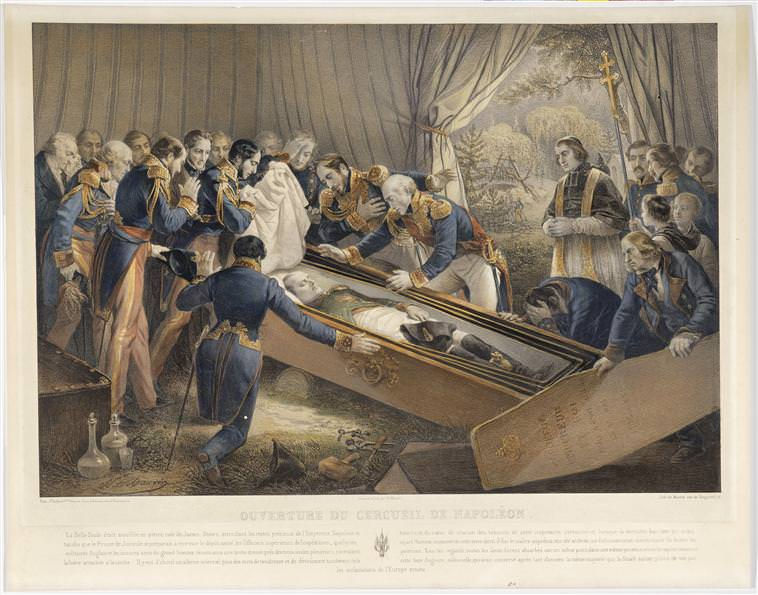
Following Napoleon’s defeat at Waterloo in 1815, he would remain in exile on the remote island of St Helena until his death in 1821. His death created discussion about what to do with the body. It was chosen that he would be buried in a low-key grave on the island, rather than sending the remains back to France to avoid further fuelling the rise in Napoleon nostalgia that had started to occur. This expressly went against Napoleon’s own wished to be returned back to France and other Frenchmen who had given their opinion along the same lines.
Whilst Napoleon’s a controversial figure in history, I have always been intrigued as a regular visitor to Paris, how monuments and cultural aspects related to him. Hazareesingh suggests that his symbolic significance for France, especially through commemorations and monuments is more important than his well-known controversy suggests. Whilst looking back on my two visits to see his current tomb at Les Invalids, this thought is less abstract as I vividly remember the last time I went 2 years ago. Whilst paying for tickets and walking around the museum, which is the national army museum of France, I could tell that some of the staff were confused about why an English family would wish to see French army related things, most notably Napoleon’s tomb. As my dad has always had a military interest in history and I have written many essays on him, we wanted to go see it again as we hadn’t seen it since our first visit to the city in 2007.
Following the death of the great military figure, his end of life transformed him into a ‘tragic hero’ and pamphlets soon began to show themes of the glorification and nostalgia towards the Bonapartist era. The Napoleon legend this created was originally started with Napoleon himself, who viewed himself as the political saviour who was forced to live on St Helena. This idea gained much credit following the publishing of Emmanuel de Las Cases’ memoirs of Napoleon, which told the story of the first 18 months Napoleon lived on Helena and the humiliation this brought to a man who was “compellingly and often pathetically human”. This opinion was bolstered by veterans returning from the Napoleonic Wars, who struggled to adjust to civilian life, adopted a nostalgic view on their past lives, quickly featuring in literature.

It is in this context that Napoleon’s repatriation began to take flight. However, with a constitutional monarchy in place after the topple of the First Empire, it was only a small minority that wished for Napoleon to be returned to France. With a growing friendship with Britain, it was unlikely for the government to wish for a great spectacle involving returning the returns of Britain’s great prisoner. However, in 1840 with King Louis-Phillipe’s decision to allow the repatriation of Napoleon’s remains came as he could no longer ignore the increasing demand and popularity of thought on the Bonapartist era.
In doing so, the idea of repatriation transitioned from an individual and minority prerogative to one that had state indorsement. Even the officialness of this scheme posed problems of exactly how to create Napoleon’s image of an inclusive figure. It was problematic as to how to show him in a way which wouldn’t encourage an anti-monarchist fever. With these problems taken into consideration, his posthumous legacy and memory became one of social mobility, “adventure, daring and action”, things that epitomised ideals set up during the Revolution and that continued under the newer constitutional monarchy.
The funeral procession that flowed through Paris was massive spectacle, acceptable for a man who was to be represented as a French collective figure. It has been described as something that “belonged more to the poetic realm of legend”. Really the funeral, despite being done with great flamboyance which Napoleon could have only dreamed of, was really done for undercurrent political reasons. The decision for his final resting place at Les Invalids was done so that he could rest in a politically neutral space and as it was the home of Napoleonic veterans, it appeased those who originally wished for a nostalgic repatriation. This act showed Napoleon as something above politics and reflected the nineteenth century idea subtle that national unity was vital to carrying on the Revolution’s aims, again indicating Napoleon was being used as a symbol of this on both sides of the political spectrum.

The repatriation of the remains wasn’t the end. There was still a tomb and the alterations to the church at Les Invalids to complete. These took much longer than anticipated following the end of the constitutional monarch and the accession of Napoleon III and his choice to create the Second Empire. Due to this political upheaval, it was actually during Napoleon III’s reign was this finally finished. It became a priority as Napoleon III, nephew to his namesake, legitimised his rule as the heir to Bonapartism and guardian of the Napoleonic tradition. The main way this as done was by commemorating the First Empire through culture, especially the Arc de Triumphe, the finishing of the Napoleon’s final resting place and making his birthday a national holiday.

Whatever your personal thoughts on Napoleon, the events that surrounded his repatriation were a major international effort in a time when repatriation wasn’t a common thing. It has since been a vital moment in defining French national identity. Napoleon was used to reinforce ideas of French national identity relating to militarism at a time when it is believed to be in crisis. He is a symbol of French national prestige which as Nicholson suggests, is an emotive response to “military capacity” and “magnificent cultural achievements”. Napoleon as a nation builder aimed to establish a French identity that would create unity within France, whilst using it to create difference from other countries. This identity was important in an era built upon war and to make the citizen soldier feel loyalty to France in a way where it would be worth the courage and self-sacrifice. As a symbol of the ‘official’ memory of France and “of the nation’s past grandeur” he could be seen as an “inspiration to both the right and the left”.
Hazareesingh, S., ‘Napoleonic Memory in Nineteenth-Century France: the Making of a Liberal Legend’, MLN, 120.4 (2005), pp. 748-749.
Hazareesingh, S., ‘Napoleonic Memory in Nineteenth-Century France’, pp. 756-757.
McLynn, F., Napoleon: a Biography (London: Pimlico, 1998), p. 664.
Las Cases, Le Memorial de Sainte-Helene cited in Hazareesingh, S., ‘Napoleonic Memory in Nineteenth-Century France’, pp. 757-758.
McMillan, J. F., Napoleon III (Harlow: Longman, 1991), p. 19; Tombs, R., France, 1814-1914 (Harlow: Longman, 1996), p. 39.
Hazareesingh, S., ‘Napoleonic Memory in Nineteenth-Century France’, p. 763.
Lyons. M., Napoleon Bonaparte and the Legacy of the French Revolution (Basingstoke: Macmillan Press, 1994), pp. 299-300.
Avener Ben-Amos, Funerals, Politics and Memory in Modern France, 1789-1996 cited in Hazareesingh, S., ‘Napoleonic Memory in Nineteenth-Century France’, p. 763.
J. Tulard, ‘Le Retour des Cendres’ in P. Nora (ed), Les Lieux de Memoire, Vol 2 (1986) cited in Lyons. M., Napoleon Bonaparte and the Legacy of the French Revolution, p. 300.
Tombs, R., France, 1814-1914, p. 302.
Tombs, R., France, 1814-1914, p. 82; Price, R., The French Second Empire: An Anatomy of Political Power (Cambridge: Cambridge University Press, 2001), p. 44.
Tombs, R., France, 1814-1914, p. 40; McMillan, J. F., Napoleon III, p. 61.
H. Nicholson, The Meaning of Prestige (1937) cited in Wood, S., ‘Nations, National Identity and Prestige’, p. 101.
Tombs, R., France, 1814-1914, p. 83.
Baycroft, T., Inventing the Nation: France, pp. 111 and 121.
McLynn, F., Napoleon: a Biography, p. 667; Hazareesingh, S., ‘Napoleonic Memory in Nineteenth-Century France’, p. 762.


Comments