


The Greek Orthodox Church in Grand Forks
- May 6, 2013
- 2 min read
Since this is the Monday after Easter for my Greek Orthodox friends, I thought it was a good time to post something on the Greek Orthodox church in Grand Forks, North Dakota. One of the first things that I noticed when I got to know something about the community here in Grand Forks was the conspicuous absence of any substantial Greek population. There was no Greek church (or any kind of Orthodox congregation) and no obvious Greek names in community lore (and no Greek restaurants, businesses, or organizations). Despite the far reach of the Greek immigrant community, Grand Forks appeared to be one of the few places that did not attract a Greek population.
The agricultural economy of the region, the absence of manufactory and extractive industries, and the inhospitable climate probably could explain the absence of substantial Greek community (although one does exist in larger communities in the region like Winnipeg to the north and Duluth to the east and a church dedicated to St. Peter the Aluet serves the Greek community (as well as others) in Minot to the west.). It is worth noting, however, that the state did see Syrian, Lebanese, and Jewish communities around the turn of the century.
Moreover, a little digging in the archives at the University of North Dakota by Daniel Sauerwein, indicated that a Greek community did exist in town, even though few traces remain. In the process of researching for a book, Daniel found a few images of the Greek church. The church was apparently moved to the corner of 4th Avenue and Walnut St. in 1958 and it functioned until 1990.
We’re pretty sure that this is an image of the building’s interior.

The building itself was wood-framed, as one might expect, and modest in size and adornment. It is difficult to know for certain whether the Greek Orthodox community built the church new or moved into a structure built for another congregation. The absence of a steeple suggests that it might have been build for the Orthodox congregation. The church stood in the neighborhood known as Churchville and was immediately adjacent to the much more imposing United Lutheran Church and nearby the Beaux Arts (with more than a few hints of Byzantine influence) Christian Science Church. My guess is that this little church served the entire Orthodox community in the area.
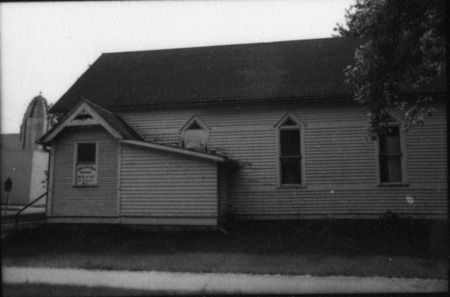

I am sure some members of the community can add to what we know about this building and it congregation (since we know next to nothing!). I have to think that some of the reason that we know so little about this church and its community is that the building has vanished.
So, if you can add more to the story, leave a comment or hit me with a tweet. Thanks to Daniel Sauerwein for keeping his eyes peeled for information on this little community and their church! (And you’ll be hearing more about Daniel’s researches in the fall, so stay tuned!)
Comments