


The Land of Punt
- Oct 18, 2013
- 3 min read
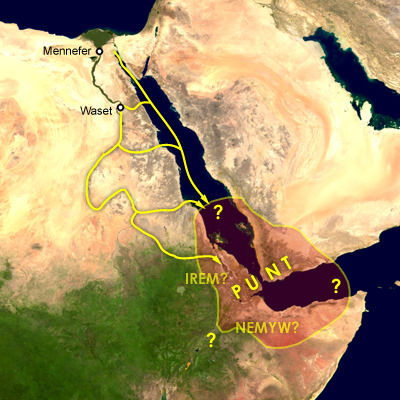


“In addition to the erection and endowments of many temples listed in the Palermo Stone, the Pharaohs of the Fifth Dynasty were active in expanding the existing trade relations with neighbouring countries , as the King Sahure (2458-2446 B.C.) from this Egyptian Old Kingdom, Dynasty V (2498-2491 B.C.), who made a trade expedition to the Land of Punt . Egyptian ships also reached the shores of the land of Punt on the Somali coast to procure highly valued cargoes of myrrh, ebony and animals, among other goods. “
Text Reference: The UNESCO General History of Africa: Ancient Civilization of Africa, Vol, II, General History of Africa, G. Mokhtar, 1990, p 64-68
By the eighth millennium BC, people of a Neolithic culture had settled into a sedentary way of life there in fortified mud-brick villages, where they supplemented hunting and fishing on the Nile with grain gathering and cattle herding.
During the fifth millennium BC migrations from the drying Sahara brought neolithic people into the Nile Valley along with agriculture. The population that resulted from this cultural and genetic mixing developed social hierarchy over the next centuries become the Kingdom of Kush (with the capital at Kerma) at 1700 BC.
Anthropological and archaeological research indicate that during the predynastic period Nubia and Nagadan Upper Egypt were ethnically, and culturally nearly identical, and thus, simultaneously evolved systems of pharaonic kingship by 3300 BC.
Together with other countries lying on Red Sea, Sudan is considered the most likely location of the land known to the ancient Egyptians as Punt (or “Ta Netjeru”, meaning “God’s Land”), whose first mention dates to the 25th century BC.
The Land of Punt, also called Pwenet, or Pwene by the ancient Egyptians, was an Egyptian trading partner known for producing and exporting gold, aromatic resins, African blackwood, ebony, ivory, slaves and wild animals, known from ancient Egyptian records of trade missions to this region. Some biblical scholars have identified it with the biblical land of Put.
At times Punt is referred to as Ta netjer, the “land of the god”. Older literature (and current non-mainstream literature) maintained that the label “God’s Land”, when interpreted as “Holy Land” or “Land of the gods/ancestors”, meant that the ancient Egyptians viewed the Land of Punt as their ancestral homeland.
The exact location of Punt is still debated by historians. Most scholars today believe Punt was located to the southeast of Egypt, most likely in the coastal region of what is today northern Somalia, Djibouti, Eritrea, Northeast Ethiopia and the Red Sea coast of Sudan. The term was not only applied to Punt, located southeast of Egypt, but also to regions of Asia east and northeast of Egypt, such as Lebanon, which was the source of wood for temples. However, some scholars point instead to a range of ancient inscriptions which locate Punt in the Arabian Peninsula. It is also possible that the territory covered both the Horn of Africa and Southern Arabia.
The Nubians are an ethnic group originally from northern Sudan, and southern Egypt. Nubians are the people of southern Egypt and northern Sudan, settling along the banks of the Nile from Aswan. They were very famous for their horsemanship, for which they rode their horses bareback and held on by their knees, making them light, mobile, and efficient, and a good cavalry choice.
The Nubian people in Sudan inhabit the region between Wadi Halfa in the north and Aldaba in the south. The main Nubian groups from north to south are the Halfaweyen, Sikut, Mahas, and Danagla. They speak different dialects of the Nubian language. Their Nubian language is an Eastern Sudanic language, part of the Nilo-Saharan phylum.


Comments