


The St Augustine Gospels
- May 27, 2023
- 3 min read
Earlier this month was the coronation of Charles III. As a historian, I was intrigued to see what the whole ceremony would be like after reading so much about medieval coronations. One of the things I wasn’t expecting to see was a large manuscript of the biblical gospels, known as the St Augustine Gospels, to be presented during the service. I clearly remember my fellow historians on Twitter being nerdily excited about their appearance and as a fellow book lover and keen fan of manuscripts, I can’t blame them. However, I hadn’t heard of this particular manuscript, so decided to do a bit of research into them and this post is a quick summary of their history.

The gospels were made in Italy in the late sixth century and arrived in England with St Augustine, a monk sent as a missionary to England by Pope Gregory in both 597 and 601, who became the first Archbishop of Canterbury. The book was designed as a teaching aid as it was portable, more visual, and written in a more readable Latin style script than other examples. Upon its arrival in England, it was held at St Augustine’s Abbey in Canterbury, which was established by St Augustine himself, until the Dissolution of the Monasteries under Henry VIII.

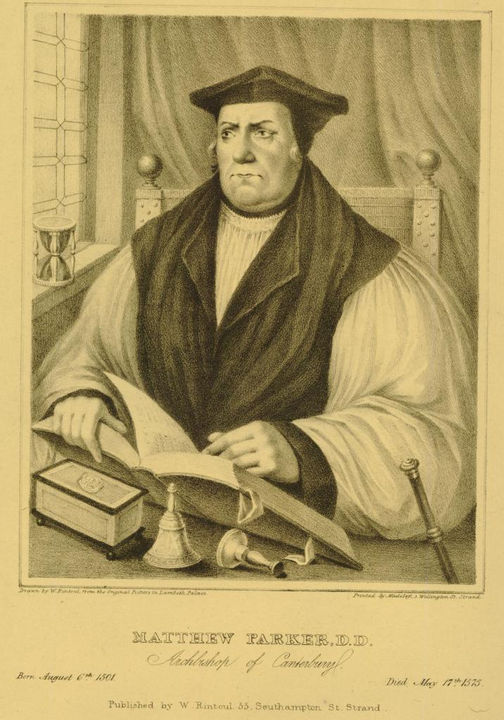
Following the Dissolution, an untold number of books and manuscripts created and held in the monasteries were destroyed and it was thought that these gospels were one of those. However, under Elizabeth I, Matthew Parker, the first Protestant Archbishop of Canterbury, was given permission to rescue what books had been able to survive the Dissolution. He was able to collect 600 manuscripts and many printed books, including the St Augustine Gospels. Considering just how much material was destroyed during this time, the St Augustine Gospels really are a miracle survivor.
Upon Parker’s death in 1575, this collection was donated to Corpus Christi College at Cambridge University, where he had studied, making the basis of what is now known as the Parker Library. With this donation, it ensured the continued future for such an important manuscript, which has now been in the possession of Cambridge for the last 450 years. I really hope it can be kept just as well for the next 450 years.
The gospels have been used during the investitures of the last seven Archbishops of Canterbury, probably as a connection to the first Archbishop of Canterbury. They have also been shown during the Papal visits of in 1982 and 2010. In 2001, the then Prince Charles was shown the manuscript and was very impressed with what he saw, which is why he requested them for his coronation. It is understandable why he found them so impressive as they are the oldest surviving illustrated Latin gospels in the world, as well as being the oldest surviving non-archaeological artefact to have survived in England. These gospels have been used to continuously share the story of Jesus for 1,400 years and as they were used in the coronation, as well as this year being added to the UNESCO Memory of the World Register, it is hoped that they can be preserved and continue to spread the gospel for many more years to come.
Corpus Christi, ‘Fit for a King: Sixth-century Augustine Gospels to be used in the Coronation of King Charles III’, https://corpus-christi-college.shorthandstories.com/a2f9d2ef-d0e0-43f8-850b-0bd1807f2650/
Ibid
Ibid; Britannica, ‘Matthew Parker, Archbishop of Canterbury’, https://www.britannica.com/biography/Matthew-Parker
Corpus Christi, ‘Fit for a King: Sixth-century Augustine Gospels to be used in the Coronation of King Charles III’, https://corpus-christi-college.shorthandstories.com/a2f9d2ef-d0e0-43f8-850b-0bd1807f2650/
Ibid


Comments