


Three Things Thursday: Writing, Wrapping up, and Looking Ahead
- Jul 4, 2024
- 5 min read
I am pretty confident that I’ve gotten “the good” out of my summer research leave this year and feel about as spent as I have in a long time. I have a few more days doing work here on Cyprus and will be heading home for a change of scenery at the beginning of next week.
As I get older I’m discovering that summers are both too short, in that I never get everything that I want to do done during them, and too long in that I never have enough energy to push through my annual research leave in a productive way (and I continue to structure with the challenge of unstructured time). I think getting home, getting back into my reading and writing chair, and shifting my attention to more pressing deadlines will be restorative!
Here’s a little three thing peaking out from my exhaustion:
Thing the First
Here’s an excerpt from the final report I’ve prepared for our work at Polis! It’s a bit technical, but it’ll give you an idea of some of what I’ve done on research leave:
Introduction
In the summer 2024 season, we primarily focused on our work on the study of trench H10 in E.F2. While our goal was to offer preliminary observations on the architectural phasing, stratigraphy, and chronology of E.F2:P10 and E.F2:H10 excavated over the course of four campaigns in 1996, 1997, 2000, and 2003. This trench is significant owing to the presence of a number of features associated with industrial activities in the area. In this regard, the trench is representative of the larger workshop area south of the later basilica. Moreover, the trench produced a significant assemblage of terracotta figure fragments and lamps. This combined with its representative character encouraged us to document the trench thorough both to contextualize the terracotta figurines and lamps as well as to speak more broadly about the workshops in this area.
Big Picture Observations
Trench P10.1996, H10.1997, 2000, and 2003 reveals a complex series of phases and depositional events. The latest walls and burials are Medieval and Late Roman in date. There are also a series of Roman period and Hellenistic walls, a least one relatively well preserved Hellenistic pebble surface, and several features of Roman or Hellenistic date. While it is possible to date many of these features, it is very difficult to associate them with one another. The industrial function of the space seems almost certain. In fact, the difficult in associating features with one another likely speaks to the flexibility of the spaces which may have been rapidly adapted for new functions.
A key element in the adaptation of these buildings is the number of fills that appear to have occurred over its history. The location of the rooms on the west side of a natural ravine likely enticed later builders to fill earlier structures in order to use their eastern walls as ad hoc (or even deliberately reinforced) terrace walls. This allowed them to expand the amount of level ground at the site. The common appearance of rubble levels introduced an assemblage of ceramics that likely derived from domestic contexts and brought massive quantities of residual ceramics that both complicated functional and chronological analysis of the area. Fortunately, these residual ceramics presented a robust assemblage that will allow us to speak more broadly of activity in Roman and Hellenistic Arsinoe. While it is clear the domestic material is unlikely to have come from the immediate vicinity of the trench, it nevertheless almost certainly derived from Arsinoe.
Thing the Second
We’ve managed to spend about a full week studying and documenting an assemblage of material from some excavations in downtown Larnaka. The excavations were not stratigraphic, and as a result, we’re treating the assemblage as we would a survey assemblage. So far, we’re able to compare the material from the various parts of these excavations to those elsewhere in the region including Pyla-Koutsopetria, Panayia-Ematousa, and, of course, elsewhere at Kition (especially Kition-Bamboula).
Here’s a little sample:
Tomi 5 produced a diverse assemblage of Hellenistic and Early Roman fine wares ranging from Hellenistic Color Coated Wares to Eastern and Cypriot Sigillata which all date to the last two centuries BC. As one would expect at Kition, the forms and fabrics present represent a range of imported and local fabrics. Notable in the assemblage is ESA 4B which is early in the ESA sequence and appears to reflect the predominantly earlier date of the assemblage from Tomi 5. It occurs at both Kition Bamboula, Panayia Ematousa, and at Pyla-Koutsopetria (as well as Paphos, House of Dionysios in 1st century BC contexts). ESA 63/64 appears at Kition Bamboula (no. 31) where it dates to the 2nd-3rd c. AD. A single example of CS appeared in this trench — CS36 — which is rare (an example from Paphos being the best example from the island), and dates early in the CS sequence. This form of CS is broadly consistent with the rest of the assemblage from this tomi which included inturned rim bowls dating broadly to the 2nd and 1st century BC. Cooking pots include variants known from Kition Bamboula, Panayia Ematousa, and Paphos including form CW13b1/PC4 which appears to date to 1st BC-1st AD contexts with some earlier and later variants of this form. This is also the earliest date for the casseroles referred to as CASS1 in Kition-Bamboula VIII and somewhat later in date (1st AD and later).
Thing the Third
This summer my colleague Richard Rothaus introduced me to the potential of AI to streamline certain aspects of our study seasons. For example, he trained CHAT GPT to read hand written inventory cards and organize the data on them to create a draft of a catalogue. To be honest, this blew my mind.
I also read Jeremy Huggett’s recent post on AI in archaeology with great interest and look forward to reading Martina Tenzer, Giada Pistilli, Alex Brandsen and Alex Shenfield’s recent article in Internet Archaeology.
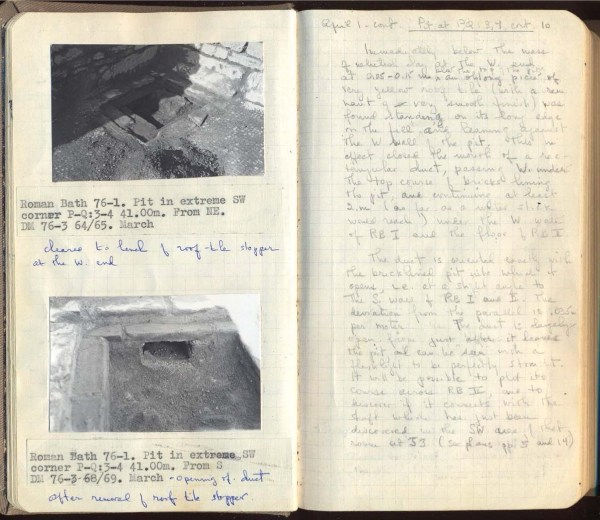
I wonder whether there might be a place for a piece titled “Slow Archaeology in the Age of AI.” The article would explore, on the one hand, the tension between the capacity for AI to produce unexpected results just as noising amplifiers, modified electronic keyboards, and the din from overdriven speakers create mediated sonic textures at punk rock show. On the other hand, I could contemplate how AIs create another layer of black boxing that separates the archaeologist from the processes that produce knowledge. Even something as simple as transcribing notebook pages and inventory cards forces us to slow down and to think about process in a way that AI obscures.


Comments