


Two Book Tuesday: Books are Born without Covers
- Feb 20, 2024
- 2 min read
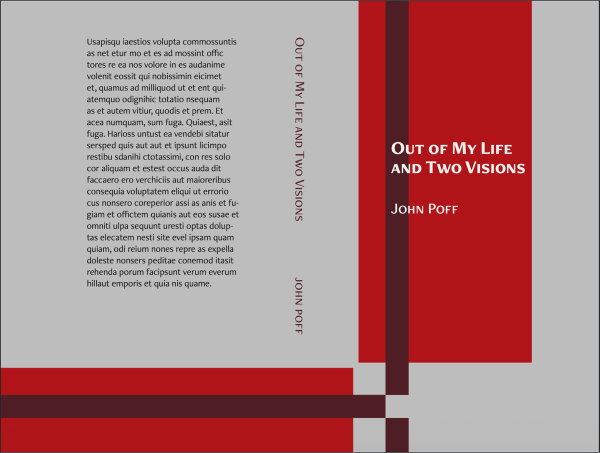
As a kid, I used to sometimes buy books without covers. Mostly these books were not memorable reads, but they were very, very cheap. At some point in my life I came to understand that these books probably re-entered the marketplace illegally after the book seller or distributor removed the cover to prove that they had destroyed the book.
Here’s a secret, though. All books are born without covers.
There are two books in the pipeline right now at The Digital Press at the University of North Dakota and both are really exciting.
Just this past weekend, I finished typesetting the penultimate proofs of David Pettegrew’s book on the Eastern Korinthia Archaeological Survey. This book began as a handbook designed to introduce students and scholars to the EKAS dataset at Open Context. In its final form, the book is a 500+ page study of the Corinthian Countryside grounded in the history and the data produced by the EKAS.
More than that, the book is massively hyperlinked not only to Open Context, but also to other stable resources on the web allowing the reader not only to dive down into the EKAS data, but also to reuse this data to produce new arguments. The book is due out either this spring (best case scenario) or in the early fall as a free download and a low cost paperback.
And, nope, we do not have a cover for the book yet.


The second book in production right now is equally amazing (if in a bit of a different register). This is Çiğdem Pale Mull’s translation of Ismail Gaspirali’s 19th century utopian tale: The Muslims of Darürrahat. Sharon Carson edited the volume and situated the text historically and philosophically.
If you want a preview of this book, check out some excerpts from the book which appeared in North Dakota Quarterly 84.1/2.

I’m pretty excited about the font that I used in typesetting this manuscript. It’s set in Sabon which was designed by none other than Jan Tschichold in 1960s. The font is a bit of a favorite for formal and serious works, such as the Washburn College Bible, and this will help emphasize the importance of this work, which is among a very small number of translated Islamic utopias. At the same time, the font feels contemporary without being too modern.
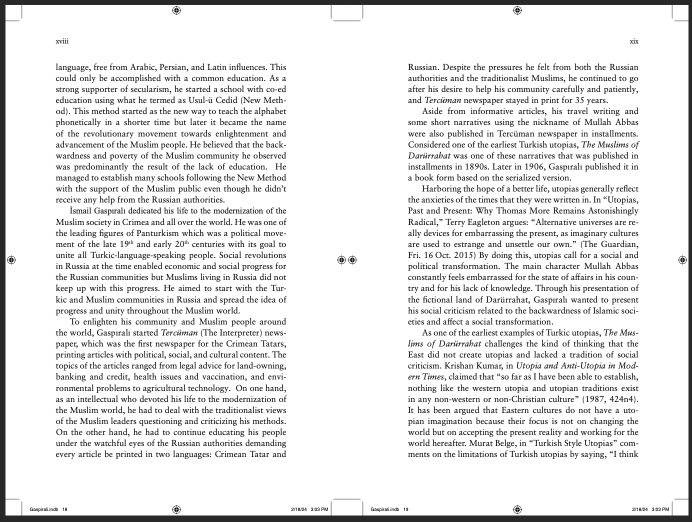
This book will appear as the third volume of NDQ’s supplement series as is fitting for a translation that first appeared in NDQ’s pages. With some good luck and good timing, this book will appear later this spring. We still don’t quite have the cover locked down, but I’ve seen some preliminary sketches for it and know its in Lucy Ganje’s good hands!
Once again, stay tuned!
Comments