


Unlocking the Secrets of the ḥtp-di-nswt Formula: Ancient Egyptian Offering Rituals and Hieroglyphic Insights
It’s a warm afternoon in the Egyptian desert, the sun casting golden hues across the ancient necropolis. Amid the quiet, a stela rises from the sands, weathered yet enduring. Its inscriptions, carved with precision millennia ago, tell stories that transcend time. The formula begins: “ḥtp di nswt,” “an offering given by the king.” With those words, one steps into a world where the living sought to touch eternity.
Imagine the scribe hunched over the limestone, his chisel a steady companion. Each stroke of his tool immortalizes a prayer, a plea. The words aren’t mere text; they’re a bridge. “Osiris, lord of Djedu, great god, lord of Abydos,” the formula intones, invoking a deity as timeless as the stars that once guided Nile boats. Osiris, guardian of the afterlife, whose name evokes both reverence and hope.
“That he may give an invocation offering,” the text continues, as if whispering across the veil of death. Bread, beer, oxen, birds, alabaster, fine clothing—each offering a thread weaving the fabric of eternal sustenance. To the modern eye, it’s a list of goods. To the ancient Egyptian, it’s survival, dignity, and a promise fulfilled.
The complete transliteration of the ḥtp-di-nswt formula reads:
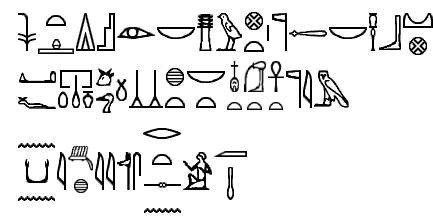
ḥtp di nswt wsir nb ḏdw nṯr ꜥꜣ nb ꜣbḏw di=f prt-ḫrw t ḥnqt kꜣw ꜣpdw šs mnḫt ḫt nbt nfrt wꜥbt ꜥnḫt nṯr im n kꜣ n ỉmꜣḫy s-n-wsrt mꜣꜥ-ḫrw
The transliteration provided is a version of the Ancient Egyptian offering formula, which roughly translates to:
“An offering which the king gives to Osiris, Lord of Djedu, the great god, Lord of Abydos, that he may give a voice-offering of bread, beer, oxen, fowl, alabaster, clothing, and every good and pure thing on which a god lives, for the ka of the revered one Senwosret, true of voice.”
Here’s a pronunciation guide, attempting to approximate the reconstructed sounds:
ḥtp di nswt wsir nb ḏdw nṯr ꜥꜣ nb ꜣbḏw

Pronounced: “Hetep di en-soot Oseer neb Jed-oo netjer aa neb Abed-oo”
Translation: “An offering which the king gives to Osiris, Lord of Djedu, the great god, Lord of Abydos.”
di=f prt-ḫrw t ḥnqt kꜣw ꜣpdw šs mnḫt ḫt nbt nfrt wꜥbt ꜥnḫt nṯr im

Pronounced: “Di ef pert-kheru tee heneket kau apedoo shes menkhet khet nebet neferet waabet ankh-netjer eem”
Translation: “That he may give a voice-offering of bread, beer, oxen, fowl, alabaster, clothing, and every good and pure thing on which a god lives.”
n kꜣ n ỉmꜣḫy s-n-wsrt mꜣꜥ-ḫrw

Pronounced: “En ka en imakhey Sen-Wosret maa-kheru”
Translation: “For the ka of the revered one, Senwosret, true of voice.”
Another example of this profound formula is:
ḥtp di nsw (n) Asir nb imn.t tA-nTr nb AbDw pr.t-hrw 1000 kA.w Apd.w ḥ.t nb(.t) nfr(.t) wab(.t) n imȧḥj ḥr inpw tp(j) Dw=f sDAw.tj bi.tj smr wa.tj imȧ-rA aXn.tjw s-n-wsr.t mȧȧ-xrw
Translated, it means: “An offering given by the king to Osiris, lord of Imentet, the god of the necropolis, and lord of Abydos, an invocation offering of 1,000 loaves of bread, 1,000 jars of beer, oxen, fowl, every good and pure thing for the revered one before Anubis, who is upon his mountain, the embalmer of the king of Upper and Lower Egypt, the sole companion, overseer of the palace attendants, Senwosret, justified.”
This example highlights the adaptability of the formula across various funerary contexts. Each version retains its core structure while adapting to the individual’s identity and their unique connection to the gods.
“For the ka of,” the inscription reads, narrowing its focus. The ka, that vital essence of a person, lingers in this world, yearning for nourishment. A name follows, etched with care: Senwosret, or perhaps another who once walked the streets of Memphis or sailed the Nile. Titles accompany the name, each one a fragment of a life lived, and the epithet “justified” closes the invocation. Justified—proven worthy in the final judgment, a soul light as the feather of Ma’at.
The ḥtp-di-nswt formula, also known as the “hetep di nesu formula” or “offering formula,” served a vital role in Ancient Egyptian funerary practices. It appeared prominently on stelae, coffins, and false doors, acting as a bridge between the mortal world and the divine. Its primary function was to ensure the deceased received ongoing sustenance in the afterlife, a concept central to Egyptian belief systems.
For those seeking to explore alternatives or deeper meanings, hieroglyphic inscriptions often vary in their offerings or deity invocations. While Osiris is a common recipient, gods such as Anubis or Ra might replace him depending on regional or personal preferences. Offerings could also reflect the deceased’s social status, wealth, or specific requests for the afterlife.
As the sun dips below the horizon, the stela stands as a silent testament to belief and artistry. It’s not merely an object; it’s a conversation across time. The scribe, the deceased, the deity, and now us—all connected through the “ḥtp di nswt” formula. This enduring inscription invites us to imagine lives filled with the same fears, hopes, and reverence for the eternal that we, too, carry in our hearts.
The formula’s beauty lies not just in its words but in what those words represent: a bridge between the mortal and the divine, the ephemeral and the everlasting. It’s a glimpse into a world where life and death were two sides of the same coin, and the king himself sanctioned the sacred exchange. In these lines, we find not just history but humanity, etched in stone and held aloft by faith.
Whether you’re researching the hetep di nesu formula, Ancient Egyptian hieroglyphs, or the offering traditions of this fascinating civilization, the ḥtp-di-nswt formula provides an unparalleled window into a culture that sought to transcend mortality through its words and rituals.
The ḥtp di nswt Formula
ḥtp di nswt (An offering given by the king)
wsir nb ḏdw nṯr ꜥꜣ nb ꜣbḏw (To Osiris, Lord of Djedu, the great god, Lord of Abydos)
di=f prt-ḫrw (That he may give a voice-offering)
t ḥnqt kꜣw ꜣpdw šs mnḫt ḫt nbt nfrt wꜥbt ꜥnḫt nṯr im (Of bread, beer, oxen, fowl, alabaster, clothing, and every good and pure thing on which a god lives)
n kꜣ n ỉmꜣḫy [Name] mꜣꜥ-ḫrw (For the ka of the revered [Name], justified)
Word-for-Word Analysis:
ḥtp di nswt
ḥtp: Offering or peace; symbolized by an offering table in hieroglyphs, denoting a gift or sacrifice.
di: Given or to give; represented by a hand hieroglyph, signifying the act of offering or transferring.
nswt: King; represented by the sedge plant hieroglyph and denotes royal authority.
Translation: “An offering given by the king.”
wsir nb ḏdw nṯr ꜥꜣ nb ꜣbḏw
wsir: Osiris; the name of the god of the afterlife and resurrection.
nb: Lord; symbolized by a basket hieroglyph, indicating dominion or mastery.
ḏdw: Djedu; a location associated with Osiris, symbolizing stability.
nṯr ꜥꜣ: The great god; emphasizes Osiris’s divine and exalted status.
nb ꜣbḏw: Lord of Abydos; Abydos is a sacred city associated with Osiris and funerary rites.
Translation: “To Osiris, Lord of Djedu, the great god, Lord of Abydos.”
di=f prt-ḫrw
di=f: That he may give; “di” means to give, and “=f” refers to “he” (the deity, Osiris, in this context).
prt-ḫrw: Voice-offering; a ritual invocation enabling the deceased to receive offerings.
Translation: “That he may give a voice-offering.”
t ḥnqt kꜣw ꜣpdw šs mnḫt ḫt nbt nfrt wꜥbt ꜥnḫt nṯr im
t: Bread; essential for sustenance and symbolic of life.
ḥnqt: Beer; another staple of sustenance in Ancient Egypt.
kꜣw: Oxen; representing wealth and nourishment.
ꜣpdw: Fowl; often included in offerings as a source of food.
šs: Alabaster; symbolic of purity and luxury.
mnḫt: Clothing; represents wealth and respect for the deceased.
ḫt nbt nfrt wꜥbt: Every good and pure thing; a collective term for all items considered ritually clean and pleasing to the gods.
ꜥnḫt nṯr im: On which a god lives; emphasizes that these offerings sustain the divine essence.
Translation: “Of bread, beer, oxen, fowl, alabaster, clothing, and every good and pure thing on which a god lives.”
n kꜣ n ỉmꜣḫy [Name] mꜣꜥ-ḫrw
n kꜣ: For the ka; “ka” is the spiritual double or vital essence of a person.
n: Of; connects the offering to the specific individual.
ỉmꜣḫy: Revered or honored one; indicates respect and acknowledgment of the deceased’s status.
[Name]: Placeholder for the name of the deceased.
mꜣꜥ-ḫrw: Justified or true of voice; indicates the deceased has passed judgment and is deemed righteous.
Translation: “For the ka of the revered [Name], justified.”
FAQ
What is the ḥtp-di-nswt formula and what is its primary purpose?
The ḥtp-di-nswt formula, also known as the “hetep di nesu formula” or “offering formula,” is a standard inscription found in ancient Egyptian funerary contexts. Its primary purpose was to ensure that the deceased received continued sustenance in the afterlife by requesting offerings on their behalf. This was done by providing a direct connection between the mortal and the divine realms.
Where can the ḥtp-di-nswt formula commonly be found?
The ḥtp-di-nswt formula is commonly found on various funerary objects such as stelae (upright stone slabs), coffins, and false doors within tombs. These locations served as a medium for communicating with the deceased and providing the necessary offerings for their afterlife.
Who is the most common deity invoked in the ḥtp-di-nswt formula?
While other gods could be invoked, the most common deity named in the ḥtp-di-nswt formula is Osiris, Lord of Djedu and Lord of Abydos. He is the god of the afterlife, resurrection, and fertility.
What are the common offerings requested in the ḥtp-di-nswt formula?
The formula typically includes a request for “a voice offering” of various items such as bread, beer, oxen, fowl, alabaster, and clothing. It also requests “every good and pure thing on which a god lives.” These items were meant to sustain the ka, the vital essence of the deceased, in the afterlife.
What is the “ka” and why is it important in the context of this formula?
The “ka” is considered a vital essence of a person, similar to the soul, that continues to exist after death. In the context of the ḥtp-di-nswt formula, the offerings are specifically for the nourishment and well-being of the deceased’s ka, ensuring its continued existence and comfort in the afterlife.
How does the ḥtp-di-nswt formula connect the living and the dead?
The ḥtp-di-nswt formula serves as a ritualistic bridge between the mortal world and the divine or afterlife realm. It’s a way for the living to actively participate in the wellbeing of the deceased, ensuring they receive the necessary provisions in the afterlife through the divine mediation.
How does the ḥtp-di-nswt formula vary in different inscriptions?
While the core structure of the ḥtp-di-nswt formula is generally consistent, there can be variations in the deities invoked and the specific offerings requested. These variations can depend on regional preferences, the social status or wealth of the deceased, and personal connections to specific gods. For example, Anubis or Ra may replace Osiris.
What does the phrase “justified” (mꜣꜥ-ḫrw) signify in the context of the ḥtp-di-nswt formula?
The epithet “justified” (mꜣꜥ-ḫrw) at the end of the formula signifies that the deceased has been found worthy in the final judgment, and is now pure and deserving of the offerings. It suggests they passed the judgment in the afterlife and their soul is light as the feather of Ma’at (Truth/Justice).


Comments