


“Unveiling Amun: The Journey of Egypt’s Hidden God from Thebes to Supreme Deity”
- Sep 22, 2024
- 7 min read

In the predawn stillness of Thebes, the grand temple at Karnak was cloaked in a serene, almost sacred quiet. The air was cool, yet charged with the anticipation of the day’s rituals. A young priest moved with purpose through the temple grounds, his heart steady and mind clear, knowing that today he would join his fellow priests in the worship of Amun, the hidden god who guided and protected them.
Before he could stand with his brothers in the sacred rites, there was a necessary ritual of purification. He approached the ceremonial lake, its waters reflecting the faint glow of the coming dawn. The lake was more than just a body of water; it was a place where the priests cleansed not just their bodies, but their souls, preparing themselves to stand in the presence of Amun.
With a deep breath, the priest stepped into the cool water, feeling it envelop him as he dipped beneath the surface. The sensation was both refreshing and grounding, washing away the dust of the world and leaving him renewed. As he rose from the water, droplets streaming down his skin, he glanced down at his circumcised penis—a sign of his purity and dedication, a mark that connected him to a tradition as ancient as the temple itself.
In that moment, the priest felt a deep sense of pride and purpose. His circumcision was more than just a physical trait; it was a symbol of his commitment, his readiness to serve Amun with a heart as pure as the water that had just cleansed him. He knew that this act of purification, combined with the ancient ritual of circumcision, made him worthy to stand in the sacred space alongside his fellow priests, offering prayers and sacrifices to the god who had watched over Egypt for millennia.
As he stepped out of the lake, the first light of dawn began to illuminate the temple, casting long shadows across the ancient stones. The priest knew that this light was a sign of Amun’s presence, a reminder that even though the god was hidden, his power and guidance were always near.
With a renewed sense of purpose, the priest joined the others, ready to worship Amun with a heart full of devotion and a spirit cleansed by the sacred waters. This was the life he had chosen, a life dedicated to the hidden god, where every act, every thought, and every breath was a tribute to Amun’s enduring presence.

Ancient Egyptian religion is like a rich tapestry, each thread representing a deity with its own unique role in the grand design of life and the cosmos. Among these divine figures, Amun emerges as a truly captivating presence. His journey from a humble local god in Thebes to the supreme ruler known as Amun-Re, “King of the Gods,” is a story woven with the threads of theology, politics, and the ebb and flow of cultural exchange. This piece unravels the fascinating tale of Amun, exploring his mysterious nature, his rise to power, his merging with the sun god Ra, and the lasting mark he left on history.
Amun’s name, which means “the hidden one,” “invisible,” or “mysterious of form,” perfectly captures the essence of his divine nature. Unlike other gods associated with visible elements of the natural world, Amun embodied the unseen and intangible forces that ruled the universe. This enigmatic quality was further highlighted by his title, “Him whose name is hidden,” a concept that reaches back as far as the Old Kingdom, appearing in the Pyramid Texts. It was this very hiddenness that set Amun apart from other deities, allowing his character to evolve over time, absorbing qualities from various gods and becoming even more profound and influential.
Amun’s story begins in the Old Kingdom (c. 2686–2181 BCE), where he was honored as a local deity in Thebes. In these early days, Amun was a modest figure, serving as a protector of the king and a god of fertility. His role, while important, was overshadowed by the likes of Osiris and Isis, who held greater sway in the pantheon. Yet, even in this humble beginning, there was a hint of something more—a mysterious depth in Amun’s nature that suggested his potential to rise far beyond his initial status.
Amun’s rise truly began in the Middle Kingdom (c. 2040–1782 BCE). As Thebes grew in both political and economic strength, so did the reverence for Amun. He became a key figure in the Theban triad, standing alongside Mut and Khonsu, which firmly established his place within the local pantheon.
The New Kingdom (c. 1570–1069 BCE) marked a turning point in Amun’s journey, as he ascended to national prominence. In the wake of the Hyksos expulsion and the unification of Egypt under powerful pharaohs like Ahmose I, Amun was credited with divine intervention in these victories. This recognition paved the way for his union with Ra, the mighty sun god, forming the composite deity Amun-Re. This fusion did more than elevate his status—it brought together the hidden and revealed aspects of his nature, blending mystery with majesty in a way that resonated across the land.
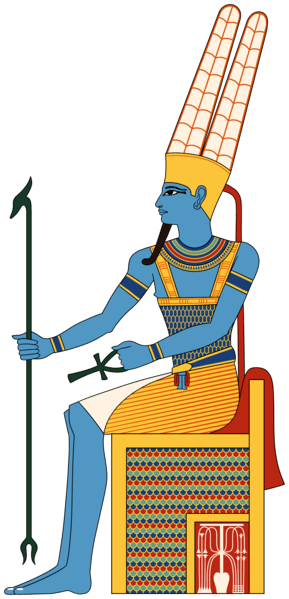
The union of Amun and Ra into Amun-Re symbolized a powerful duality—merging the hidden creative force with the life-giving energy of the sun. This combination resonated deeply with the Egyptian concept of Ma’at, or balance, perfectly embodying both mystery and visibility. Even with this merger, Amun’s enigmatic nature remained untouched, preserving his identity as “Him whose name is hidden.” This blend of the unseen and the seen, the mysterious and the manifest, made Amun-Re a deity of profound depth and significance, reflecting the very essence of the universe itself.
The “one-and-millions” formula beautifully captures the paradoxical nature of Amun-Re, portraying him as both transcendent and immanent. The “one” represents Amun-Re as the singular, all-encompassing source of creation, while the “millions” symbolize the countless ways his divine power manifests in the world. This concept allowed the ancient Egyptians to harmonize their traditional polytheistic beliefs with the emerging tendencies toward monotheism, presenting a unified divine principle that lay behind the diverse pantheon. In Amun-Re, they found a way to embrace both the oneness of the divine and the richness of its many expressions.
Within this framework, the various gods were understood as expressions or emanations of Amun-Re’s singular essence. This theological innovation underscored Amun-Re’s supremacy, while still honoring the rich diversity of deities within Egyptian religion. It allowed for a unifying principle that embraced the complexity of the pantheon, emphasizing Amun-Re’s role as the ultimate source of balance and harmony in the cosmos. Through this lens, Amun-Re became not just a god among gods, but the very essence from which all divine forces flowed, embodying the core of cosmic order and unity.
Amun’s worship reached far beyond Egypt’s borders, largely through military campaigns and the gradual process of cultural assimilation. During the New Kingdom, as Egyptian armies ventured into Nubia, they established Amun temples in the territories they conquered. These temples not only symbolized Egyptian dominance but also served as conduits for spreading the cult of Amun. The grand temple at Jebel Barkal became a particularly significant center for Amun worship among the Nubians, where his presence was felt just as strongly as in Egypt itself. Through these acts of expansion, Amun’s influence grew, weaving his worship into the fabric of distant lands.
As Amun’s influence spread into neighboring regions, his worship evolved through syncretism, merging with local deities and adapting to different cultural landscapes. In Nubia, Amun became associated with the ram-headed solar deity of the Kerma culture, blending the two into a powerful symbol of divine authority. The Greeks, seeing parallels with their own pantheon, identified Amun with Zeus, giving rise to the hybrid deity Zeus-Ammon. These adaptations highlighted Amun’s remarkable versatility and his capacity to integrate into various cultural contexts, making him a truly universal god.
The Kushites, who came to power in Nubia after the New Kingdom, embraced Amun as their chief deity to legitimize their rule. King Piye’s conquest of Egypt, achieved through his devotion to Amun at Karnak, is a powerful example of how Amun’s cult became a tool for asserting political authority and securing divine favor. In this way, Amun was not just a religious figure but a symbol of power and legitimacy, shaping the course of history far beyond the borders of Egypt.
Amun’s worship endured long after the decline of both the Egyptian and Kushite empires, leaving a lasting mark on the ancient world. The oracle of Amun at Siwa Oasis remained a sacred and revered site well into the classical period, drawing powerful figures like Alexander the Great, who sought divine confirmation of their rule. This enduring legacy underscores the profound and lasting impact of Amun’s cult, which continued to influence and inspire even as the empires that first revered him faded into history. Amun’s presence, both hidden and revealed, persisted as a symbol of divine authority and legitimacy across the broader ancient world.

Despite his exalted status as the supreme god, Amun-Re remained a deity who was deeply accessible to individuals from all walks of life. His connection to Ma’at—embodying balance, justice, and order—along with his role as a protector of the poor and troubled, made him a beacon of comfort and hope. This personal connection is vividly illustrated in the votive offerings from Deir el-Medina, a village of artisans and laborers. Here, Amun-Re wasn’t just a distant cosmic force but a close and caring presence in the daily lives of his followers, who turned to him for guidance, protection, and reassurance in their struggles. Through these simple yet heartfelt offerings, we see how Amun-Re’s influence extended beyond temples and royalty, touching the hearts of ordinary people who found solace in his divine presence.

The reign of Akhenaten (1353–1336 BCE) brought a profound challenge to Amun’s dominance. Akhenaten sought to elevate Aten, the sun-disk, as the sole deity, suppressing the worship of Amun and other gods in his quest to reshape Egyptian religion. This period of Atenism, though revolutionary, was brief. After Akhenaten’s death, his successor Tutankhamun reinstated the traditional religious practices, restoring Amun to his central role in Egyptian worship. This swift return to the old ways highlighted Amun’s resilience and the deep-rooted devotion of the Egyptian people to him. Despite the attempted upheaval, Amun’s worship remained steadfast, proving that his influence was too deeply woven into the fabric of Egyptian life to be easily undone.
Amun’s journey from a humble local deity in Thebes to the supreme god Amun-Re is a powerful reflection of the ever-evolving nature of religious belief in ancient Egypt. His dual role as the hidden creator and the accessible protector captures the intricate balance between the divine and the personal, showing how deeply intertwined the gods were with the lives of the people. Despite the shifting political landscapes and attempts at religious reform, Amun’s worship remained unshaken, constantly adapting yet enduring through the centuries.
The grand temple complex at Karnak stands as a monumental testament to Amun’s enduring legacy, a symbol of his profound influence on Egyptian religion and culture. Amun’s story is a vivid illustration of the dynamic and sophisticated nature of ancient Egyptian theology, where mystery and accessibility walked hand in hand, creating one of history’s most enduring and revered divine figures.


Comments