


Ur-Ar-Tu / Ur-Ash-Tu / Ar-Men-Ia – Ar-Ar-At


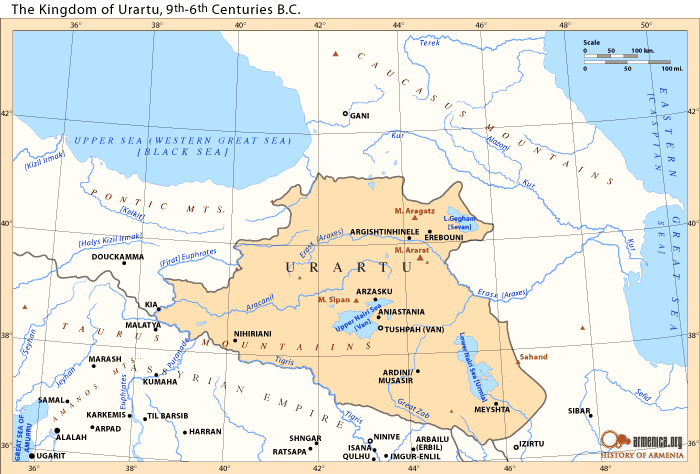
The root AR is the most common root of the Armenian vocabulary. Most place names and words either start with Ar or have it in them.
“Armenian” is composed of the roots “Ar” and “men/man” and the ending “ian”. The suffix “ian” means “of or belonging to”, the root “man” has a similar meaning in Armenian as the English word “man” which is preserved in the Armenian word “man-uk” (child) like a “small man”, “uk” being a diminutive suffix in Armenian.
“Ch” “Չ” is the negative prefix in Armenian as the Enlglish “un-, im-, in-, il-, and ir-, and dis-“. When put in front of “Ar”, we get the Armenian word “Char” “չար” which means “evil, (darkness)”, that is when negating “Ar” we have the word “evil”, while “Ar” means “light, kindness”. Thus the word “Armenian” has the meaning of “People of the Light”.
Ararat derives from the Armenian word “ararel” – “to create”. The same root is in the words “Creator” – “Ararich”, “Creature” – “Ararats”, and the very “PLACE OF CREATION” – “ARARAT”. Similar word is “bacat”- meadow which is an open area – bacel – to open, and “at” makes it “a place of open area”.
Urartu (Armenian: Urartu, Assyrian: Urarṭu; Babylonian: Urashtu), corresponding to the biblical Kingdom of Ararat or Kingdom of Van (Urartian: Biai, Biainili) was a prehistoric Iron Age kingdom centred around Lake Van in the Armenian Highlands.
Urheimat; a German compound of Ur- “primitive, original” (before, ante-, pro-; over- ) and Heimat “home, homeland”) is a linguistic term that denotes the homeland of the speakers of a proto-language. Forming words with the sense of ‘proto-, primitive, original’.
In Armenian the word ari means brave and noble, and the word ayr (Armenian: այր) means man, which, as some scholars believe, correspond to the Graeco-Aryan theory of origin of Indo-European peoples. In Iranian context the original self-identifier lives on in ethnic names like “Alani”, “Ir”. Similarly, The word Iran is the Persian word for land/place of the Aryans.
The English word “Aryan” is borrowed from the Sanskrit word ārya meaning ‘Noble’; but apparently, it was initially used as a national name to designate those who worshipped the Vedic deities (especially Indra) and followed Vedic culture (e.g. performance of sacrifice, Yajna).
Armenia (Uraštu “Urashtu” in Akkadian, Armina in ancient Persian, and Arminia in Arabic) is 9,000 year old. The Sumerians referred to Armenia as Ararat or Arrata, the birth of civilization. The Early Sumerian scribes acknowledged that the Arratans (Armenians) living on the high plateau of Armenia were their ancestors. Thus, civilization did not start in Mesopotamia or in any other part of the world, but in Armenia.
According to a 1957 theory by Laroche, Indo-Iranian ar-ya- descends from Proto-Indo-European (PIE) *ar-yo-, a yo-adjective to a root *ar “to assemble skillfully”, present in Greek harma “chariot”, Greek aristos, (as in “aristocracy”), Latin ars “art”, etc. Thus, according to this theory, an Aryan is “one who skillfully assembles”.


Comments