


Urkesh and the Hurrians


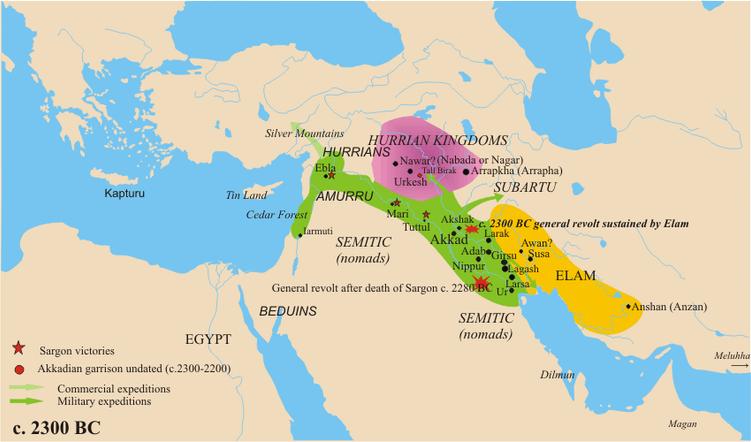


Urkesh, today a small village known as Tell Mozan, was a major political and religious center of the Hurrians
– an elusive population of the ancient Near East.
Urkesh or Urkish (modern Tell Mozan) located in the foothills of the Taurus Mountains in Al-Hasakah Governorate, northeastern Syria. It was founded during the fourth millennium BC possibly by the Hurrians on a site which appears to have been inhabited previously for a few centuries.
Hurrian was the language of the social group that originally founded the city, towards the end of the fourth millennium. It hailed from the highlands to the north, and while the language remained in use over the following centuries, it probably became differentiated from its rural counterpart that continued in use in the highlands.
It acquired a political valence as it remained in use not only for personal names, but also for political inscriptions and to refer to the supreme political authority, the – and this at a time when Akkadian overlordship was extending to all of Syria, presumably posing a threat to any expression of local autonomy.
We can also assume that Hurrian continued to be in use as the main language of religion at Urkesh: this is based on archaeological evidence that links Urkesh with explicit Hurrian myths and rituals known from later times. We do not, at this point, have evidence for any Sumerian personal names from Urkesh.
Urkesh was an ally of the Akkadian Empire through what is believed to have been a dynastic marriage tradition. Tar’am-Agade the daughter of the Akkadian king, Naram-Sin, is believed to have been married to the king of Urkesh.
Akkadian was the language spoken by the majority of the urban population in Syro-Mesopotamia from the Old Akkadian period on. It must have been in common use at Urkesh as well, for two main reasons. First, many of the individuals who resided there (in particular the two queens known to us at present) have Akkadian names, and were likely to be of Akkadian ethnic affiliation.
Second, Akkadian being the language most commonly spoken in the region, and Urkesh being a city in close contact with this world, it seems inevitable that a one way bilingualism should have been the rule (i.e., all urban Hurrians would speak Akkadian, though certainly not all Akkadians would speak Hurrian).
Besides personal names, we have evidence of Akkadian being used in the writing of administrative texts. In some instances, it also came to be used to express logograms – thus, for instance, in the same l. 15 of the inscription of Tiš-atal, where the second sign (-SU2) is the Akkadian pronominal suffix of the third person, presumably to be read as Hurrian.
Amorite was the language spoken by the rural population of the Syro-Mesopotamian plains during the latter part of the third millennium. In the early part of the second millennium, populations bearing Amorite names show a marked ascendancy in the political arena, so that many of the ruling dynasties in the major kingdoms exhibit a preference for Amorite onomastics, even though the scribal culture remains thoroughly Akkadian.
In third millennium Urkesh there is for now no evidence of an Amorite presence. In the second millennium, the two rulers who were Zimri-Lim’s vassals in Urkesh bear Amorite names (Haziran and Terru, the latter only arguably Amorite): no other Amorite names are otherwise attested so far at Urkesh.
During the early second millennium BC the city passed into the hands of the rulers of Mari (Semitic Amorites), a city a few hundred miles to the south. The king of Urkesh became a vassal (and apparently an appointed puppet) of Mari, but the people of Urkesh evidently resented this, as the royal archives at Mari provide evidence of their strong resistance; in one letter, the king of Mari tells his Urkesh counterpart that “I did not know that the sons of your city hate you on my account. But you are mine, even if the city of Urkesh is not.”
In the middle of the millennium, Tell Mozan was the location of a Mitanni religious site. The city appears to have been largely abandoned circa 1350 BC., although the reason for this is unknown to archaeologists at this time.


Comments