


What was the Amarna period?
The Amarna period occurred during the Egyptian New Kingdom’s 18th dynasty and is when Akhenaten (r. 1372–1355 bce) assumed complete solo power following the death of his father, Amenhotep III. It is famous for being a watershed moment in Ancient Egypt’s culture and civilisation. The dogma propagated by Pharaoh Akhenaten (Amenhotep IV) and Queen Nefertiti fueled this period. It was a time of thriving artistic innovation and great social distress. It was also during this time that the sun-worshipping Akhenaten lost part of the empire’s Levantine possessions.
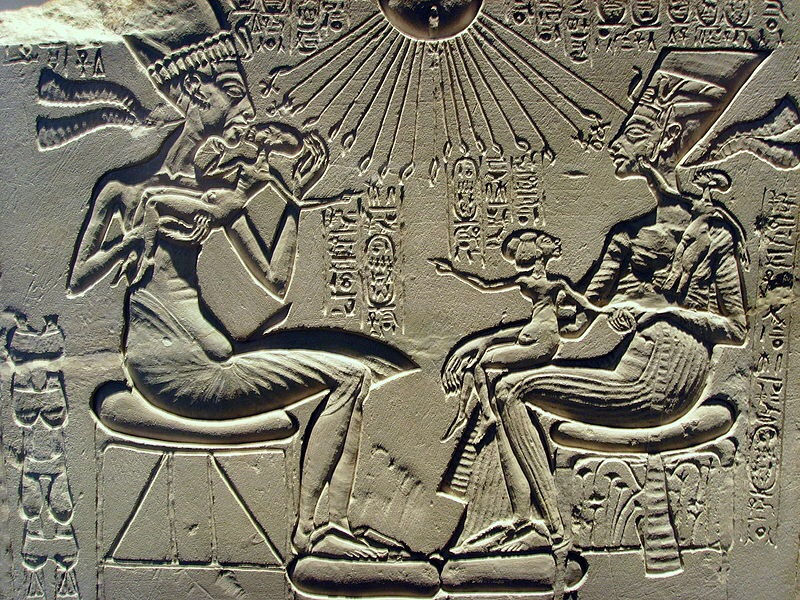
Needless to say, Akhenaten’s radical theology forms a major topic of discussion in all books about the period. Especially as Jan Assmann relates since the distinction between the two realms, the living and a realm of dead which in Egypt was also the realm of the gods, was radically challenged in the religious revolution undertaken by Akhenaten.
Akhenaten lived in the southern capital of Thebes at the start of his reign. This is where he began to make significant changes to the Egyptian religious belief system and to establish Aten’s monotheism. He began with the idea of a henotheistic cult that acknowledged other Gods while eventually transitioning to a completely monotheistic system. While in Thebes, he attempts to eclipse Amun’s power and consolidate more religious power in Akhenaten and the Aten, and several temples were built in his honour. The Aten was depicted as a solar disc, its rays transforming into arms that embrace its creation and provide the pharaoh with all of its power and life.
During his early years in Thebes, in his third year as king,Akhenaten had the name Aten written in cartouches, the same way that royal names had always been written. This new idea was based on the idea that the Aten was like a king, the same as Akhenaten. By this time, Aten’s cult had taken over the economic power of the institutions of the old gods.
For more about life under the Amarna period click here.

In the sixth year of his reign, he changes his name from Amenhotep (Amun is pleased)to Akhenaten (servant of Aten) and relocates the government to Akhetaten, a purpose-built city near modern-day Amarna, hence the period’s name.
With abandoning Thebes and Amun he makes a clear indication of his disdain for Amun and the old order. At this time initiates an iconaclastic programme. Akhenaten and Nefertiti are the sole intermediaries between the “unique and universal god” and Creation from that point forwards. In essence, the Aten serves as their personal God.
This abrupt change will be felt in all aspects of Egyptian life, culture, and religion. The emergence of the “monotheistic” cult results in the development of a new canon and style. People are shown in a more “realistic” and less perfect light. Also, during the Amarna Period, the traditional canon of proportions for the royal family was totally changed. The scenes on the walls of tombs and temples have a thematic shift. Even in literature, prose is becoming more common and prefered over poetry.
Egyptologists from the past thought that Akhenaten was a pacifist whose lack of skill in foreign policy was bad for Egypt’s status as an empire during the Amarna era when this wasn’t true. Egyptian diplomacy in Asia was all about trying to keep one’s power in check against another. This strategy was mostly successful until late in Akhenaten’s reign, when Egypt’s allies, the Mitanni, were defeated by the Hittites. In Year 12 or 13, the Nubian viceroy put down a rebellion in the south.

The Amarna period’s demise is somewhat contentious, particularly in relation to Akhenaten’s succession. Smenkaré, a figure who could be male or female, appears to succeed him. There is still much disagreement about who Smenkaré was. Some claim he was Akhenaten’s son, a brother, or even Nefertiti herself.
Two of Akhenaten’s daughters are thought to have succeeded him to the throne in a co-regency, which was unusual in ancient Egyptian history, according to a recent theory proposed by Kara Cooney.


Comments