


Yuan dynasty fleet excavated | plus updates
- Oct 25, 2011
- 3 min read
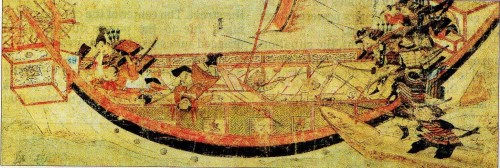
From Zusetsu Nihonshi (Graphics of Japanese history) published by Keiryusha
Source: The Yomiuri Shimbun

NAGASAKI–The wreck of a military ship, believed to be from the Yuan Dynasty fleet that tried to invade Japan in 1281, has been found in Imari Bay off Matsuura, Nagasaki Prefecture.
Discovered near Takashima island, the ship is believed to have gone down during the Battle of Koan in 1281, according to Prof. Yoshifumi Ikeda, an archaeologist with University of the Ryukus. Ikeda leads a team searching for ships that sank during failed Mongol invasions.
Pieces of Yuan ships, anchor stones, cannonballs and other relics had been found around the island, but the latest discovery was the first time a nearly intact ship’s hull has been excavated.
Part of the ship’s hull was found last year about one meter below the seabed, about 20 meters to 25 meters underwater, south of the island.
The team of researchers began a full excavation project on Sept. 30 this year.
The team discovered a keel, 15 meters long and 50 centimeters wide, and many wood planks on both sides of it.
The planks were 15 centimeters to 25 centimeters wide, 10 centimeters thick and one meter to 10 meters long, and are thought to be parts of the ship’s hull. Both sides of the keel were painted gray.
Pieces of Chinese ceramics were found above parts of the hull, and bricks unique to China were also found. Based on this evidence, the team concluded the ship was from the Yuan fleet.
Based on pieces connected to the keel, the team estimated the ship was at least 20 meters long.
In the Kamakura period (1192-1333), Kublai Khan of China’s Yuan Dynasty twice dispatched joint fleets with Goryeo, a kingdom on the Korean Peninsula, in an attempt to subjugate Japan.
Following the Battle of Bunei in 1274, the Battle of Koan saw a fleet of about 4,400 ships carrying 140,000 soldiers arrive in Japan. There were some fights with samurai in the Hakata district, today part of Fukuoka Prefecture, and other locations.
The ships later gathered near Takashima island where they were hit by a storm, which the Japanese later dubbed kamikaze (divine winds), and most of the ships sank, according to Japanese historical records.
There are cases of dugout canoes dating back to the Jomon (ca 10,000 B.C.-ca 300 B.C.) and Yayoi (ca 300 B.C.-ca 300 A.D.) periods being discovered in Japan.
But this is the first discovery of a nearly complete, pre-medieval wooden ship with its original shape mostly unchanged.
===

Courtesy of University of the Ryukyus' archaeology research laboratory
Findings include ceramics, shell
Although the mast and upper structures of the ship are missing in photographs the research team unveiled Monday, some outer planks of the ship’s hull can be seen arrayed around both sides of ship’s keel.
About 100 pieces of Chinese ceramics and at least 300 bricks, believed to have been ballast, were found scattered around the site. The pieces include what Japanese called tetsuhau, a kind of explosive shell used by Yuan Dynasty soldiers. Tetsuhau are depicted on a Japanese picture scroll made in the late Kamakura period.
Remains of the ship’s ribs and bulkheads also were also confirmed.
Ikeda told reporters at the Nagasaki prefectural government office there is no doubt the ship belonged to the Yuan Dynasty. “We are ready to continue our research. We’d like to consider raising the ship, too,” the archaeologist said.
(Oct. 25, 2011)
***
Mongol shipwreck to be first historical seabed site (Feb. 19, 2012)
Kyodo
The sea floor off Nagasaki Prefecture should be designated as a national historical site because of the wreck of a ship thought to have been used by 13th-century Mongol invaders, the Cultural Affairs Council has recommended.
The 384,000-sq.-meter area, about 200 meters off the island of Takashima, is expected to soon become the first underwater site to be awarded the designation. There are nearly 1,700 national historical sites in Japan.
The ship is believed to have sunk in a storm in 1281, during an ill-fated Mongol attempt to invade Kyushu.
Underwater excavations began at the site in 1980. Researchers from the University of the Ryukyus found the remains of the hull last year, including a 12-meter-long section of the keel and an outer panel.
Large amounts of porcelain and weaponry were also found in the vicinity.
The council determined the shipwreck to be a significant source of information on the 1281 Mongol attack, as well as on military activities and foreign affairs at that time. Before the discovery, information about the attack had only been gleaned from historical documents and records.
Granting the designation is seen promoting further research and preservation of underwater ruins. As of 2000, 216 such ruins had been confirmed beneath Japanese waters, according to a report by the education ministry’s Cultural Affairs Agency.
Source: Retr. from Japan Times, Feb 19, 2012)


Comments